Form Factor Variety, AI, Personalized Insights Redefining Sleep Tracking
- Sleep tracking has evolved from passive monitoring to personalised, sensor-driven insights integrated across consumer devices.
- New form factors, including rings, earbuds, headbands and mattresses, are expanding how and where sleep is tracked while catering to user comfort and lifestyle.
- Devices are incorporating AI-based coaching, energy and recovery scoring, and smart home integration to turn data into meaningful action.
- Adoption barriers like comfort, privacy, and subscription fatigue remain, but ecosystem integration and frictionless design are driving the next phase.
In recent years, sleep tracking has moved from being a niche wellness feature to a mainstream use case across consumer devices. With rising consumer awareness around the role of quality sleep in overall health, brands are investing in more advanced sleep algorithms, personalized insights, and even AI-led coaching tools. From passive monitoring to active intervention, sleep tracking is evolving rapidly, shaped by innovations in sensors, data accuracy, and cross-platform integration. The sleep-tracking category continues to expand steadily, driven primarily by smart wearables including smartwatches, smart bands (including screenless fitness wristbands) and smart rings, which together are projected to grow at a 6% CAGR from 2025 to 2030, according to Counterpoint Research’s Global Smart Wearable Tracker, 2025.
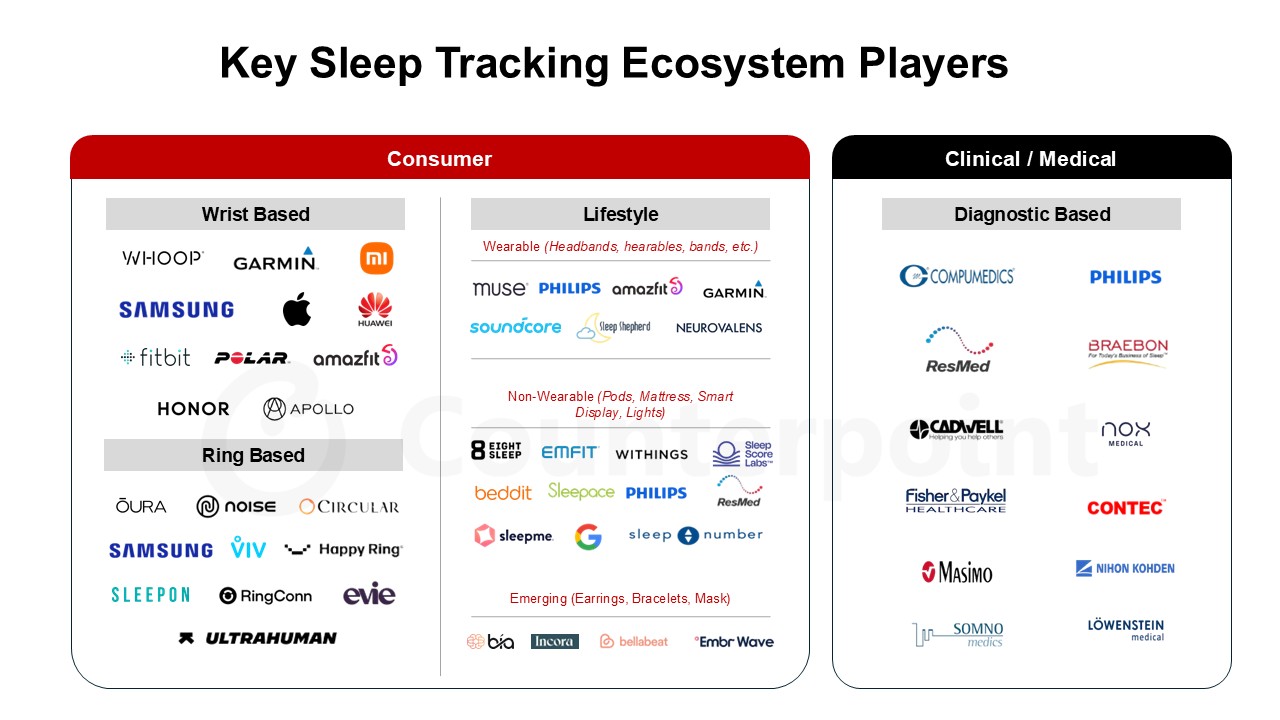
The competitive frontier continues to widen. Advanced wearables like the Oura Ring and Whoop deliver high-resolution biometrics and granular sleep-stage analytics, while non-wearables such as the Eight Sleep Pod (mattress) and Google Nest Hub (smart display) prioritize passive, contactless monitoring for maximum comfort. Hearables like the Soundcore Sleep A30 and EEG-driven headbands such as Muse S Athena push the boundaries of fidelity and specialized use cases. Further, across categories, brands are increasingly positioning sleep tracking not as a standalone metric but as the gateway to broader wellness journeys anchored in personalization, circadian alignment, habit formation, and recovery optimization.
Simplification of sleep data for users is another emerging trend. High-end platforms now present complex physiological signals as simplified readiness and recovery scores, whether it is Oura’s Readiness Score, Whoop’s Recovery Score, Fitbit’s Sleep Score, Samsung Health’s long-standing Sleep Score or Apple’s newly introduced Sleep Score in the Watch Series 11. These composite indices shift the category from pure tracking to actionable guidance, helping users understand not just how they slept but what they should do next, whether adjust training loads, optimize bedtime routines or rebalance daytime activity.
However, adoption still faces friction. Many users hesitate to wear devices overnight due to comfort concerns, screen-time fatigue or privacy considerations. Others experience the opposite challenge – over-reliance on sleep metrics that can create anxiety or “orthosomnia”, where the pursuit of perfect sleep paradoxically disrupts rest. These behavioural dynamics underscore the need for thoughtful design, transparent data practices, and guidance that supports rather than overwhelms consumers.
In the Decoding Sleep Tracking: How Sensors and Smart Devices Are Reshaping Sleep report, we outline the foundations of reliable sleep tracking, from the sensor stacks used in today’s consumer devices to the impact of body placement on measurement accuracy. We break down how modern algorithms interpret sleep stages and physiological metrics, assess the emerging form factors reshaping adoption, and analyze leading players such as the Oura Ring 4, Ultrahuman Ring Air, Apple Watch 11, Whoop 5.0, Samsung Galaxy Watch 8 and the Eight Sleep Pod 5 Core. We also explore how sleep data is moving beyond passive measurement into ecosystem integration, early detection of health risks, and AI-driven coaching, ultimately redefining how consumers understand, manage and optimize their sleep.
Receive our insightful weekly newsletter and stay ahead of the competition.
Author
Srishti Jain

Srishti Jain is a Research Analyst at Counterpoint Technology Market Research, where she closely tracks the Consumer IoT domain with a focus on Laptops, Tablets, Smart Wearables, and Smart Home devices. She has prior experience as a Product Manager at Xiaomi India, where she worked across multiple categories, including Smartphones, Smart Wearables, and Smart Home products. Srishti holds an MBA from IIM Udaipur and is passionate about the intersection of technology, user-centric design, and innovation.