

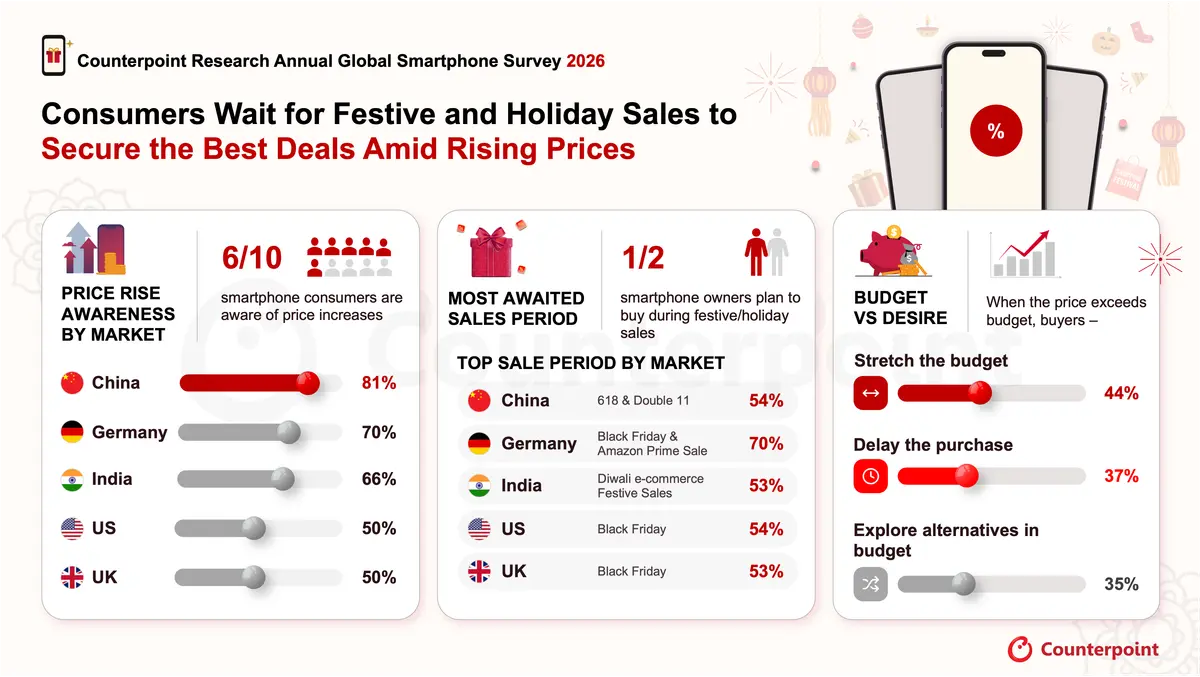
- 6 in 10 consumers planning to buy a smartphone are aware of price increases; China leads in memory driven smartphone price hike awareness (81%), followed by Germany (70%), India (66%), and the US and UK (50% each).
- 1 in 2 people plan to buy their next smartphone during a festive sale/holiday season; Around 6 in 10 (56%) of Gen Z consumers wait for sales or special deals before buying a smartphone now.
- 44% would stretch their budget for their preferred device, while 37% would delay, and 35% would explore alternatives within their budget. Very few would downgrade their device experience.
New Delhi, Beijing, Berlin, Buenos Aires, Fort Collins, Hong Kong, London, Seoul, Taipei, Tokyo – October 8, 2026
63% of consumers planning to buy a smartphone in the next six months have noticed an increase in device prices, according to Counterpoint Research’s annual global smartphone consumer survey. Among everyday products and services, smartphones rank among the top two categories where consumers are noticing significant price increases, alongside fuel/gas and groceries and daily essentials. China records the highest share of smartphone price awareness at 81%, followed by Germany at 70%, India at 66%, and the US and UK at 50% each.
Commenting on the dynamics, Research Director Tarun Pathak said, “Rising memory costs are pushing smartphone prices higher, leaving OEMs with limited room to absorb the impact. Consequently, by the end of 2026, prices of existing smartphone models are likely to go up by 20% on average worldwide and new launches up to 30% YoY, according to our Global Smartphone Price Hike Report. Hence, consumers are responding by delaying upgrades and timing purchases around major sales events, while financing and trade-ins are helping support demand in premium markets.”
Counterpoint Research’s survey targeted consumers planning to buy a smartphone within the next six months. Drawing on responses from over 5,000 respondents across India, China, the US, the UK and Germany, the survey explored smartphone purchase intent, particularly during various festive or holiday season sales, with a focus on how consumers are weighing their options amid consistently rising smartphone prices.
The consumer survey found that 50% of the respondents planned their smartphone purchase around upcoming festive or holiday sales. Across countries, younger consumers are more deal-driven, with 56% of Gen Z and 50% of Millennials waiting for festive or holiday seasons before buying a smartphone. This trend is particularly visible in India, with 7 in 10 consumers (69%) timing their purchase around festive or holiday periods, followed by Germany (57%) and the US (48%).
Associate Director Claudia Krehl commented, “For consumers planning to buy a new smartphone, the upcoming festive/holiday seasons offer a key opportunity to lock in a deal before prices rise further. As this is compounded with further delays potentially leading to higher costs, 44% say they would stretch their budget for their preferred device if offers fall short. 35% would explore options within their budget, creating an opportunity for competing brands to capture market share, while 37% would delay their purchase.”
- In China, the 618 Mid-year Shopping Festival (29%) and Double 11 (25%) are the key events influencing smartphone purchase timing.
- Germany shows strong interest in both Amazon Prime Day and Black Friday, with 35% of consumers planning around each event.
- In India, with the festive season around the corner, Diwali emerges as the key smartphone shopping period, with e-commerce sales, deals and offers taking the lead at 53%.
- Black Friday takes the lead in the US (54%) and UK (53%), with more than half of consumers planning their purchase around the event.
Commenting on buyer’s preferences for deals across markets, Senior Analyst Arushi Chawla said, “The festive season is increasingly becoming about finding the right value, not just seeking the lowest price. What is considered as a compelling smartphone offer varies significantly by market. Price discounts lead in India (37%) and China (20%), while German consumers favor free storage upgrades (22%). In the US, free phone offers (27%) are the most preferred, while free gifts or accessories top the list in the UK (22%), highlighting the need for brands to tailor festive/holiday offers to local consumer expectations.”
As smartphones become increasingly central to everyday life and consumers continue to desire better technology, rising prices are making the purchase decision more complex. These festive/holiday sales could therefore be as much about winning the deal as it is about winning the consumer.
About Counterpoint Research
Counterpoint Research is a global market research firm specializing in products across the technology ecosystem. We advise a diverse range of clients – from smartphone OEMs to chipmakers and channel players to Big Tech – through our offices located in the world's major innovation hubs, manufacturing clusters and commercial centers. Our analyst team, led by seasoned experts, engages with stakeholders across the enterprise – from the C-suite to professionals in strategy, analyst relations (AR), market intelligence (MI), business intelligence (BI), product and marketing – to deliver services spanning market data, industry thought leadership and consulting. Our core areas of coverage include AI, Automotive, Consumer Electronics, Displays, eSIM, IoT, Location Platforms, Macroeconomics, Manufacturing, Networks and Infrastructure, Semiconductors, Smartphones and Wearables. Visit our Insights page to explore our publicly available market data, insights and thought leadership, and to understand our focus, meet our analysts and start a conversation.
Follow Counterpoint Research


