

Marvell is buying Lumentum for an implied enterprise value of $115 billion, all in stock. It is the biggest bet yet that whoever owns the laser will likely control AI optics.
On November 2, building on last week’s reported rumour, both boards signed a definitive agreement. The deal is audacious on both fronts. The financials are aggressive, and the strategy is sound. Marvell has always wanted to be Broadcom. With Lumentum it gets there, and then some.
Quick Take: AI infrastructure has hit a Laser Wall, and it is a supply-side wall. Every optical link needs a laser, whatever the architecture. Marvell is buying the one part of the optical stack that outlasts every design shift, plus the fabs that make it.
The Deal: All Stock, No Pay
Lumentum holders get a fixed 4.5 Marvell shares for each Lumentum share. That implies about $1,132 per share, a 23.9% premium to the October 28 close, the last trading day before the rumour broke (Marvell press release).
| Term | Detail |
| Implied enterprise value | $115 billion |
| Premium | About 23.9% to the unaffected October 28 close |
| Pro forma ownership | Marvell holders about 67%, Lumentum holders about 33%, fully diluted |
| Leadership | Matt Murphy stays Chairman and CEO |
| Board | Three Lumentum directors, including CEO Michael Hurlston, join Marvell's board, expanding it to ten members |
| Synergies | Line of sight to more than $1 billion in annual run-rate cost synergies |
| EPS | Expected to be accretive to Marvell non-GAAP EPS in year one after close |
| Claimed TAM | $550 billion for the combined company |
| Expected close | First half of calendar 2028 |
| Conditions |
Both shareholder votes, regulatory approvals, customary conditions |
Three things stand out
-
No cash, no debt. A fixed ratio with no collar disclosed means Lumentum holders carry Marvell's share price risk until close. Marvell keeps its balance sheet clean, but existing holders give up a third of the company. Still, the valuation bump and potential TAM increase look worth it (for now).
-
A long runway to close. First half of 2028 is 14 to 20 months away. That timeline signals the companies expect long antitrust reviews in several countries, China included.
-
Cost synergies over $1 billion. That is a big number for two businesses that mostly do not overlap. The obvious places to look are overlapping module lines, R&D and back-office. How they get there matters for customers, because cutting the wrong programmes would hurt supply.
The merger agreement, termination fees and any customer protections will sit in the 8-K and Form S-4. I will update this when those are filed.
Laser Focused, for a Reason
Marvell is making it all about “co-design” and a potential $550 billion TAM. It is really about the laser, the one part Marvell does not make.
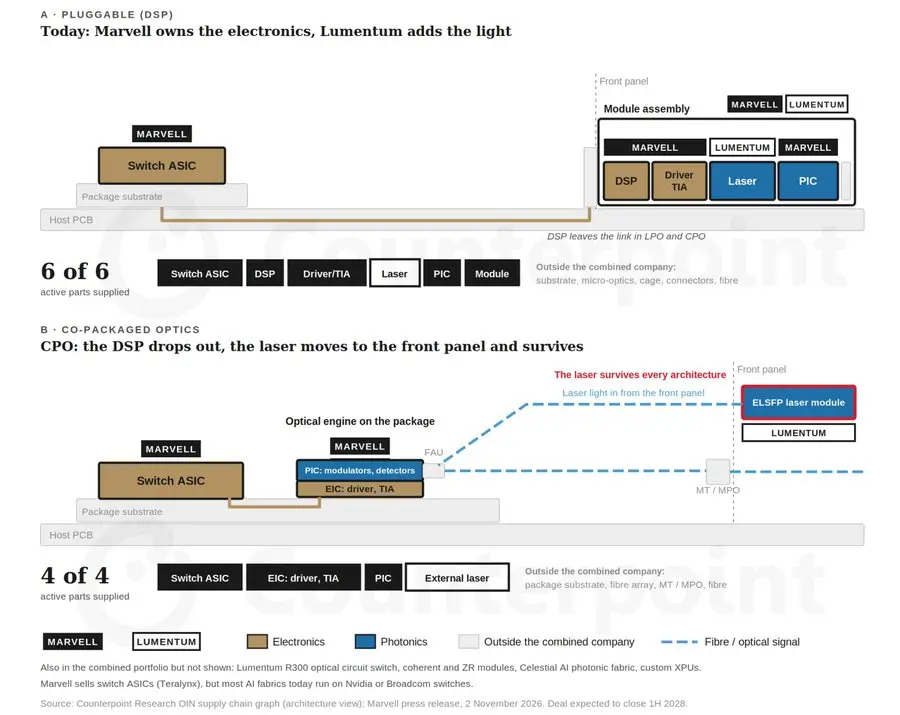
Marvell's optical franchise currently rests on PAM4 DSPs, drivers, TIAs and silicon photonics. That franchise faces a slow squeeze. Linear drive optics and co-packaged optics take the DSP out of the link, or move the optics next to the switch or XPU. My colleague Gareth Owen made the point well last week: Marvell is hedging its bets. Whatever happens with CPO, links still need lasers, and now Marvell will make them (Counterpoint).
The laser shows up everywhere:
- Pluggable modules need EMLs or CW lasers.
- LPO and LRO modules drop the DSP and keep the laser.
- CPO and NPO move the laser out into an external light source, but it is still there, and at higher power.
The second reason is supply. Lumentum is sold out through early 2029, according to its CEO. The combination should "strengthen strategic supply". Building a new InP fab takes years. Lumentum and Coherent hold most of the world's high-speed InP laser capacity, according to our OIN Laser Market Tracker and Forecast Model. Owning that capacity gives Marvell guaranteed access to a resource its competitors depend on.
The upside for the industry is that a bigger, better-funded owner could expand InP capacity faster. If that happens, the Laser Wall gets lower for everyone, not only for Marvell's customers. And Marvell is best positioned to capture most of it.
New Light on the Value Chain
Marvell becomes a full-stack optics vendor. It already had DSPs, drivers, TIAs, silicon photonics, switching, custom XPUs and Celestial AI's photonic fabric. Lumentum adds CW and EML lasers, external light sources for CPO and NPO, datacom and coherent transceivers, and optical circuit switches. Broadcom is the closest match. It already pairs custom silicon with its own InP fab for EMLs, CW lasers and VCSELs. Coherent has the InP but no custom silicon. Where Marvell now goes further than Broadcom is in transceivers, coherent optics and optical circuit switching.
Broadcom has to answer. With its own InP fab and the TH6 CPO switch, it does not need Lumentum. But it now faces a rival with a comparable stack and a laser supply to match its own. I would love to see what Broadcom does next. A capacity deal, a smaller InP acquisition or a push on its ELSFP partner network are all on the table.
Module makers face a supplier that is also a competitor. Innolight, Eoptolink and the other big module houses buy Marvell DSPs and Lumentum EMLs. After close, both come from a company that also sells modules. Expect them to dual-source harder. We flagged that some module vendors could move DSP sockets to Broadcom or Credo. On the laser side, they will push to qualify more EML and CW suppliers, in Japan and China.
Further reading: Innolight, Coherent, Lumentum: Who Wins and Loses in the Proposed FCC Ban on Chinese Transceivers?
Bundling becomes possible. Whoever controls 200G-per-lane laser capacity gets to decide who is served first. A vendor that can offer DSP and laser together, at a time when lasers are short, has real pricing leverage. That is exactly what regulators will look at.
Full Laser Cake, OCS is the Icing
The lasers make the whole cake. OCS is the icing.
The two companies already demoed this together at OFC 2026. Lumentum's R300 optical circuit switch ran alongside Marvell's Ara 1.6T, Aquila coherent-lite and COLORZ 800 ZR/ZR+ modules, with Marvell's RELIANT software monitoring the links (Marvell blog). The deal turns a partnership demo into a new product line.
OCS matters for three reasons:
-
It keeps the DSP in the rack. An OCS switches light without converting it to electrical signals, so it does not care about data rate or protocol. Today it sits between pluggable modules, and those modules carry DSPs. CPO threatens Marvell's DSP business. OCS-based fabrics protect it.
-
It gives Marvell a systems business. Marvell sells chips and modules. The R300 gives it hardware plus software, a step toward selling network fabrics.
-
It fits Marvell's custom-XPU customers. Google proved optical circuit switching at scale in its own TPU clusters. Hyperscalers building their own accelerators with Marvell are natural buyers of an off-the-shelf version.
OCS is small today, but the icing is part of what makes the cake worth buying.
Nvidia's Bittersweet Stake
Nvidia put $2 billion into Lumentum in March and another $2 billion into Marvell at the end of March. The Lumentum deal came with a multibillion-dollar purchase commitment and nonexclusive rights to future laser capacity (Nvidia and Lumentum). The Marvell deal included joint silicon photonics work and NVLink Fusion.
Because this is all stock, Nvidia's Lumentum shares convert into Marvell shares at 4.5 to 1. Nvidia ends up with one larger stake in the combined company.
Where Nvidia wins. Financially it comes out roughly neutral, as the gain on Lumentum offsets the hit Marvell's shares took when the rumour broke. Strategically, as we highlighted before, Marvell becomes a major laser source for Nvidia. Lumentum says it is a key laser supplier for Nvidia's Spectrum-X CPO switch. A bigger owner with deeper pockets could add InP capacity faster, which Nvidia needs.
Where it hurts. Those lasers will now sit inside a company that helps AWS, Microsoft and others build chips that compete with Nvidia GPUs. There is co-opetition on every side. In a shortage, every allocation call carries a quiet conflict of interest. Nvidia's stake is small, so its real leverage is commercial: its purchase volumes and whatever change-of-control terms sit in its Lumentum supply agreement.
How it plays out. Nvidia is unlikely to fight the deal in public. It will hedge. Coherent, where Nvidia made a matching $2 billion bet, becomes its independent laser source and probably picks up more orders. Nvidia will also keep pushing its own CPO work, which reduces the laser count per link.
Laser Roulette: Who Wins the Spin
Once Lumentum sits inside Marvell, every buyer that competes with Marvell will want a second, independent laser source. With Lumentum sold out for years, the overflow goes to whoever has merchant capacity on the right timeline. Our OIN supply chain tracker splits the field into five groups.
| Group | Companies | Why they gain | Catch |
| Independent incumbents | Coherent, Mitsubishi Electric, Sumitomo Electric | First call for diversification at 200G per lane | Coherent also makes modules, so it competes with its laser customers |
| Chinese challengers | Yuanjie, Sanan IC, Henan Shijia, Accelink, Source Photonics | Chinese module makers now have a commercial reason to localise, on top of the political one | Source Photonics, owned by Dongshan Precision, mostly feeds its own modules |
| New CW and external light source capacity | Sivers Photonics, Scintil, Tower | CPO needs high-power CW lasers, and these are new merchant sources | Volumes ramp from 2027 and are not yet contracted |
| Picks and shovels | JX, Sumitomo, AXT (InP substrate); IQE, VPEC (epi); Veeco, Aixtron (tools); Aehr, Chroma (burn-in) | They gain whoever wins the laser race | AXT still needs US export permits for Chinese-made wafers |
| InP stretchers and alternatives | POET, microVCSEL and microLED players, quantum-dot lasers | Fewer laser dies per link, or no InP at all | No volume design wins yet |
- Lumentum leaving the merchant market sets off a round of laser roulette. The combinations and names worth watching:
- Nvidia and Coherent get closer. Nvidia already has $2 billion in Coherent. A bigger purchase commitment or prepayments for new InP lines is the simplest hedge.
- Mitsubishi and Sumitomo are the cleanest merchant winners. They sell lasers and do not compete with module makers. Sumitomo gains twice, as an InP substrate supplier too.
- Broadcom locks up Japanese capacity. Long-term supply deals with Mitsubishi Electric or Sumitomo Electric add a second source without an antitrust fight.
- Module makers move upstream. Innolight and Eoptolink take stakes in Chinese laser makers such as Yuanjie, or build their own EML lines.
- Credo finds a light source. It picks up DSP sockets leaving Marvell but has no lasers. A tie-up with a CW or external light source maker such as Sivers closes the gap.
- Coherent becomes the prize. It is the largest laser maker left that does not also sell DSPs or switch chips, which makes it a takeover target, though any buyer would face the same scrutiny Marvell does. It plans to double internal InP laser capacity and double it again by end-2027. It is the obvious hedge for Nvidia and for module makers.
- Source Photonics makes its own 200G EMLs in Hsinchu and has a $1.2 billion expansion under way. It is a localisation winner more than a second source for US buyers.
- POET packages lasers rather than growing InP. Marvell cancelled all of Celestial AI's orders with POET in April, citing a confidentiality breach, so any upside comes from buyers outside Marvell.
Beijing Holds the Light Switch
Going this vertical invites scrutiny. Lumentum holds a strategic spot in the optical supply chain, and 200G-per-lane InP capacity is one of the scarcest resources in AI infrastructure. We expected regulatory attention even before the deal was signed. The companies seem to agree, given they are guiding to a close in the first half of 2028.
The pressure will come from two directions. Big customers and competitors can lobby, especially module makers that buy both DSPs and lasers from the combined company. Regulators may also ask for supply commitments to third parties as a condition of approval.
China is the wild card. China revenue helps both companies, and it also hands China's market regulator, SAMR, a lever. SAMR has held up or killed US chip deals before, and US moves against Chinese optics, such as the FCC's proposed limits on Chinese transceiver imports, give Beijing every reason to take its time. The question is whether China throws a spanner in the works, or uses the review to win guarantees that Chinese module makers keep their laser and DSP supply.
Watch Out: Ten Signals Before the Lights Go Green
- The 8-K and Form S-4. Termination fees, any supply commitments to customers, and whether Nvidia's Lumentum agreement has change-of-control terms.
- The review calendar. US antitrust timing, any second request, the EU, and above all SAMR.
- Where the $1 billion in cost synergies comes from. Cuts to overlapping module lines or R&D could affect customer roadmaps.
- Module makers' sourcing. Whether Innolight, Eoptolink and others move DSP sockets to Broadcom or Credo, and which new laser suppliers they qualify.
- Nvidia's orders. Any step-up at Coherent, or new laser capacity deals elsewhere.
- Broadcom's response. A capacity deal, an InP acquisition, or a bigger ELSFP partner push.
- InP capacity. Whether the combined company commits to new fabs faster than Lumentum could alone.
- Lumentum's non-AI businesses. Telecom, industrial lasers and 3D sensing do not fit Marvell's AI story. A sale of some of these would not surprise me.
- The share price. With a fixed ratio, Lumentum holders ride Marvell's stock for more than a year. Any big move changes how the votes go.
- OCS scales up. Whether the R300 moves from OFC demo to hyperscaler purchase orders, the clearest sign the icing is worth paying for.

