- Global retail Wi-Fi CPE shipments continue to decline as ISPs increasingly bundle advanced, high-quality hardware with their broadband subscriptions.
- Mesh Wi-Fi system shipments grew due to strong consumer demand for reliable coverage throughout the home, enabling increasing numbers of connected devices.
- Vendors with strong brand recognition, such as Google or Amazon's Eero, alongside robust smart home ecosystems, are outpacing overall market growth.
- Cloud and online gaming are driving demand for gaming routers within the retail router market. Brands have started to focus on this segment as it continues to be one of the fastest-growing.
Seoul, New Delhi, Beijing, Berlin, Buenos Aires, Fort Collins, Hong Kong, London, Taipei, Tokyo – July 8, 2026
The global retail Wi-Fi CPE market declined by 6% YoY in Q1 2026, according to Counterpoint’s Retail Wi-Fi CPE Report. This follows the 4th consecutive year of market decline in 2025, with a nearly 34% decrease compared to the 2021 peak.
In 2021, demand surged as global lockdowns due to the COVID-19 pandemic led to greater reliance on the home network. Home working, education and entertainment became widespread, leading to greater demand for strong coverage and more reliable home networks. Consumers turned to retail Wi-Fi CPE solutions, including mesh Wi-Fi systems, to address their new requirements. In the following years, internet service providers (ISPs) have greatly improved their own broadband CPE solutions to avoid losing control of the home network to retail CPE vendors. These improved broadband CPE solutions, combined with reduced reliance on the home network have lessened the need for consumers to purchase their own retail hardware.
Global Retail Wi-Fi Shipments Share by Vendor, Q1 2026 vs Q1 2025
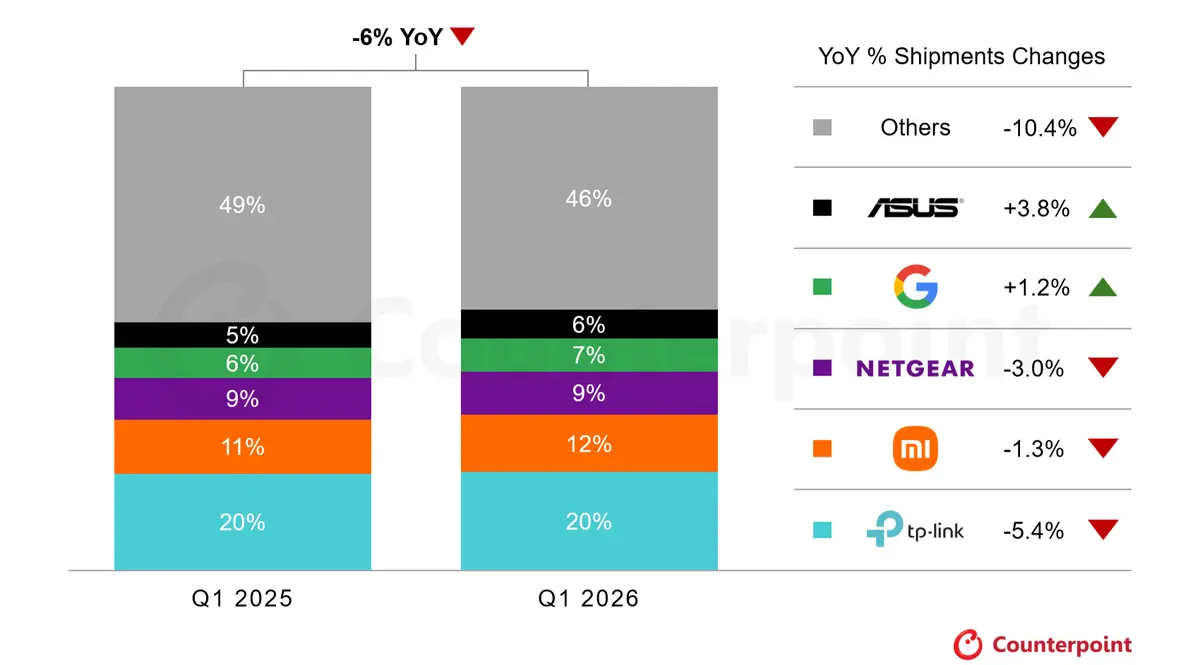
The retail Wi-Fi CPE market is heavily dominated by TP-Link and Xiaomi, accounting for nearly 33% of global shipments. Netgear, ASUS and Google rounded out the top 5, while ASUS, Google and Amazon’s Eero were the only vendors to grow YoY in Q1 2026.
Commenting on the overall market dynamics, Principal Analyst Tina Lu said, “The market continues to experience decline as ISP-provided hardware meets the needs of the majority of customers. ISPs are now offering mesh Wi-Fi systems, addressing coverage requirements and also investing in the latest Wi-Fi technologies, reducing the technological gap to retail solutions. ISP offerings are now seen as sufficient for the average consumer, with power users turning to retail options to upgrade their home network.”
Despite the overall market decline, mesh Wi-Fi systems grew, as consumer demand for whole-home coverage continues to increase with more connected devices throughout the home. Vendors like Google and Amazon’s Eero have benefitted from this trend, along with their strong brand recognition and existing smart home product portfolios.
Gaming routers were another segment that experienced growth, supported by a strong base of power users looking for the best home networking solutions to reduce latency in online competitive gaming. The growth of cloud gaming is also driving the gaming router market, with lower latency and higher bandwidth requirements.
Commenting on the product trends, Senior Analyst Taimur Zafar said, “The growth of mesh Wi-Fi systems amid the overall declining retail Wi-Fi CPE market is indicative of the changing requirements of the home network. Consumers are looking for whole-home coverage, with high performance to support the growing number of data-intensive smart home devices. Constant connectivity and reliability are key requirements for these devices, with mesh Wi-Fi systems well positioned to support this.”
On the gaming router market, Zafar added, “Gaming is a key use case within the retail Wi-Fi CPE market, with many leading vendors targeting this group of power users. Enthusiastic customers, with an understanding of network requirements for gaming, continue to seek high-performance hardware that can offer ultra-low latency, strong reliability and higher speeds. As online and cloud gaming services continue to grow, retail vendors will continue targeting this premium segment of consumers.”
About Counterpoint Research
Counterpoint Research is a global market research firm specializing in products across the technology ecosystem. We advise a diverse range of clients – from smartphone OEMs to chipmakers and channel players to Big Tech – through our offices located in the world's major innovation hubs, manufacturing clusters and commercial centers. Our analyst team, led by seasoned experts, engages with stakeholders across the enterprise – from the C-suite to professionals in strategy, analyst relations (AR), market intelligence (MI), business intelligence (BI), product and marketing – to deliver services spanning market data, industry thought leadership and consulting. Our core areas of coverage include AI, Automotive, Consumer Electronics, Displays, eSIM, IoT, Location Platforms, Macroeconomics, Manufacturing, Networks and Infrastructure, Semiconductors, Smartphones and Wearables. Visit our Insights page to explore our publicly available market data, insights and thought leadership, and to understand our focus, meet our analysts and start a conversation.


