
- BOE is reportedly pursuing an acquisition of Visionox, while Visionox said on November 25 that it has not signed any legally binding agreement with any investor
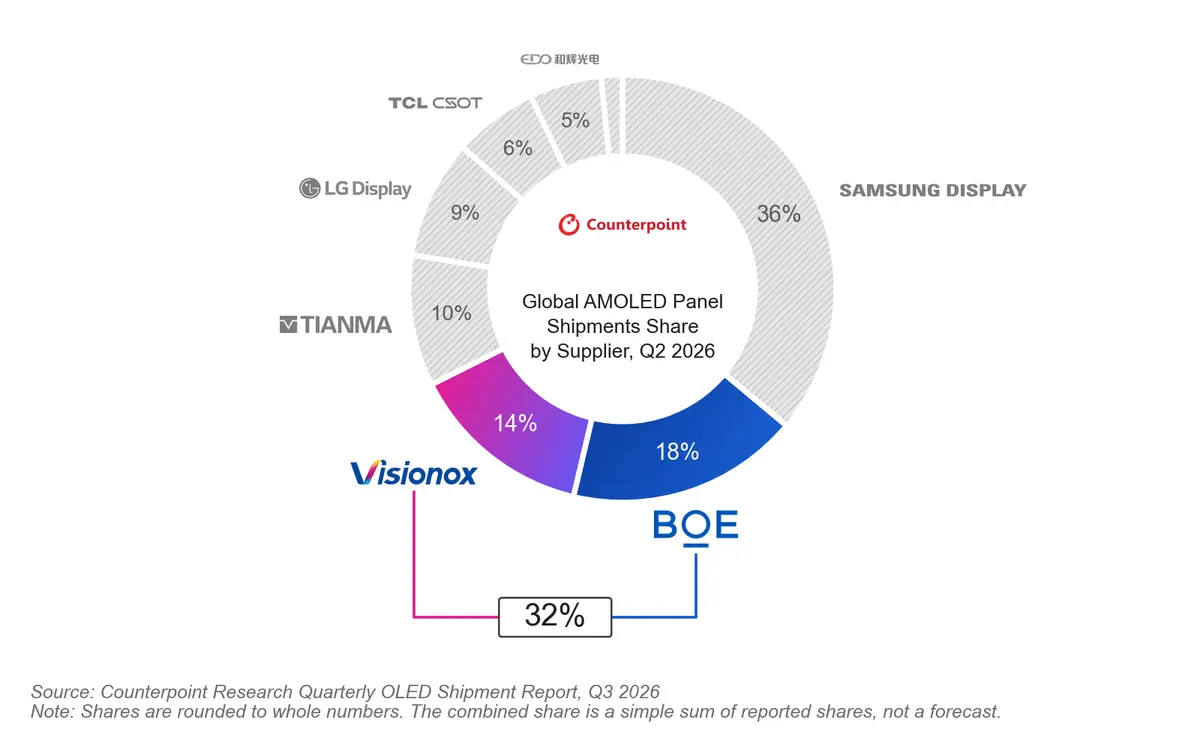
- In Q2 2026, BOE held 18% of global AMOLED panel shipments and Visionox 14%; added together, the two would hold about 32%, second only to Samsung Display at 36%
- A combination could accelerate consolidation in China's OLED industry and strengthen BOE's position in IT OLED, putting pressure on Samsung Display and LG Display
- Counterpoint Research's Jaehak Choi says that, despite considerable challenges, the strategic upside of a Visionox acquisition for BOE is compelling
Beijing, Berlin, Buenos Aires, Fort Collins, Hong Kong, London, New Delhi, Seoul, Taipei, Tokyo – November 28, 2026
According to reports on November 24, BOE is pursuing an acquisition of Visionox, with discussions reportedly expanding from a single OLED production line to the entire company. On November 25, Visionox stated that it has not agreed on a specific transaction plan or signed any legally binding agreement with any investor, and that any change of control remains uncertain.
The reported discussions surrounding BOE’s potential acquisition of Visionox could mark one of the most consequential developments in the global display industry in recent years.
This is not simply about acquiring additional OLED capacity. It is about scale, technology leadership, capital efficiency and the future competitive balance of the display industry.
If the acquisition materializes, the implications could be far-reaching:
- Industry consolidation: China’s OLED industry could follow a similar trajectory to its LCD industry, with fewer, larger manufacturers gaining greater influence over global supply and pricing.
- Accelerating IT OLED adoption: Combining BOE’s Gen 8.7 IT OLED investments with Visionox’s V5 facility and its ViP technology could strengthen BOE’s competitive position across notebooks, tablets and monitors.
- Competitive pressure on South Korea: Samsung Display and LG Display could face a financially and technologically stronger Chinese competitor, accelerating the need for innovation, manufacturing efficiencies and product differentiation.
- Capacity and pricing discipline: Consolidation could help rationalize capital expenditures, improve fab utilization, reduce redundant investments and potentially restore much-needed pricing discipline across the OLED industry. According to Counterpoint Research, global display equipment capex is projected to fall 49% YoY in 2027, following a 61% YoY surge in 2026.
- OEM sourcing strategies: Apple and other leading smartphone and PC brands could benefit from a stronger alternative OLED supplier, while navigating the risks associated with greater supplier concentration.
- Supply chain implications: Equipment manufacturers, material suppliers and component providers could face increased purchasing power from BOE, changes in investment roadmaps and greater pressure on margins.
- Broader technology industry implications: Greater concentration of advanced display manufacturing in China could reshape global supply chains, regional technology investments and geopolitical considerations.
However, Visionox’s financial challenges, complex ownership structure and local government involvement make this a particularly complicated transaction.
What would a combination mean for OLED share?
In Q2 2026, BOE accounted for 18% of AMOLED panel shipments and Visionox for 14%, according to Counterpoint Research’s Quarterly OLED Shipment Report. Added together, the two would account for about 32%, second only to Samsung Display (36%).
In his report, BOE's Potential Acquisition of Visionox: Strategic Move for BOE’s OLED Business, Jaehak Choi, Associate Director at Counterpoint Research, writes, “While the acquisition process is likely to face considerable challenges, the strategic upside is compelling. Given BOE's current position, pursuing a Visionox acquisition at this juncture appears to be a sound strategic move.”
On the Korean panel makers, he adds: “To prevent history from repeating itself in OLED, they need a robust counter-strategy, and now is the time to execute it decisively.”
Analyst Take
The display industry may be entering a new phase where manufacturing scale alone is no longer sufficient. Technology differentiation, capital discipline, sustainable profitability and customer diversification will increasingly determine the winners.
The bigger question is not whether BOE becomes larger, but whether this potential acquisition accelerates a broader wave of consolidation across the global OLED industry.
Explore More Display Industry Insights
Counterpoint Research’s comprehensive display research portfolio provides actionable data, forecasts and strategic insights across:
Explore Related Research
BOE's Potential Acquisition of Visionox: Strategic Move for BOE’s OLED Business
Display Equipment Capex to Fall 49% in 2027 as Sunic System Becomes Top Korean Supplier by Revenue
The OLED landscape is evolving. Are you ready for what’s next?
Gain deeper insights into the forces reshaping the global display industry with Counterpoint Research. Contact us to explore our latest display research, forecasts and strategic insights.
