

- In 2025, around an additional 16,000 units of humanoid robots were installed worldwide, with China alone accounting for more than 80% of the installations.
- AGIBOT topped the global list of vendors with the highest number of annual humanoid robot installations, followed by Unitree, UBITECH, Leju and Tesla. The top five enterprises accounted for a 73% share.
- The cumulative installations of humanoid robots are projected to exceed 100,000 units by 2027.
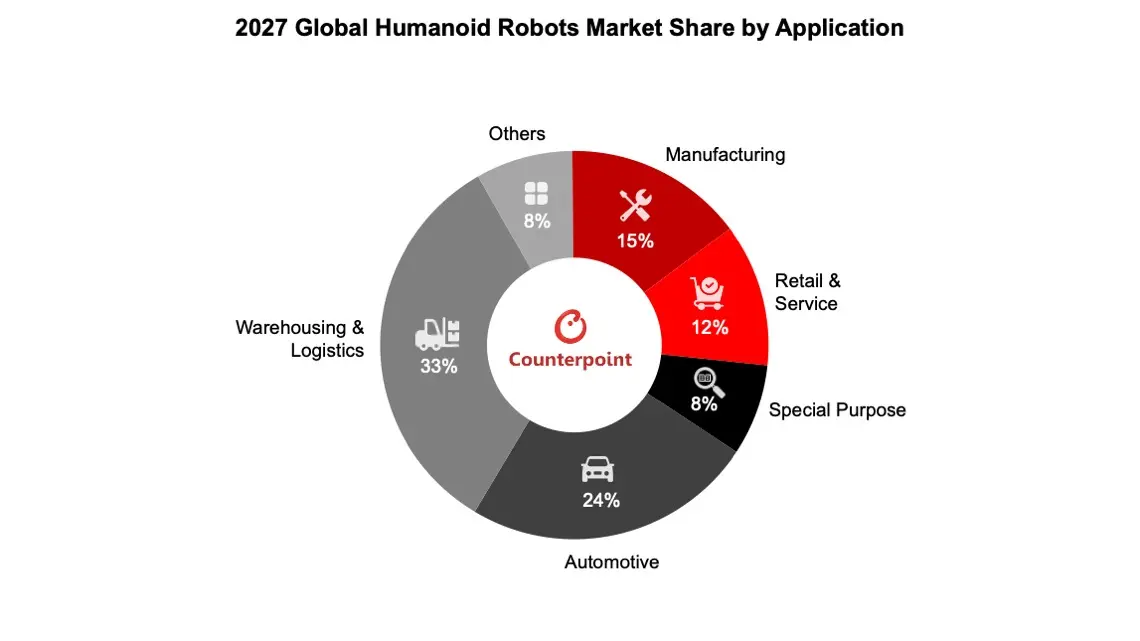
- In terms of applications, logistics, manufacturing and automotive will represent 72% of the annual installations in 2027.
Seoul, Beijing, Berlin, Buenos Aires, Fort Collins, Hong Kong, London, New Delhi, Taipei, Tokyo – Jan 14, 2025
The humanoid robot industry made significant progress in commercialization in 2025. According to Counterpoint Research’s Humanoid Robot Research, worldwide installations of humanoid robots jumped by 16,000 units during the year, primarily driven by increasing adoption in areas including data collection and research, warehousing and logistics, manufacturing, and automotive. The top five vendors in terms of humanoid installations took 73% share of the market in 2025.
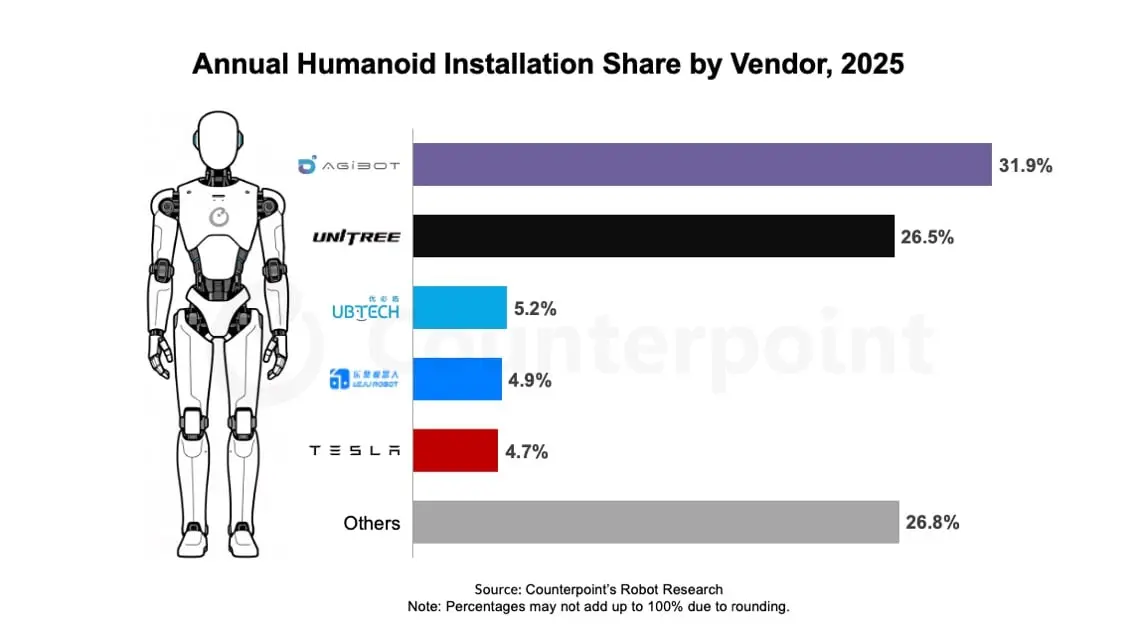
AGIBOT, a Shanghai-based startup founded in February 2023, quickly expanded its product range and started mass-producing the AGIBOT X2 and G2 robots in 2025. Leveraging the diverse product range, high-quality humanoid manipulation dataset and the unique open-source strategy, AGIBOT robots have achieved commercial deployment across the hospitality, entertainment, manufacturing and logistics industries. So far, AGIBOT has rolled out more than 5,000 humanoid robots from its Shanghai factory and captured a nearly 32% share in 2025.
Unitree, a world-leading manufacturer of quadruped robots, has deep expertise in dynamic motion and balance control. At CES 2026, Unitree G1 robots again gained considerable attention by demonstrating a boxing match. With self-developed drive motors, reducers, LiDAR and customized MCUs, Unitree can produce humanoid robots with great locomotion performance at a relatively lower cost. In 2025, Unitree robots accounted for a 27% share.
UBTECH, a Shenzhen-based and Hong Kong-listed humanoid robot enterprise, ranked third with a share marginally over 5%. Its Walker series focuses on catering to industrial needs and can be seen on the factory floors of multiple automotive players. By combining BrainNet 2.0 with Co-Agent technology, UBTECH robots can learn skills from each other and operate collaboratively.
Leju, another high-profile Shenzhen-based humanoid robot enterprise, captured a 5% share in 2025. Through its strategic collaboration with Huawei Cloud, Leju’s KUAVO series supports cloud-based training and skill upgrades, resulting in greater generalization capability.
Tesla entered the top five in 2025 and captured nearly 5% share, driven by the production ramp-up of the Optimus Gen 2 and Gen 2.5. Optimus has been a critical driver for humanoid supply chain advancement. With the plan of starting the Gen 3’s mass production in 2026, the world’s major EV manufacturer and AI tech giant will become the backbone driving the large-scale deployment of humanoid robots in the auto industry.
During CES 2026, versatile humanoid robots emerged as the undisputed highlight, and the frenzy also boosts the morale of industry players. The next two years will see more humanoid enterprises commercializing the mass-production versions of robots, and their performance will largely determine the development pace of the whole industry. Three new trends are worthy of greater attention:
1. Some Chinese enterprises have introduced affordable solutions, such as NOETIX’s Bumi, which is priced lower than $1,600. The design of such products focuses on intelligent and emotional interaction and excellent mobility, rather than the capability of completing structured and unstructured tasks across the industry and service sectors. There is a vast potential across household scenarios and humanoid enterprises would not like to leave it untapped.
2. Renting robots as a service (RaaS) has emerged as a key business model to facilitate the adoption of humanoid robots, particularly in the service sector, including live performance and automated retail. In China, Unitree and AGIBOT are among the major contributors to advancing the RaaS model, and Counterpoint expects dedicated platforms to be established to manage and maintain the leased robots and help reduce the cost of ownership.
3. Leading humanoid enterprises are keen on scaling up their production capacity, likely resulting in decreasing manufacturing costs in 2026 and beyond. Both Tesla and Figure AI have aggressive plans for building production lines with robotic involvement, and this movement indicates a key trend that the future industrial production will be adapted to the application of humanoid robots.
According to Counterpoint’s Humanoid Robot Research, the cumulative installations of humanoid robots will exceed 100,000 units by 2027. In terms of applications, logistics, manufacturing and automotive will represent 72% of the annual installations in 2027.
About Counterpoint Research
Counterpoint Research is a global market research firm specializing in products across the technology ecosystem. We advise a diverse range of clients – from smartphone vendors to chipmakers and channel players to Big Tech – through our offices located in the world's major innovation hubs, manufacturing clusters and commercial centers. Our analyst team, led by seasoned experts, engages with stakeholders across the enterprise – from the C-suite to professionals in strategy, analyst relations (AR), market intelligence (MI), business intelligence (BI), product and marketing – to deliver services spanning market data, industry thought leadership and consulting. Our core areas of coverage include AI, Automotive, Consumer Electronics, Displays, eSIM, IoT, Location Platforms, Macroeconomics, Manufacturing, Networks and Infrastructure, Semiconductors, Smartphones and Wearables. Visit our Insights page to explore our publicly available market data, insights and thought leadership, and to understand our focus, meet our analysts and start a conversation.
Analyst Contacts
Counterpoint Research
press(at)counterpointresearch.com


