- Humanoid robots will play a significant role in warehousing and logistics scenarios, addressing the flexibility gap with traditional automated equipment.
- Simplified humanoid form factor is more viable due to lower cost and higher reliability.
- By 2030, warehousing and logistics deployments will represent 25% of the total humanoid robotics installation, driven by embodied AI and manipulation advancements to improve robotics capabilities.
Humanoid robots in logistics are not meant to replace existing automated systems like AGVs or fixed robotic arms, which excel in standardized, high-volume tasks. Instead, their value lies in addressing the “flexible picking” gap—a major bottleneck in modern logistics caused by small-batch, multi-SKU operations that require frequent changeovers and exception handling. Traditional automation struggles here, often needing human intervention, while peak-season reliance on temporary workers introduces errors and inefficiencies. Frontline staff also face repetitive strain and stress. Humanoid robots offer a complementary solution. Their human-like form, dexterous manipulation, and AI-driven perception allow them to handle diverse item shapes and quickly adapt to new SKUs—overcoming the rigidity of conventional systems.
Warehousing and logistics are relatively structured scenarios compared to manufacturing or householding, making it an ideal early-use case for current “embodied intelligence” systems, which still lack true general intelligence. A pragmatic approach focuses on specific tasks and iterative development, enabling faster commercialization. Simplified designs—such as gripper-style end effectors instead of high-DoF hands, or wheeled bases over bipedal locomotion—reduce cost and complexity while maintaining reliability and performance in targeted scenarios. This balance makes large-scale adoption feasible.
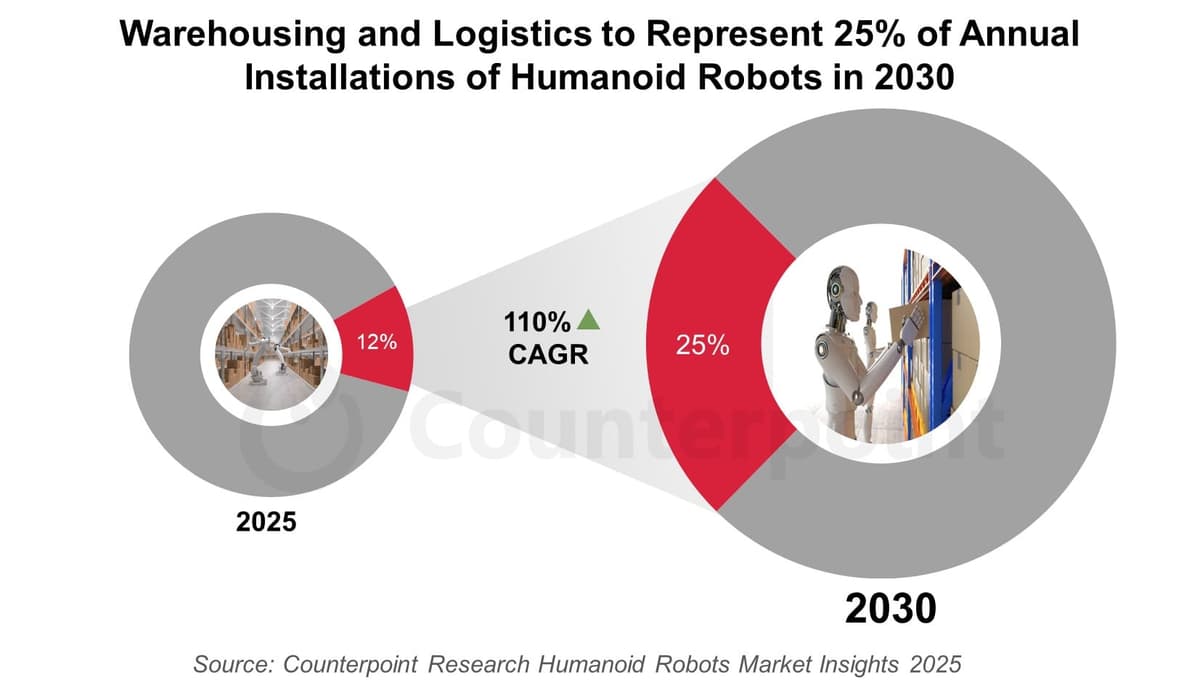
Real-world deployments are already underway. GXO uses humanoid fleets from Agility and Reflex Robotics; BZS Technology integrates Robotera’s L7 model; and Hangcha Group has launched its X1 humanoid. Currently, about 2,000 units are deployed globally in logistics, accounting for 12% of total humanoid installations. JD Logistics plans to procure 3 million robots (not exclusive to humanoids) over next five years, while Amazon is testing humanoids for last-mile delivery. As embodied AI and manipulation improve, humanoid robots will expand beyond handling and sorting into packaging, quality inspection, and inventory counting. According to Counterpoint’s latest Humanoid Robots Market Insights 2025, deployment in logistics is projected to reach 64,000 units by 2030, 25% of the global total.
For the full research note, please log on to our Research Portal. If you are not a client, reach out to us at [email protected]

