

- The majority of tracked sovereign LLMs are adapted models fine-tuned on pre-existing open-source bases, at 56% share. Foundational builds trained on native data follow closely at 44%.
- Llama is the dominant foreign base model family, accounting for 38% of adapted sovereign LLMs.
- Qwen and Mistral follow as close challengers with near-equal shares of 20% and 19%, respectively.
- Adapted sovereign AI LLMs therefore remain largely reliant on foreign providers, namely the US and Chinese foundation LLM families.
Beijing, Buenos Aires, Dubai, Hong Kong, London, New Delhi, Seoul, San Francisco, Taipei, Tokyo – Sep 21, 2026
Adapted models account for the majority of the sovereign LLM build mix at 56% share, driven by Meta’s Llama, which is the most preferred US open-source foundation for sovereign-adapted LLMs and captures a sizeable 38%, according to Counterpoint Research’s H1 2026 Sovereign AI LLM Index. Notably, the Llama LLM family stands as the dominant base across all the regions assessed in our research.
Most countries combine foundational and adapted LLMs in their portfolios, reflecting different stages of sovereign AI LLM maturity. The move to developing foundational LLMs on native data is a strategically decisive step, factoring in their relatively difficult and expensive deployment.
Commenting on the findings, Marc Einstein, Research Director at Counterpoint Research, said, “Sovereign AI is about control and strategic autonomy, but control is a continuum rather than a switch. A slight majority of ‘sovereign’ LLMs are fine-tuned on open-source foreign bases, so true autonomy is still the exception. What matters is the direction of travel, and our study shows a clear push towards foundational models built from scratch on native data.”
In the first two parts of this analysis, we introduced our study and evaluated more than 170 models, spanning over 55 active sovereign LLM nations across the Middle East, Central & Eastern Europe, Western Europe, Asia-Pacific (APAC, excluding China), Central Asia, Africa, North America (Canada, excluding US), and CALA, to understand how nations outside the US and China are competing to build domestic LLM capabilities and AI infrastructure.
Read the earlier parts of this series on the Counterpoint Research website: Part 1 on the H1 2026 Sovereign AI LLM Index rankings and Part 2 on the AI chip infrastructure behind sovereign LLMs.
The full study, Sovereign AI LLM Research Report: Mapping the Global Race to Build Domestic LLMs, is also available there.
That analysis covered various dimensions, including the type of sovereign LLM models, the AI chip infrastructure for training and inferencing, and LLM capabilities in terms of sovereign LLM ownership, foundational build, local language depth, and application. Here, building on the same study, we take the analysis further and examine the adapted models by base model family.
Counterpoint’s Sovereign AI LLM Share of Adapted Models by Base Model Family
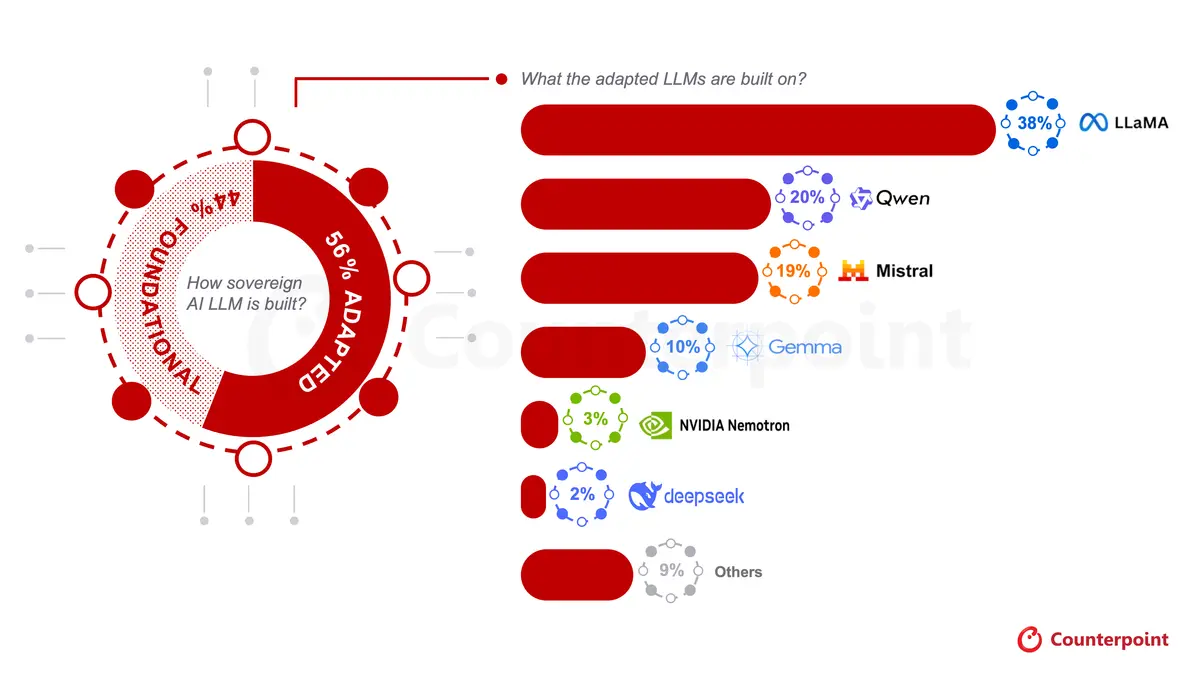
Source: Counterpoint Research: AI 360 Practice: Sovereign AI Research, July 2026
Trailing Llama closely, China’s Qwen is increasingly used as a key foundation for locally adapted models across Central & Eastern Europe, Asia-Pacific, and Africa, leveraging its broader multilingual base and efficient open model architecture to address local language customization.
France’s Mistral, a foundational model developed in Western Europe, emerges as a close challenger, strengthening its foothold in the Middle East through strategic partnerships such as G42, alongside broader traction across Western Europe, Central & Eastern Europe, and Asia-Pacific.
For more on how Abu Dhabi is turning these partnerships into deployed AI, see Counterpoint Conversations: Abu Dhabi’s Digital Blueprint to Deploy Predictive, Proactive and Responsible AI at Scale, recorded around GITEX Global last year.
Looking across regions, adapted LLMs increasingly draw on a wider set of foundations such as Llama, Qwen, Mistral, Gemma, NVIDIA Nemotron and DeepSeek. This reflects diversification to reduce complete dependence on a single foundation.
About Counterpoint Research
Counterpoint Research is a global market research firm specializing in products across the technology ecosystem. We advise a diverse range of clients – from smartphone OEMs to chipmakers and channel players to Big Tech – through our offices located in the world's major innovation hubs, manufacturing clusters and commercial centers. Our analyst team, led by seasoned experts, engages with stakeholders across the enterprise – from the C-suite to professionals in strategy, analyst relations (AR), market intelligence (MI), business intelligence (BI), product and marketing – to deliver services spanning market data, industry thought leadership and consulting. Our core areas of coverage include AI, Automotive, Consumer Electronics, Displays, eSIM, IoT, Location Platforms, Macroeconomics, Manufacturing, Networks and Infrastructure, Semiconductors, Smartphones and Wearables. Visit our Insights page to explore our publicly available market data, insights and thought leadership, and to understand our focus, meet our analysts and start a conversation.
Follow Counterpoint Research
