Welcome to the Zoo! The Zoo has become an important platform in this AI jungle.
The cat is out of the bag. NVIDIA has agreed to buy Hugging Face for $12.93B - and the deal is about much more than acquiring an AI model platform. NVIDIA was already an investor in Hugging Face, which has become the world’s biggest and most important “AI model” zoo: the de facto platform where the world’s largest and smallest models are published, ranked, copied, fine-tuned, and used. It has transformed from a marketplace into a key asset in the AI infrastructure race.
Horizontal Integration
This is more of a “horizontal integration” move, and an important one for NVIDIA. By owning the model zoo, NVIDIA learns which models are gaining traction and pulls more of those workloads directly onto its silicon, systems, and software.
Related: The $Trillion Bottleneck — NVIDIA’s NVHBM and the Fight for the Base Die — how NVIDIA is pushing the same integration logic down into the memory stack.
Closer to the Ecosystem
See the market before it shows up in chip demand. Downloads, fine-tunes, evals, benchmarks, and serving patterns tell us which architectures, compression techniques, agent stacks, and policies are growing, and at what pace — long before any of it appears in chip orders. That becomes a valuable roadmap for compilers, runtimes, and next-generation systems.
Related: NVIDIA GTC 2026 — Groq, Tokenomics, CMX — where this ecosystem signal shows up in the roadmap.
The Open-Models Hedge
This is perhaps the biggest motivation behind the acquisition. Closed labs drive frontier models alongside their own custom silicon. NVIDIA is more general-purpose, and its breadth of optimisation runs across thousands of open-weight models, not just three.
The idea is to give every open model the hardware to produce maximum-performance tokens efficiently. If enterprise value keeps shifting toward adapting open weights to proprietary data, products, and robots, the winner will be whoever makes that path cheapest and fastest on its hardware. NVIDIA knows that.
Distribution Platform for NVIDIA
NVIDIA already hosts its own open models and datasets on Hugging Face. Ownership lets that relationship evolve beyond discovery and deployment on NVIDIA chips into a direct distribution channel to the world at scale.
Key to Physical AI
Robotics, humanoid models, teleoperation data, and simulation represent one of the fastest-growing parts of the Hub. Wiring that work into the community is how NVIDIA can further strengthen its lead in open Physical AI. From Nemotron to Alpamayo, NVIDIA could make Hugging Face the default place where these stacks live.
Switzerland of AI Models — or Not?
Many silicon players wouldn’t like Hugging Face becoming less neutral. At the same time, hyperscalers building their own chips have an interest in the Hub remaining open and neutral — which is exactly the tension NVIDIA now has to manage.
From the Analyst Call
On the analyst call with Clement Delangue (Hugging Face) and Justin Boitano (NVIDIA), the message was consistent on openness:
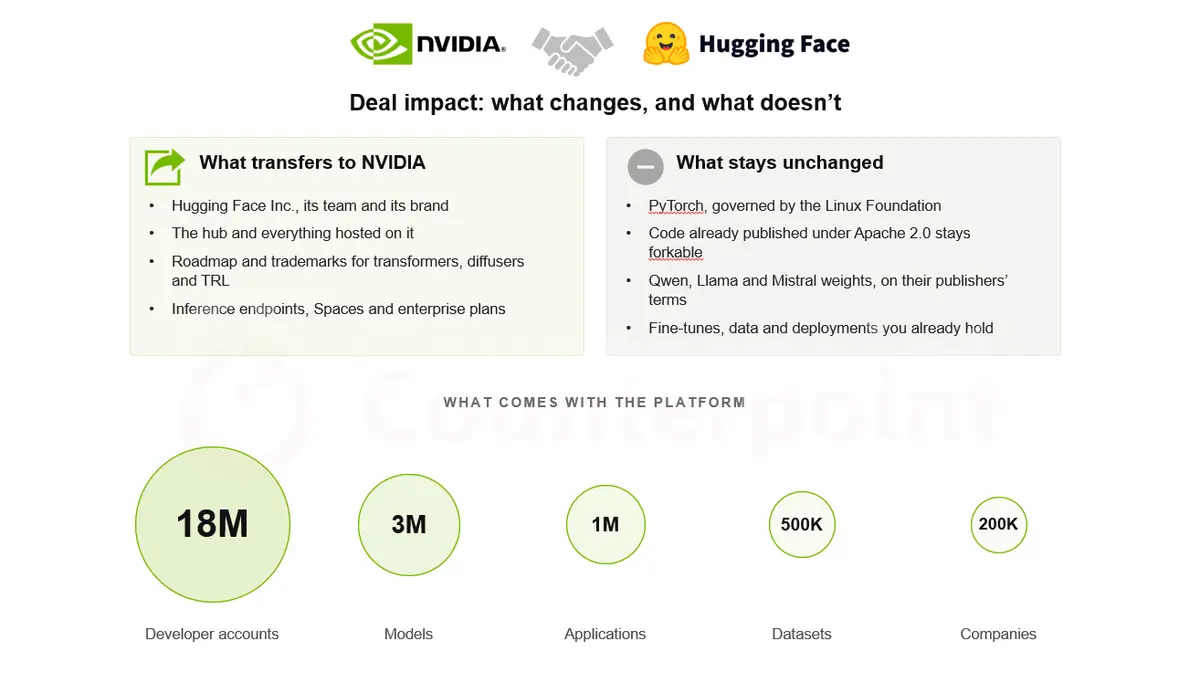
- NVIDIA aims to keep the Hub open.
- Hugging Face has more than 18M developers and 200K enterprises on the platform, and NVIDIA believes it will be a great home for them.
- The goal is to get to 100M AI builders.
- Hugging Face will continue to push for open models and open datasets everywhere.
- This AI era is an industrial infrastructure build-out in every country, built on low-cost open models that let people discover and build.
- Everyone can source the open models, fork them, and use the capabilities to build more.
Related: NVIDIA Dominates With 92% Share in Counterpoint’s Sovereign AI LLM Index — the country-by-country build-out behind that “industrial infrastructure” framing.
Final Takeaways:
In the end, it boils down to “neutrality.” Hugging Face works because everyone publishes there — from big labs and startups to NVIDIA’s hardware rivals. The day it starts looking like a CUDA club, the zoo fragments and the asset shrinks.
So, the Hugging Face deal could work well if NVIDIA:
- Keeps the Hub open and multi-hardware
- Keeps rivals posting
- Keeps its moat working, but doesn’t amplify it too aggressively
- Maintains prudent circulation
- Uses that circulation to make open models, agents, and robots default to NVIDIA systems, while still giving others an opportunity
More on NVIDIA from Counterpoint Research
If this thesis is useful, these companion pieces go deeper on the three pillars behind it — silicon and systems, memory, and sovereign demand:
- NVIDIA GTC 2026: Groq, Tokenomics, CMX — the roadmap, tokenomics and the systems story.
- The $Trillion Bottleneck: NVIDIA’s NVHBM and the Fight for the Base Die — why the memory base die is the next control point.
- NVIDIA Dominates With 92% Share in Counterpoint’s Sovereign AI LLM Index — how nations are building on NVIDIA silicon.
Follow Counterpoint Research for ongoing coverage of AI infrastructure, semiconductors and memory — and reach out if you’d like a briefing on what the Hugging Face deal means for your roadmap.


