Evolution of Autonomous Vehicle Sensors
- Autonomous driving is reshaping vehicle perception, with LiDAR, radar, and camera technologies evolving rapidly to enable higher levels of driving automation.
- Partnerships between automakers, Tier 1 suppliers, and startups are speeding up innovation and making advanced sensor technology ready for large-scale use.
- AI integration and sensor fusion are redefining accuracy, efficiency, and adaptability across next-generation ADAS systems.
Radar, cameras, and LiDAR are foundational to ADAS, helping vehicles move from basic driver assistance features toward higher levels of autonomous driving. According to Counterpoint’s Global Autonomous Vehicle Forecast, Q2 2025, global ADAS penetration from SAE L1 to L4/5 is projected to reach 94% by 2035. This widespread OEM adoption is driving strong demand for advanced sensors that are faster, smarter, and more compact. As a result, the global market for Global ADAS and Autonomous Vehicle Sensor Forecast is projected to reach $61.17 billion by 2035, creating significant opportunities for OEMs and Tier 1 suppliers to invest in next-generation, scalable sensing technologies.
LiDAR: From Spinning Towers to Digital Eyes
Early automotive LiDAR (Light Detection and Ranging) used large, spinning roof-mounted devices. Today, solid-state, MEMS (Micro-Electro-Mechanical Systems), and digital/FMCW (Frequency-Modulated Continuous Wave) LiDAR are compact and can be integrated into bumpers, headlights, or windshields. They process data locally with edge AI, detecting objects, measuring distance and speed, and understanding the environment in real time. This enables faster, more accurate perception, supporting ADAS and higher autonomy levels like L2+ and L4.
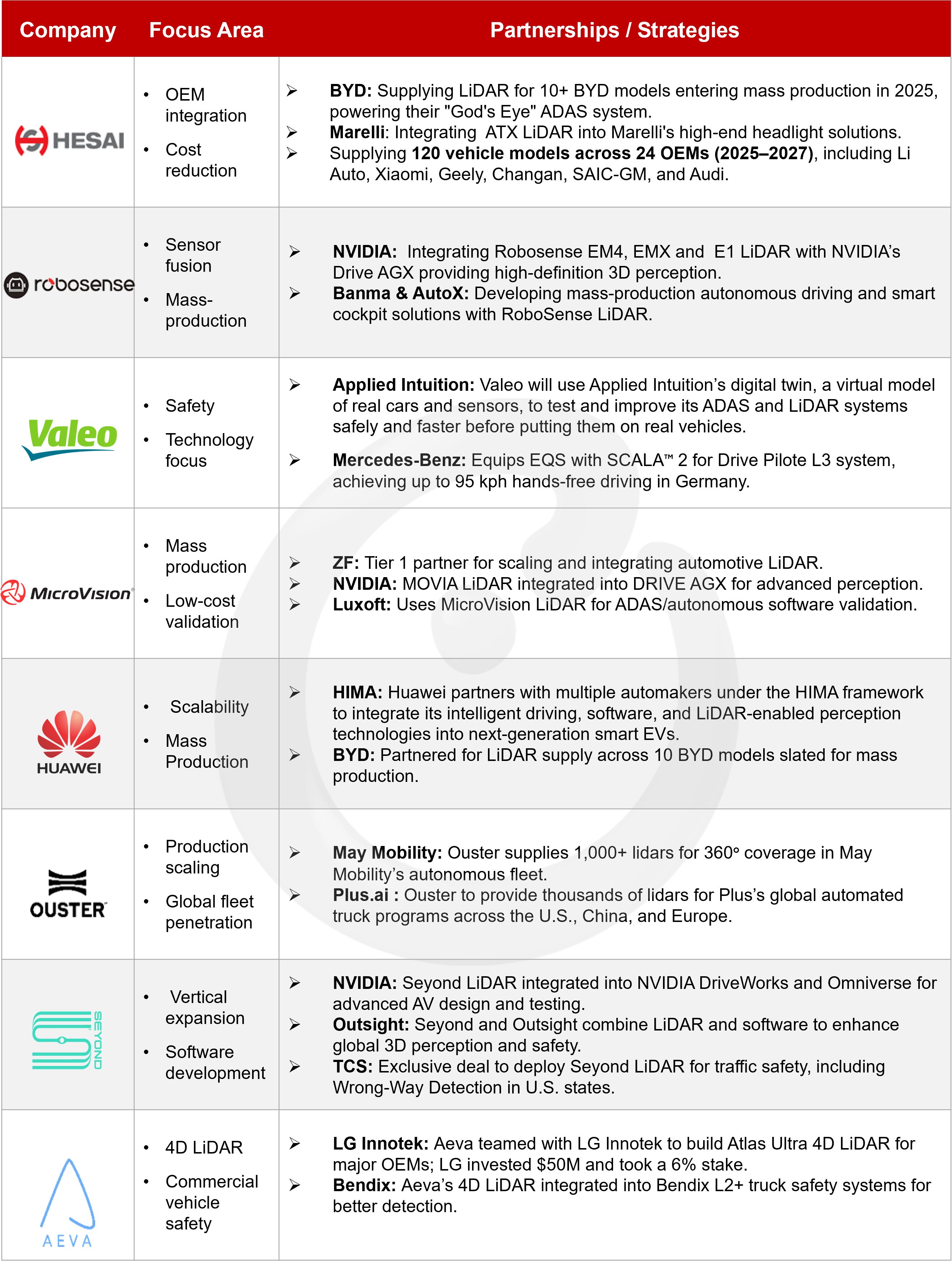
The following table provides details about several LiDAR suppliers and their automaker customers.
LiDAR
Radar Reinvented: High-Resolution Sensing for Every Weather
Radar technology has progressed from analogue systems to modern digital precision. Today’s digital array radar generates detailed point clouds similar to LiDAR and works reliably in fog, rain, and snow. Imaging radar further enhances this by delivering high-resolution, 4D perception with precise range, velocity, and elevation information. Advanced AI-enabled chips help the radar predict the movement of vehicles and pedestrians, ensuring dependable perception even in low visibility. Compact, efficient, and cost-effective, radar is now a critical component of modern sensor suites.
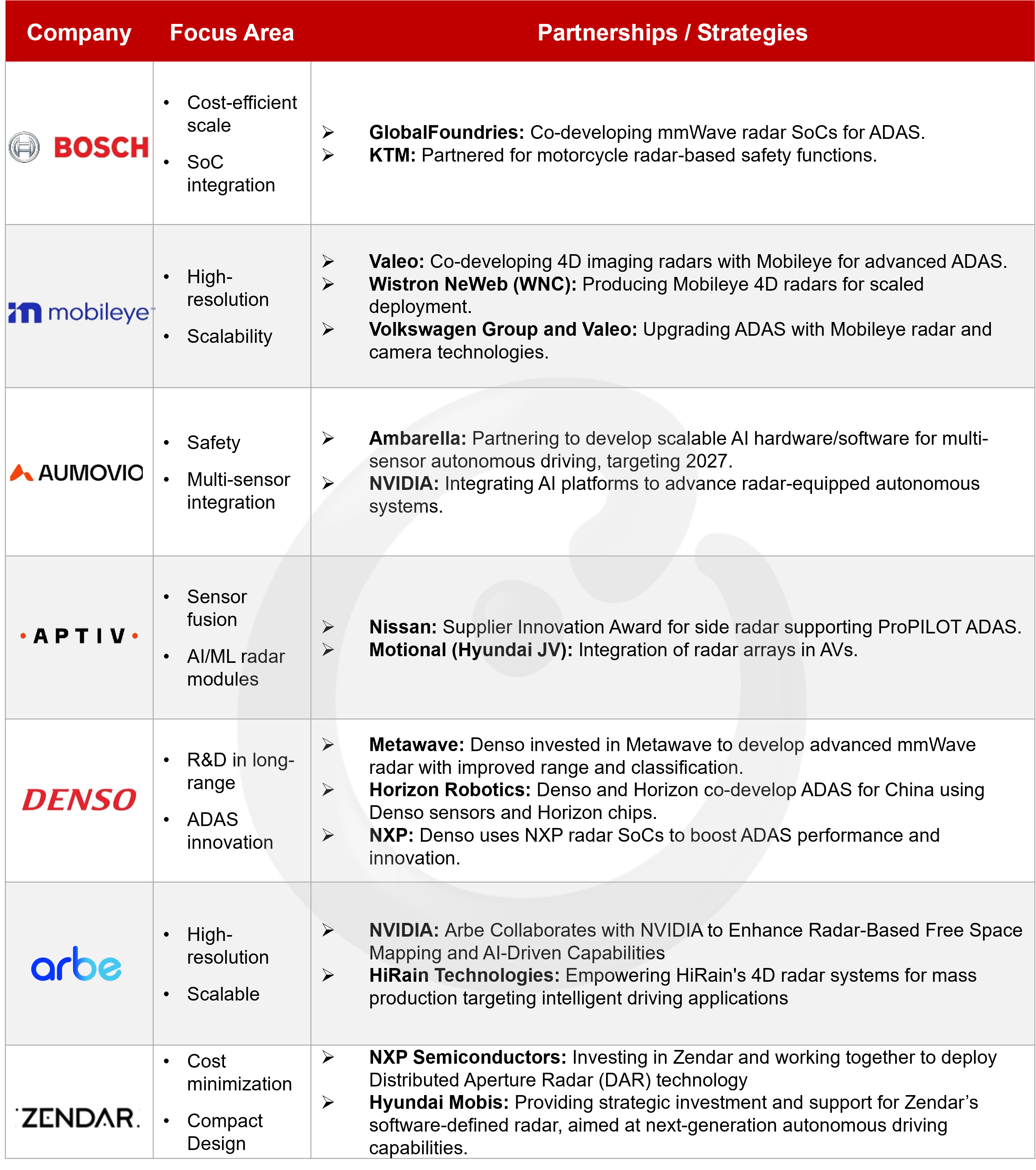
The following table describes radar solutions from several companies and notable partnerships they have with automakers and other suppliers.
RADAR
Cameras Grow Up: From Backup Lens to Autonomous Eyes
Vehicle cameras have advanced from simple rear-view helpers to the primary “eyes” of autonomy. Early systems offered a camera with a single forward-facing lens with modest resolution; today’s platforms deploy multi-camera, 360-degree arrays with high-megapixel sensors and wide dynamic range, feeding real-time AI models that detect lanes, traffic signs, pedestrians, and subtle road cues. While many automakers continue to rely on a blend of sensor types, Tesla has taken the vision-only approach the furthest, dropping radar from its Full-Self Driving program and relying entirely on cameras. The company believes that with strong neural networks and fast on-board computing, a camera-first setup can rival a sensor suite that consists of the more expensive LiDAR and Radar. Other automakers still prefer a mix of sensors, but the camera remains a core part of the vehicle perception sensor suite
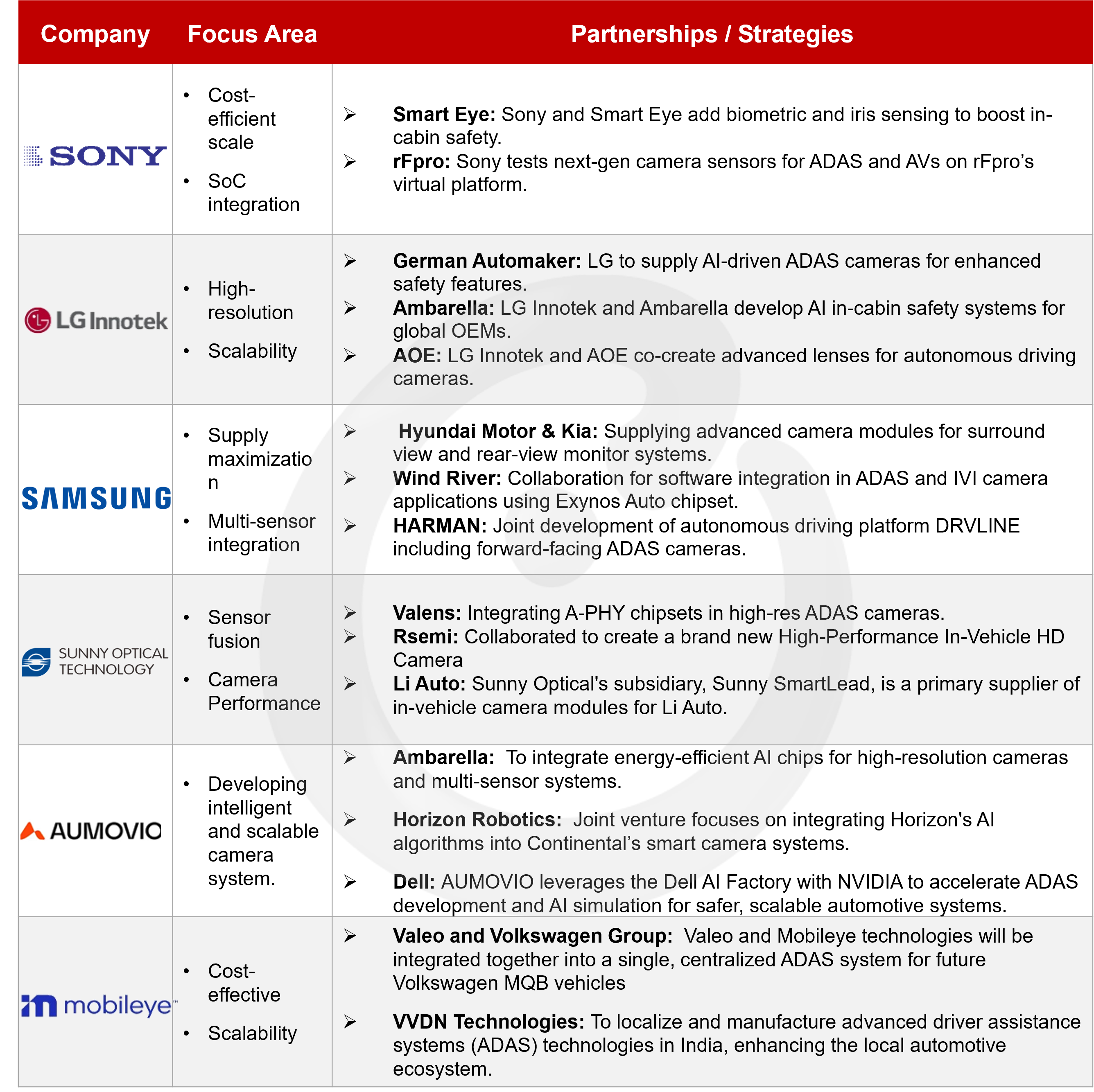
The table below describes camera suppliers and their industry relationships.
CAMERA
The evolution of autonomous vehicle sensors is being driven by a strong collaboration between major automotive sensor companies and startups that specialize in cutting-edge sensor technologies. This collaborative ecosystem enables rapid development and integration of advanced sensor functionalities such as AI-powered radar, millimeter-wave radar, and 3D sensing cameras. Sensor companies are forming strategic alliances with OEMs to co-develop and deploy sensor solutions specifically designed for production vehicles. This provides scalable mass production and system-level integration, which are critical to enabling automakers to profitably produce autonomous vehicles.
Analyst Take
- Start-ups with innovative sensor technologies and Tier 1 suppliers are collaborating to accelerate innovation and commercialization of next-gen sensors such as 4D imaging radar and digital LiDAR. For example, partnerships like Mobileye-Valeo on imaging radar or Aeva-LG Innotek on 4D LiDAR combine software innovation with automotive-grade manufacturing. This ensures faster time-to-market and scalable deployment of high-performance sensing technologies in production vehicles.
- AI-driven perception is emerging as a key differentiator in sensor technologies- including cameras, radar, and LiDAR. By enabling edge-based real-time detection and prediction, AI significantly boosts the reliability and efficiency of each sensor type. As vehicles progress toward higher autonomy, AI integration will be essential for unlocking the full potential of these sensors.
- Cost optimisation remains central to scaling ADAS and autonomy. Tier 1 suppliers are driving down sensor costs through design simplification and system integration, making imaging radar and LiDAR more affordable for mass-market vehicles, a key enabler for wider autonomous adoption.
Category
Industry
Automotive
Service
Standard
Report Type
Report
Time Period
Other
Receive our insightful weekly newsletter and stay ahead of the competition.
Author
Team Counterpoint
Counterpoint research is a young and fast growing research firm covering analysis of the tech industry. Coverage areas are connected devices, digital consumer goods, software & applications and other adjacent topics. We provide syndicated research report as well as tailored. Our seminars and workshops for companies and institutions are popular and available on demand. Consulting and customer