

With the smartphone market getting saturated in China, device OEMs, ODMs, and investors have been exploring the new areas for growth in the consumer segment since 2017. The bet is on IoT and smart home devices to create a new revenue stream over the next 5 to 10 years.
Within the smart home segment, smart door locks have emerged as a popular device. It is fast turning into an essential utility which liberates people from the inconvenience of carrying, losing, forgetting, or searching for the physical door lock keys. The adoption of smart door locks in China remains relatively low at around 5% (excluding serviced apartments) as of 2018. In comparison, smart door lock penetration has reached 60% in Japan and South Korea, while in Western countries, it is nearly 35%. The low penetration in China offers immense potential for growth.
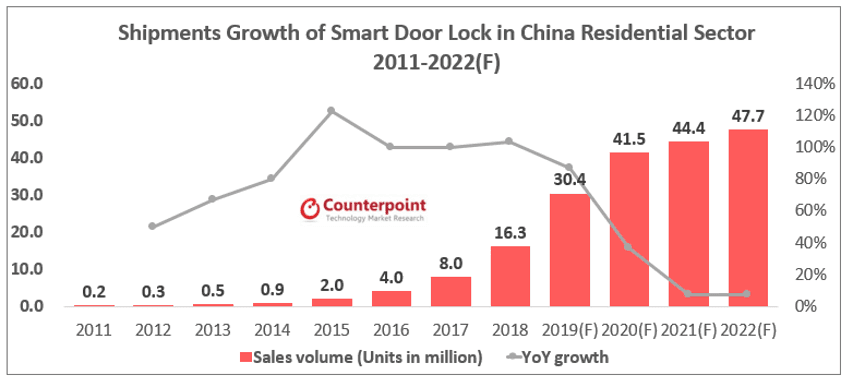
China smart door lock market has grown exponentially since 2015, albeit from a small base. In 2018, shipments of smart door lock reached over 10 million units registering 63% year-on-year (YoY) growth. We estimate that 2018-2020 will be the golden period for smart door lock sales in China. According to our forecast, by 2020 the sales volume of smart door locks in China is expected to reach around 40 million units in the residential sector (households + long-term service apartments). As a result, the penetration of smart door locks in Chinese households will grow to 20%, from 5% only in 2018.
Exhibit 1: Shipments of Smart Door Lock in China Residential Sector (households + long-term service apartments) from 2011-2022 (F)
Source: Counterpoint Estimate, Public information
Note: Shipments in business sector such as to hotels, offices and other commercial buildings are excluded
What is the impetus for the growth of smart door lock in China?
Several factors will contribute to the growth of the smart door lock market in China. The advancement of biometric recognition (E.g., fingerprint recognition) and wireless communication (4G, Bluetooth, NFC, NB IoT) technologies will enhance the security and product utility of smart door locks. Currently, general smart door locks in China can accurately recognize various authentication codes, allowing consumers to unlock the door within seconds by simply inserting passwords or pressing their fingers. In terms of security, smart door locks can efficiently tell fake authentication and automatically report it to the police station, in case a stranger is trying to unlock the door by force.
Further, prices of components such as fingerprint recognition modules and wireless communications modules have dropped, which also brought down the Bill of Materials (BoM) costs of smart door locks. Additionally, Chinese start-up companies and internet giants such as Xiaomi have entered the smart door lock market offering low product prices to acquire users. As a result, the average retail price of smart door locks in China has dropped to less than RMB2,000 (US$300) since 2018.
Finally, millennials (the generation born between 1980 to 2000) in China, representing over 400 million population, have grown to be the dominant consumer group for real estate in China. The Chinese millennials have adapted to a digital lifestyle having grown up surrounded by electronic products. They are more keen to try innovative smart devices such as smart door lock in their life. Following the increase in the number of millennial property buyers in China, we expect sales of smart door locks to rise accordingly.
Current landscape
Currently, the smart door lock market in China remains crowded with over 1,500 players and 3,500 brands. We have grouped key smart door lock OEMs in different categories showcased in Exhibit 2.
Exhibit 2: Lineups of major smart door lock OEMs in China
Source: Counterpoint collect, public information
Key strengths of different groups of players vary. While the traditional door lock/smart door lock OEMs appear the strongest in product design and manufacturing, smartphone and home appliances OEMs are stronger across sales channels. Internet companies, most of which are start-ups established in 2010s, have managed to create clear differentiation over traditional device OEMs by offering high-quality platform services (SaaS).
In the long-term serviced apartment segment, internet smart door lock companies dominate due to their expertise in SaaS. Yun Ding Network is the indisputable market leader controlling 60% market share. As of 2018, there have been over 30 million units of serviced apartments in China run by rental service operators such as Ziroom, MoFang Apartment, Vanke Port Apartment, and more. The estimated penetration of smart door lock in this segment is around 10%, representing roughly 3 million units in 2018. Among this, the installed base of apartments adopting smart door locks provided by Yun Ding Network has reached over 1.5 million units. Moving forward, the continuous efforts of rental service operators to acquire new apartments and equip existing apartments with smart door locks will increase the penetration.
In the Chinese household segment, the installed base of smart door locks reached 20 million units as of June 2018, representing 5% of the 400 million households in China. For the Chinese household segment, the smart door lock market has no clear market leader, and it remains very fragmented. Internet companies have realized the importance of this under-penetrated market and aggressively invested in online marketing to raise brand awareness. Traditional door lock OEMs, such as KAADAS and DESSMANN, are leading in the offline construction and ironmongery channels with their long-established industrial networks. Going forward, we expect annual sales volumes of smart door locks in the household segment to grow, and penetration of smart door locks in this sector to rise to over 20% by 2020, and 35% by 2022.
Despite all the benefits a smart door lock can provide, security concerns, such as the possibility of disrupting the circuit of a smart door lock with a Tesla coil, or people hacking into the data center of door lock companies to steal user information, are still the biggest roadblocks for adoption. Thus, to catch up on the “golden period”, it will be essential for smart door lock OEMs to advance product security technologies and invest in consumers education. The smart door lock market in China, though crowded with thousands of brands, is still a vast market with no clear leader. With the right strategy, both big companies and start-ups can have the chance to stand out in the next 2-3 years.

