- Samsung unveiled the Galaxy Watch 7 and the high-end Galaxy Watch Ultra at the Galaxy Unpacked event, following the release of its entry-level Galaxy Watch FE in June.
- This diversification reflects Samsung's strategy to boost revenue growth, similar to trends seen with other major smartwatch OEMs like Huawei and Apple.
- The Galaxy Watch 7 features improved battery capacity, Exynos W1000 chipset and Galaxy AI.
Samsung Electronics launched its latest smartwatch iteration, the Galaxy Watch 7, along with the Galaxy Watch Ultra, a completely new high-end variant, on July 10 during the Galaxy Unpacked event in Paris. Samsung also unveiled its new lineup of foldable smartphones alongside the Galaxy Ring at the event.
With this, Samsung’s latest smartwatch lineup now consists of the Galaxy Watch 7 base model, Galaxy Watch Ultra and the Galaxy Watch FE – another new smartwatch variant introduced in June, targeting the entry-level segment. This reflects Samsung’s diversification strategy to boost revenue growth, a method adopted by most major smartwatch OEMs. The Galaxy Watch Classic/Pro was not released at this year’s Galaxy Unpacked event.
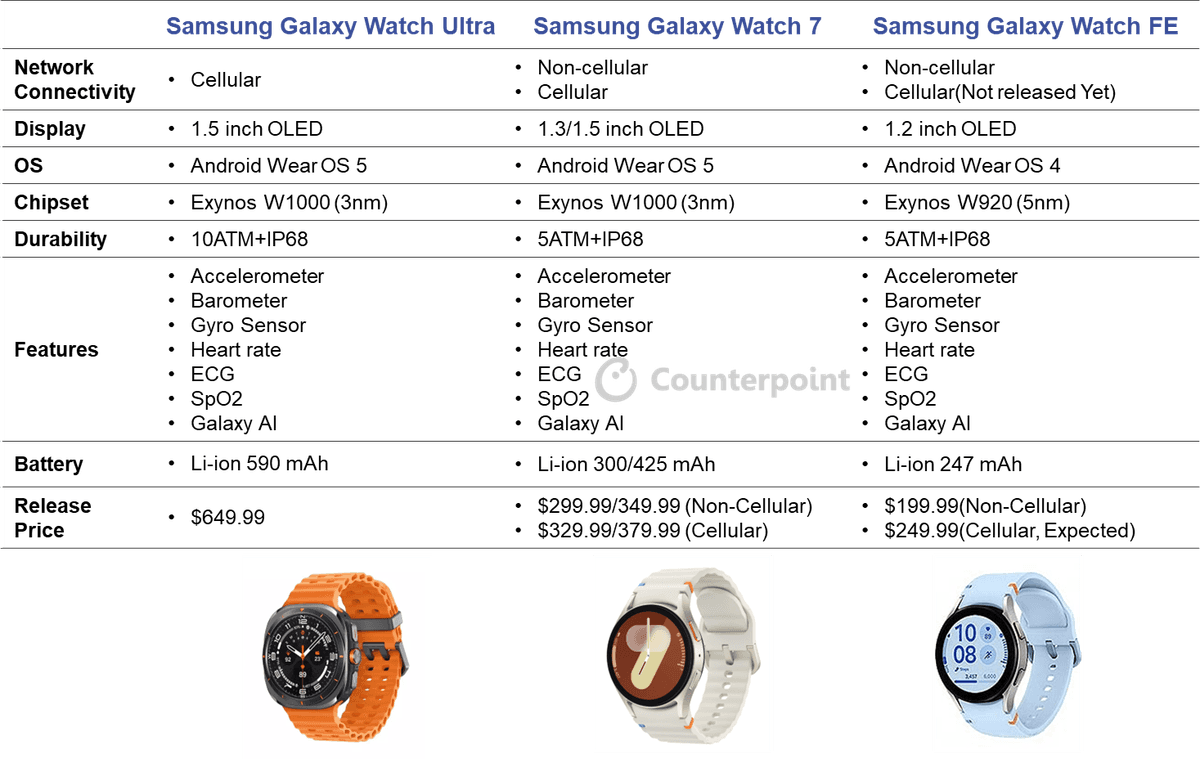
Samsung’s Galaxy Watch 7 features significantly improved specifications compared to the previous iteration. The new lineup boasts better battery capacity and usage time, and is equipped with the Exynos W1000 wearable chipset, the first wearable chipset to utilize the 3nm process.
Perhaps the most remarkable aspect of Samsung's new smartwatch collection is the Galaxy AI, which has been driving the GenAI craze on smartphones. The freshly adopted Galaxy AI feature can analyze health indicators and remember users' habits based on personal health data obtained from the devices. The feature is expected to provide a more systematic approach to predicting and diagnosing future health conditions. Additionally, it can also present new directions in various fields such as medical care and sports. Galaxy AI’s other functions include translation, text conversion assist, text summarization and automatic generation of customized text messages directly on the smartwatch.
Table 1: Specifications Comparison of Samsung's New Smartwatch Lineup
 Source: Samsung
The newly added Galaxy Watch Ultra is priced at $649.99, which is 1.5x higher than the Galaxy Watch 6 Classic, one of the more expensive models in last year’s lineup. Meanwhile, the release price of the Galaxy Watch 7 base model remains almost similar to last year’s iteration, despite its upgraded specifications surpassing those of the Galaxy Watch 6 Classic.
The Galaxy Watch Ultra’s price point does not overlap with the Classic (or Pro) as this is Samsung’s first time introducing this price point. However, this does not completely replace the Classic (or Pro), and we cannot rule out the possibility that the Ultra will be released simultaneously with the Classic (or Pro) smartwatch in the future. If that happens, the Galaxy Watch lineup will consist of four tiers – FE, Basic, Classic (or Pro) and Ultra. The Galaxy Watch FE, which was released for the first time in June this year, has become the entry-level option in the Galaxy Watch series, with the launch price set at $199 for non-cellular models.
Samsung has been diversifying its smartwatch lineup like most major smartwatch OEMs. For example, Huawei and its various types of smartwatches. Alongside basic smartwatches that perform only simple functions, Huawei is also launching HLOS smartwatches like the Huawei Watch GT 4, which support third-party apps. Huawei also offers kids smartwatches specifically designed for children, such as the Huawei Children Watch 5.
Apple has also recently shown a pattern of segmenting its lineup. Apple introduced its entry-level first-generation Apple Watch SE in 2020, about five years after it first began selling the Apple Watch. In 2022, Apple recorded its highest-ever annual shipment helped by the high-end Apple Watch Ultra and the second generation Apple Watch SE, which were both launched during the same year. Apple achieved this result despite an 8% decline in Apple Watch S8 shipments compared to its predecessor.
 Picture 1: Apple, Samsung, Huawei’s HLOS Smartwatch Lineup
* Note: The most recently released models for each lineup are listed, with the price indicating the release price.
Samsung, having newly established both an entry-level and high-end lineup this year, is also expected to see a rebound in both shipments and revenue. The Galaxy Watch FE appears to be highly appealing to consumers in emerging countries who have been using low-end smartwatches thus far, as it allows them to experience the latest market technology like Galaxy AI through products from Samsung's high-end brand within their budget. This will enable more people to enter the Galaxy ecosystem.
The launch of the Galaxy Watch Ultra is expected to provide Android smartphone users with a viable alternative to Garmin, especially in the high-end smartwatch market priced over $500. In 2023, revenue of high-end (>$500) smartwatch market accounted for 27% of total smartwatch revenue. The Galaxy Watch Ultra is expected to help Samsung increase its smartwatch revenue in 2024, potentially displacing some of the current market leaders.
The diversification of smartwatch lineups is expected to manifest in various directions throughout the market in the future. For example, HLOS smartwatch brands are likely to segment into affordable premium, premium and ultra-premium categories. In contrast, low-cost smartwatch brands, represented by local Indian brands, are expected to strive to even encroach on the remaining smart band and fitness tracker markets by organizing their own lineups toward ultra-low, low and mid-low without entering the high-end (>$500) market.


