

Till 2019, Samsung had too many smartphone models in the mid-to-low tier price bands. The complicated list of models often left consumers confused. However, the brand fixed it in Q1 2019 after it simplified and consolidated its lineup under the new Galaxy A series. This new line of models incorporated the previous A series, the J series, On series and the C series. To further distinguish it from the previous A series, the new lineup used a two-digit number in the nomenclature, for example, the A30 and the A50. But was this lineup rejig successful? The answer is an overwhelming yes given the response that the new A series has received from the market since its launch.
Sales growth of New Galaxy A series
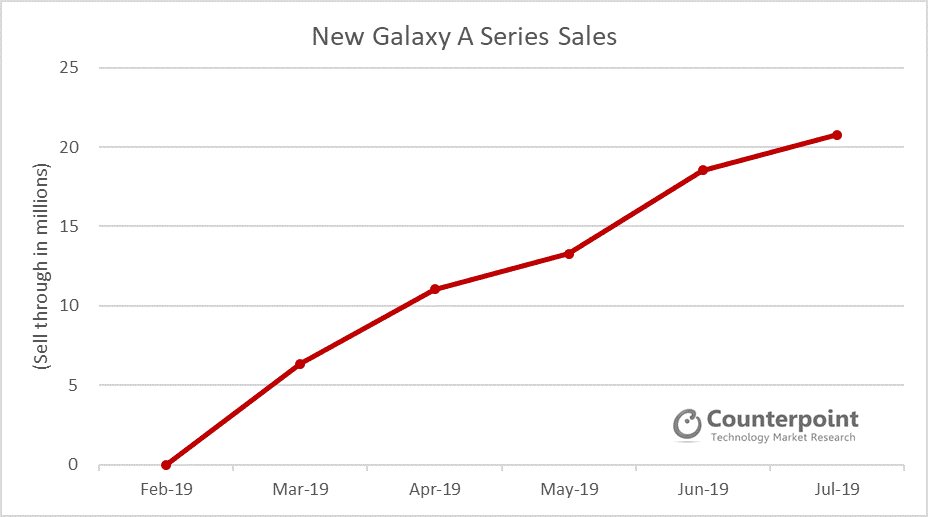
Starting with the Galaxy A10 in March 2019, Samsung has released a new model under the A series every month. With this, the new A series accounted for 56% of Samsung’s smartphone sales in Q2 2019. Exhibit 1 shows how the relentless push through new model launches has helped the A series maintain growth momentum.
Exhibit 1: New Galaxy A Series Sales
Global trend: Low-end Trade Up to Mid-low tier
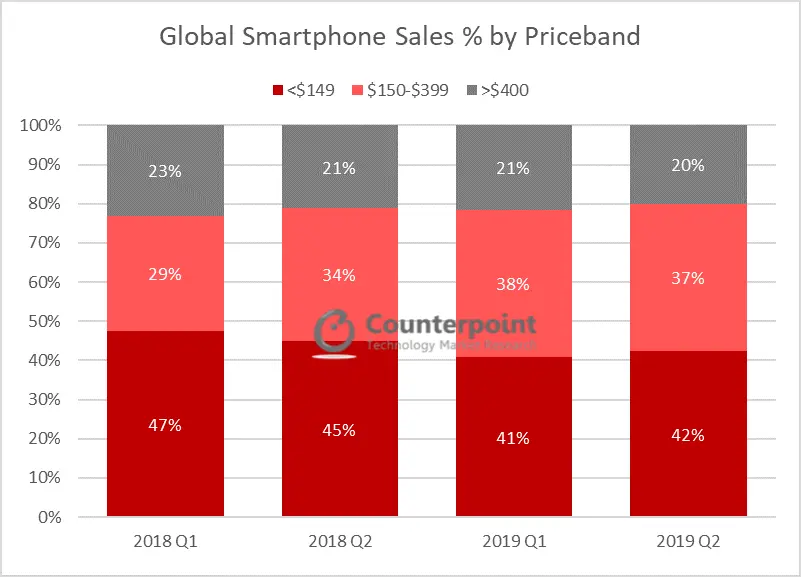
The global smartphone market price trends over the past year show that the premium tier, above US$400 (wholesale price), is stagnating while the low-end, below US$150, is in fact decreasing. Growth can be seen in the mid-to-low tier price bands, US$150-US$300. This can be attributed to the trend of new users coming from feature phones to smartphones preferring to trade-up, wherein consumers first use an entry-level smartphone for one-two years and quickly replace it with a smartphone priced between US$100-US$120.
Xiaomi's rebound and success, in 2017 and 2018, was due to this trend. Now, It seems as if the trade-up trend has shifted to the US$150-US$250 price band (all in terms of wholesale prices).
Taking share from HONOR's US$200-US$299 price band
In May 2019, the US’ trade ban on Huawei, affected its global smartphone sales. In particular, regions like Europe were severely affected. HONOR products, mainly in the US$180-US$249 price band, accounted for a large portion of sales outside of China, dropped significantly. Samsung's new A series effectively took advantage and boosted sales volumes. It was possible because Samsung had a product portfolio that closely matched the target price range of HONOR’s mid-to-low price lineup. In some cases, the value for money proposition was so high that making the switch was quite logical for the practical user.

To sum up, the successful debut of the Samsung Galaxy A Series was because of three key reasons:
- Strategically targeting mid-to-low tier price bands, which aligned with the global consumer trade-up trend
- Effectively replacing a strong competitor in crisis, Huawei’s HONOR brand.
- Excellent value for money proposition with features such as OLED displays and triple cameras
We expect the sales share of Samsung’s A series to expand with the launch of additional models such as the A90 in H2 2019. In particular, the A90 will be the first model to support 5G in mid-tier smartphones and is likely to receive lots of interest from users. Thus, while Samsung’s comeback in the market happened amid the crisis of Huawei, the new A series has turned out to be an effective weapon to take share from its Android competitors.
