

- NVIDIA has announced NVIDIA DRIVE AGX Hyperion 10 as a reference compute and sensor architecture that enables automakers and developers to build Level 4 vehicles for consumers and as robotaxi fleets.
- The company announced it is teaming up with automotive OEMs and ecosystem player Uber to deploy 100,000 robotaxis starting in 2027.
- NVIDIA DRIVE supports the use of third-party AD software stacks from the likes of Avride, May Mobility, Momenta, Nuro, Pony.ai, Wayve and WeRide.
At the October 2025 GTC event in Washington, D.C., NVIDIA unveiled Hyperion 10 as a reference compute and sensor architecture that can be adopted for Level 4 autonomous vehicles. It has also announced several major ecosystem partnerships, both with major OEMs and Uber for robotaxi vehicles. NVIDIA hopes to gather millions of on-road miles from robotaxi deployments to feed into the development and validation of its Level 4 solution. As such, NVIDIA is pivoting from one-off stack relationships to a more standardized, safe and validated platform that can widen its appeal to more OEMs, Tier 1 suppliers, and robotaxi operators.
DRIVE AGX Hyperion 10 – Reference Level 4 Platform
NVIDIA describes the DRIVE AGX Hyperion 10 as a reference production compute and sensor suite architecture. The architecture bundles the DRIVE AGX Thor system-on-chip (SoC) with NVIDIA DRIVE OS operating system and a validated multi-modal sensor suite. This enables automakers to shorten time-to-market and reduce integration risk by using a validated hardware, OS, and sensor suite. Historically, automakers’ autonomous vehicle projects have used discrete compute, OS and sensors that complicate the integration and require repeated validation. NVIDIA aims for this architecture to become a blueprint for automakers and system integrators, helping them accelerate the development and deployment of Level 4 autonomous vehicles, which NVIDIA CEO Jensen Huang, earlier this year at CES 2025, called a “multi-trillion-dollar industry”.
There are three components to the Hyperion 10 architecture:
Compute: The DRIVE AGX Hyperion 10 is built around the NVIDIA Drive AGX platform and uses two DRIVE AGX Thor SoCs, each delivering more than 2,000 TOPS. The SoCs provide high performance and are automotive safety certified and designed to meet cybersecurity standards. NVIDIA has optimized them for 360-degree sensor inputs and transformer, vision-language-action (VLA) models and generative AI workloads.
Software: The platform is built with DRIVE OS operating system, DRIVE AV software stack, NVIDIA’s simulation and validation toolchain, and NVIDIA’s Halos system safety integration. However, NVIDIA has stressed that its platform can host third-party autonomous driving software from either the OEM or other ecosystem companies, such as Momenta, Wayve and Pony.ai.
Sensors: The reference platform features a pre-qualified and validated multi-modal sensor suite that includes 14 high-definition cameras, 9 radars, 1 LiDAR and 12 ultrasonic sensors, which the OEMs can adopt or adapt. The sensors match a DRIVE AGX reference board and come with placement guidance, enabling speedy adoption and deployment by automakers.
These three validated components of the platform can save considerable time, which otherwise would be required for qualification and safety verifications.

NVIDIA Level 4 Ecosystem Extension and Robotaxi Partnership
NVIDIA and ride-hailing leader Uber have joined forces to scale up Level 4 robotaxi fleet deployments. This partnership will deploy DRIVE AGX Hyperion 10 platform-ready autonomous vehicles. The aim is to deploy as many as 100,000 such vehicles under Uber starting from 2027.
The key elements of this major effort in the Level 4 autonomy and robotaxi space include:
- Uber-NVIDIA partnership: Uber will run operations for the NVIDIA DRIVE AGX Hyperion 10-ready autonomous vehicles, which it will purchase from OEMs. The company will make those vehicles available on its platform, which will have a mix of human drivers and robotaxis. NVIDIA will support the hardware — compute, sensors and data pipelines, which will be supported by models trained on NVIDIA’s Cosmos platform for AV model simulation, accelerating development. Together, they plan to scale up to 100,000 robotaxis starting from 2027, demonstrating the wide ambition and scale of the deployment.
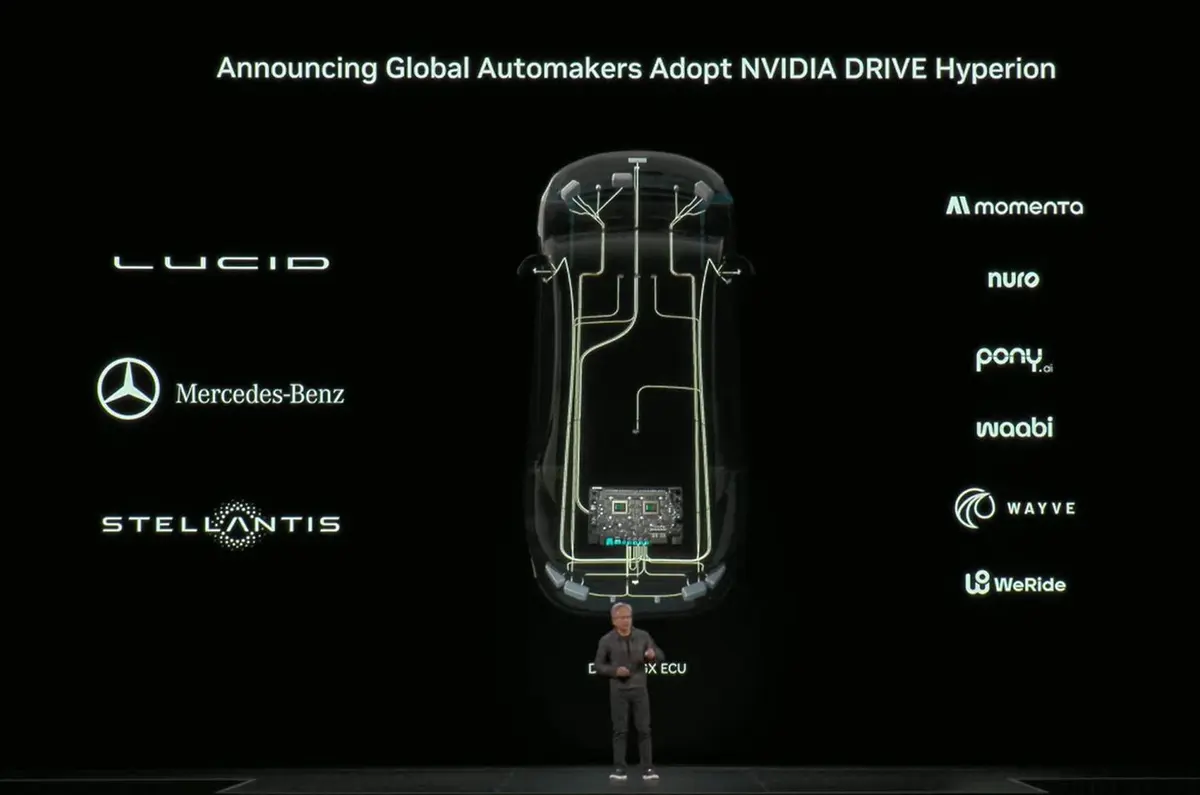
- Ecosystem: NVIDIA announced that automotive OEMs Stellantis, Mercedes-Benz and Lucid will use the DRIVE AGX Hyperion platform.
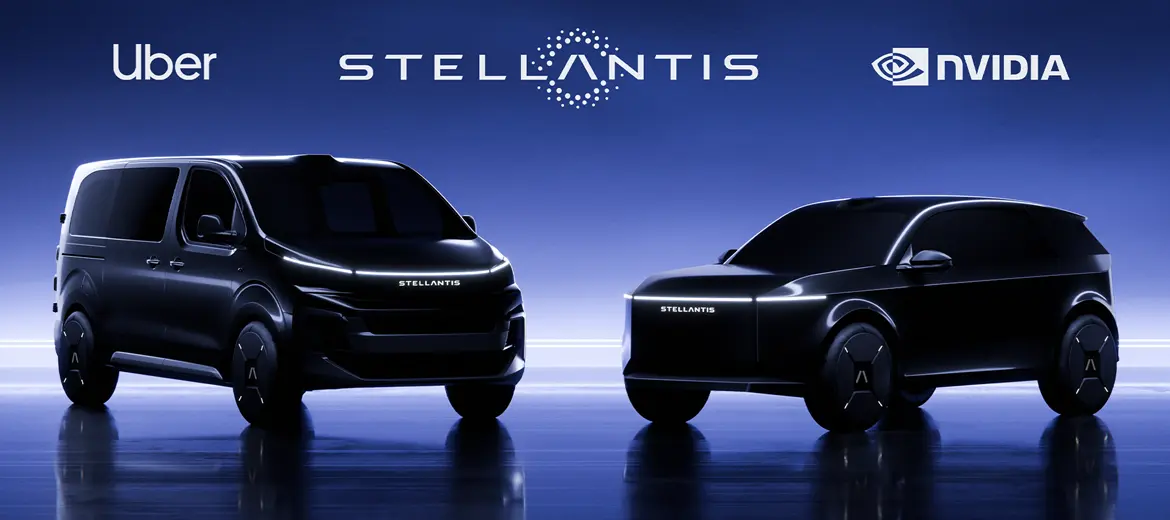
- Stellantis is already developing Level 4 autonomous vehicles to meet robotaxi requirements and will now integrate NVIDIA’s DRIVE AGX Hyperion 10 in these vehicles. Stellantis has also signed an MoU with Uber and Foxconn to develop robotaxis, with Stellantis bringing vehicle design, engineering and manufacturing, Foxconn bringing electronics and system integration, and Uber bringing operational know-how for deployment of robotaxis. Stellantis will start with delivering 5,000 autonomous vehicles for initial deployment in the US starting in 2028. These vehicles will be based on its K0 medium-size van and STLA small platform, which will integrate NVIDIA DRIVE AV software and run on the NVIDIA DRIVE AGX Hyperion 10 architecture, including DRIVE OS.
- Mercedes-Benz is already using NVIDIA DRIVE AGX Hyperion in its models with its own proprietary MB.OS software stack. The new S-class, when launched, is expected to offer a Level 4 autonomous driving configuration and will utilize NVIDIA’s Hyperion 10 platform.
- Lucid is also advancing its Level 4 autonomous vehicle efforts by using NVIDIA’s full AV software stack and DRIVE Hyperion platform for its forthcoming model launches.
- NVIDIA has opened its platform to AD software stack providers such as Avride, May Mobility, Momenta, Nuro, Pony.ai, Wayve and WeRide, enabling them to incorporate their software in the application layer, providing automakers and robotaxi operators the freedom to choose the right partner and solution suited to their ambitions
NVIDIA’s Core Enablers for Level 4 Autonomy
Foundation Models and Data Layers: NVIDIA has trained its AI models on trillions of real-world and synthetic miles, enabling the models to navigate complex urban driving with humanlike reasoning. It also has a vision-language-action (VLA) model that combines visual understanding and natural language and action generation. VLA models enable autonomous vehicles to interpret nuanced and unpredictable real-world driving encounters, such as sudden changes in traffic patterns or unpredictable behavior of other humans (and their vehicles) on roads. Fortellix is collaborating with NVIDIA to incorporate its Physical AI toolchain with NVIDIA DRIVE to help test and validate the VLA models, a challenging area for automakers and regulators alike. NVIDIA is also making available what it terms as the “world’s largest multimodal dataset”, consisting of 1,700 hours of real-world multi-sensor data (from cameras, radar, and LiDAR sensors) from 25 countries to help validate autonomous driving foundation models.
Safety and Certification: NVIDIA Halos covers the full development lifecycle and has guardrails for design time, deployment time and validation time, enabling the building of safety and explainability into AI-based AV stacks. The standardisation of inspection and certification processes for physical AI systems, including sensors, boards and software stacks for autonomous vehicles, is done through the new NVIDIA Halos certified program overseen by Halos AI System Inspection Lab, which has been set up to ensure products and systems meet rigorous criteria for physical AI deployments with an aim to accelerate safe and large-scale deployment of Level 4 automated vehicles. AUMOVIO, Bosch, Nuro and Wayve are inaugural members of the NVIDIA Halos AI System Inspection Lab
AI data factory: NVIDIA has an existing partnership with Uber where it has developed a robotaxi data factory powered by NVIDIA Cosmos, a platform for physical AI. Uber contributes through its more than 3 million hours of robotaxi-specific driving data that can help train and validate the L4 model. NVIDIA, through its GPUs, Cosmos physical AI platform, and tools for data curation, search and simulation, enables improvement of autonomy stacks. The combined forces enable shortening of the model iteration cycle and speeding up autonomy deployment.
Analyst Takes
• The launch of NVIDIA DRIVE Hyperion 10 architecture is a smart move by NVIDIA, which is aiming to provide a standardized and shared reference for Level 4 autonomous vehicles, with the aim of attracting adoption by both automotive OEMs and robotaxi fleet operators. While on one hand scaling can help in improving the autonomous vehicle supply chain economics for sensors, compute boards and software application stacks, it also enables NVIDIA to remain at the centre stage of the increased Level 4 autonomous vehicle deployments through its SoC, NVIDIA DRIVE OS, NVIDIA DRIVE software stack and also through its simulation and validation toolchain and NVIDIA Halos system safety integration. NVIDIA, with this launch, has positioned itself as a key enabler for Level 4 autonomy and hopes this early access and deployment puts it in a leadership position as the market and adoption of L4 autonomous vehicles increase.
• Uber’s ambitious target of deploying 100,000 robotaxis from automakers using the NVIDIA DRIVE Hyperion 10 architecture signals NVIDIA’s push to accelerate and expand Level 4 autonomous vehicle deployment. Uber will manage the robotaxi fleet and procure autonomous vehicles from NVIDIA’s OEM partners like Stellantis. This arrangement leaves NVIDIA to focus on its core competence and deliver the best Level 4 autonomous vehicle solution that can be standardized both for personal use vehicles and robotaxis. This partnership and collaborative approach, where each player contributes its strengths, contrasts starkly with the higher investment and resources needed in approaches adopted by existing robotaxi players. Companies like Waymo, Baidu Apollo, WeRide, Pony.AI and Tesla have the additional responsibilities of vehicle development or retrofitting their AV solutions to existing non-Level 4 vehicles. Some players also manage the operations of their robotaxi fleets. While NVIDIA is not a robotaxi company, the faster development of technology through real-world deployment, as well as growth in the supply of NVIDIA DRIVE AGX Thor SoCs and vehicles using NVIDIA’s Hyperion 10 architecture, will in the near-to-medium term be assured net positive in revenues and profitability for the company, even as the robotaxi players will take longer to make positive margins through their fleet deployments.
• SoC competitors are focused on the L2+ market, which is expected to remain the mainstay over the next 10 years. NVIDIA also supplies L2+ solutions and has a significant share of that market. However, by kickstarting wider Level 4 adoption across automotive OEMs and robotaxi fleet operators, NVIDIA is certainly pushing for earlier adoption of autonomous vehicles. The wider deployment of robotaxis will impact overall vehicle sales volumes, as robotaxis hold the promise of being a more cost-effective means of transportation. If NVIDIA and other robotaxi players are successful with the deployments, it will impact the total addressable market for competitors and NVIDIA alike for lower levels of ADAS and autonomous vehicles (Level 3 and below). Also, Level 3 as a step may be skipped completely due to consumer preferences for a fully autonomous vehicle at a marginal cost increment.
