

Key takeaways:
-
The interconnect market is in the midst of far-reaching changes. Not only are developers ramping up performance, they are developing new form factors and adapting to new materials.
-
Keep a close eye on many of the emerging standards battles: XPO vs. CPX vs USFP, MicroLED vs MicroVCSEL and copper vs. optical vs. dielectrics
-
New products optimized for scale-across are also beginning to emerge.
1. 400G/lane Optics: Far More Than a Speed Bump
400G/lane networking will come to market in a number of vehicles: co-packaged optics (CPO), near-packaged optics (NPO), the new ultra dense small form factor pluggable modules (USFP), XPO modules, active light cables (ALCs) and more.
The other common characteristic is that most of these vehicles will be different from technology on the market today. USFP, XPO and Open CPX are all new and evolving standards. Only samples and prototypes exist today. (A Cisco representative confessed the company, a sponsor of USFP, didn’t even have a prototype at the booth, but there was an Nvidia rep walking around with one in his coat pocket.) Module makers such as Genuine electronics will develop silicon photonics/thin film lithium niobate modulators, for 3.2T/400G modules, a first.
ALCs, for their part, will debut next year as a new product category. These initial products will also ignite a debate between using MicroLEDs or MicroVCSELs for these devices.(For an in-depth view of the MicroLED/MicroVCSEL competition, go to the Optics, Interconnects and Networking Monthly Supply Chain and Market Pulse Index.)
Taking all of these considerations together, it becomes clear that the shift to 400G/lane will likely be more complicated and difficult than most transitions. It will also impact the design of switches and downstream equipment as well.
Which of these vehicles will win? CPO and NPO in most estimations will constitute the largest segment by 2030. In terms of modules, XPO proponents note that 175 companies have joined its MSA. Multiple companies including Foxconn Interconnect Technologies and Terahop displayed working modules while Microsoft made positive comments about the form factor. Meanwhile, MicroVCSEL and MicroLED will likely enter an edgy coexistence with MicroVCSEL holding an edge in longer distances and MicroLED finding favor in memory fabrics and short-reach scale-in distances.
It may only be toward the end of the 400G/lane era when winners can be chosen.
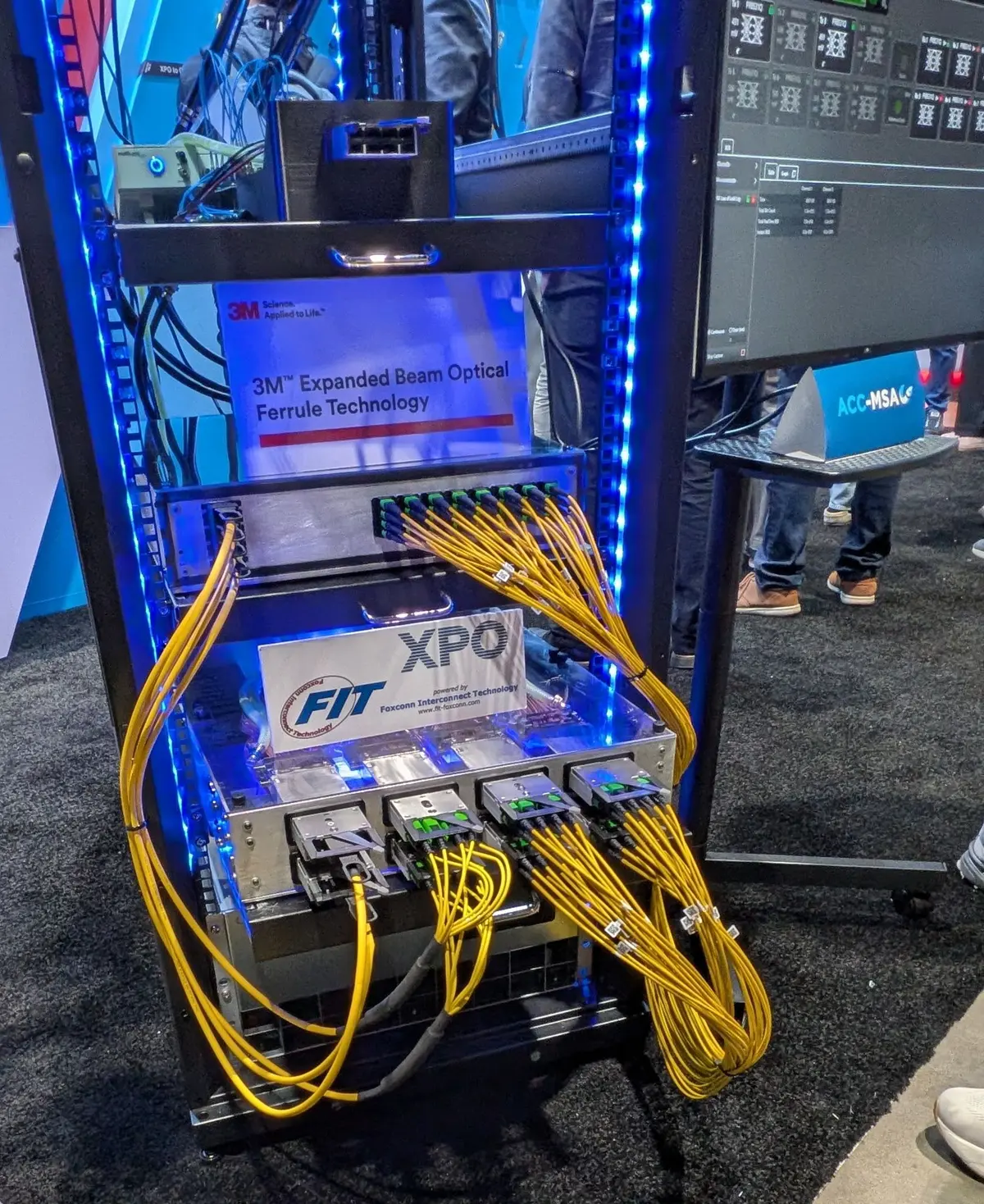
FIT’s XPO modules in action. The 12.8 Tbps/sec modules can be configured in multiple ways: with DSPs, as DSP-less LPO modules or with integrated or external lasers. The power ceiling for the form factor is 500 watts.
2. Cables: Evolving with the Times
In a similar vein, copper interconnects are undergoing substantial changes. Copper-based active electrical cables will shift from PAM4 modulation to PAM6, another first. (PAM 6 cables, in fact, are further along in development.) Luxshare, TE Connectivity and others also highlighted new interfaces for co-packaged copper
Volumes, notes Amphenol, remain strong. The company noted it ships 40 million differential pairs a day. Not even 40 million 800G and 1.6T modules ship in a year.
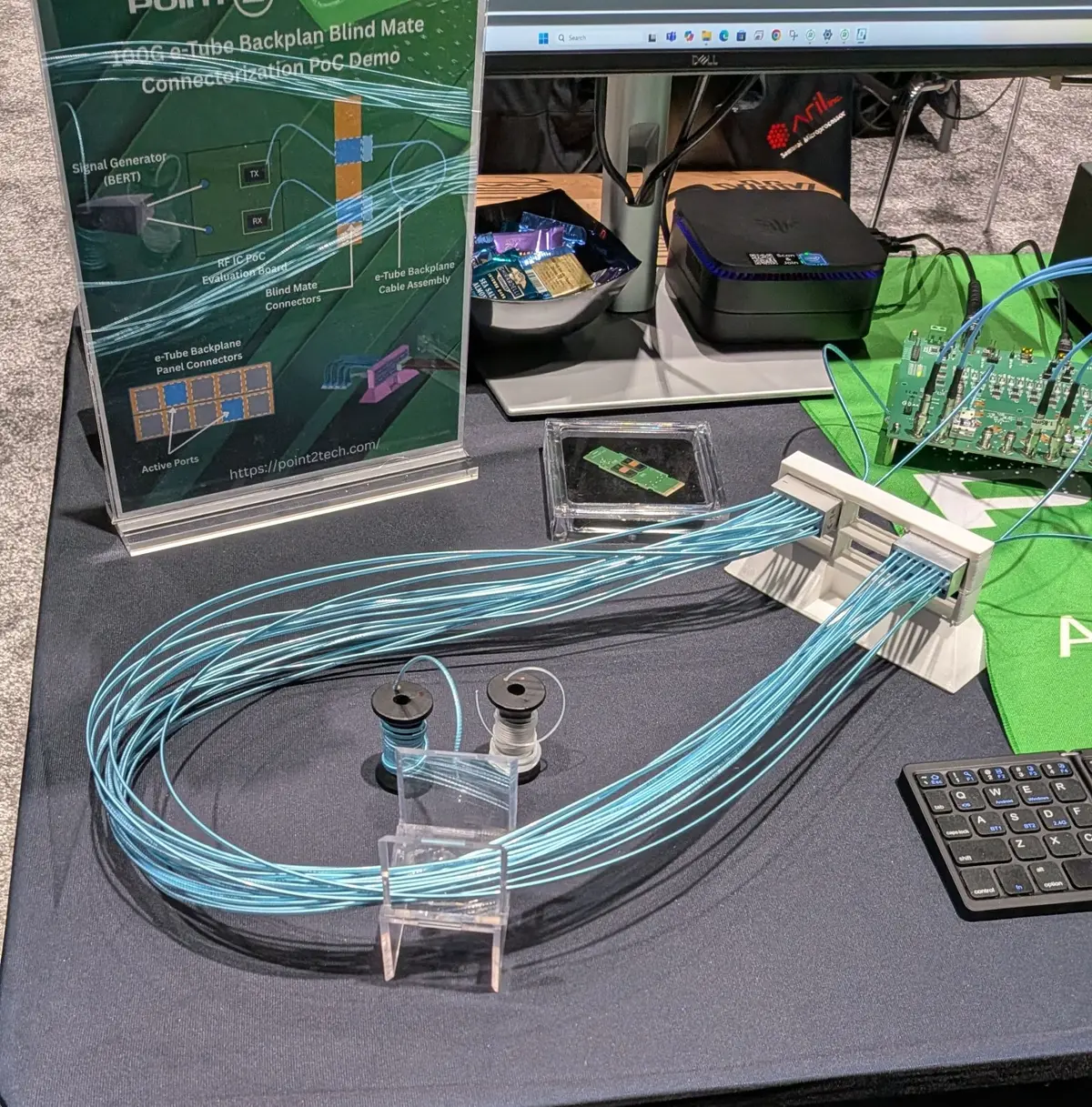
Point2, among others, are also developing alternatives that provide the simplicity and efficiency of copper with a longer, optical-like reach. These devices (below) rely on dielectric wave guides made from plastic and other materials. While relatively new and untested, a small, but growing, number of customers are testing the market.
3. The Ecosystem Rack Gains Momentum
The rack is the new unit of computing in AI and for a wide swath of vendors, that can be an ominous prospect: a design miss with a hyperscaler or major CPU vendor can dramatically change the future outlook.
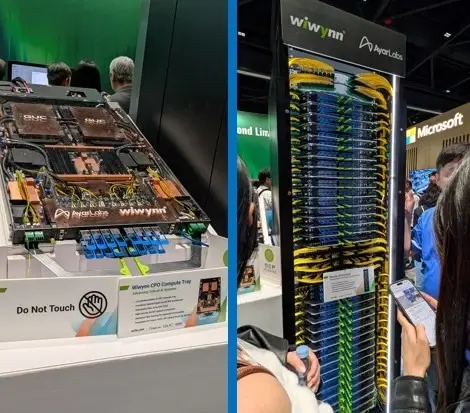
As a result, semiconductor makers, ODMs, equipment vendors and others are striking new alliances, joining MSAs and reaching out to co-location providers and large enterprises interested in in-house interference in an effort to broaden the customer base. Optical networking specialist Ayar Labs highlighted its alliance with Wiwynn and GUC in rack system development. Rebellions outlined a similar strategy at AI Infra earlier this year. If history is any guide, the heterogeneous rack will gain momentum especially as more customers enter the market.
4. Scale-Across Slowly Begins to Differentiate from DCI.
Are scale-across networks (for distributed AI infrastructure) and data center interconnects (for distributed cloud and AI infrastructure.) the same thing? For now, largely yes, admits Tom Williams of Acacia/Cisco, but changes to optimize technology for AI are already underway.
Acacia and Ciena both showcased multi-rail optical line systems which effectively enable data center operators to deliver 4x more capacity for a 75% reduction in power and 80% reduction in space. (See Ciena’s scale-across multi-rail system below). In the future, a typical scale across network might require 20 Pb/sec over hundreds of fiber pairs, noted Frank Chang of Ciena. Telecommunications providers could utilize these systems, but don’t necessarily need them yet. 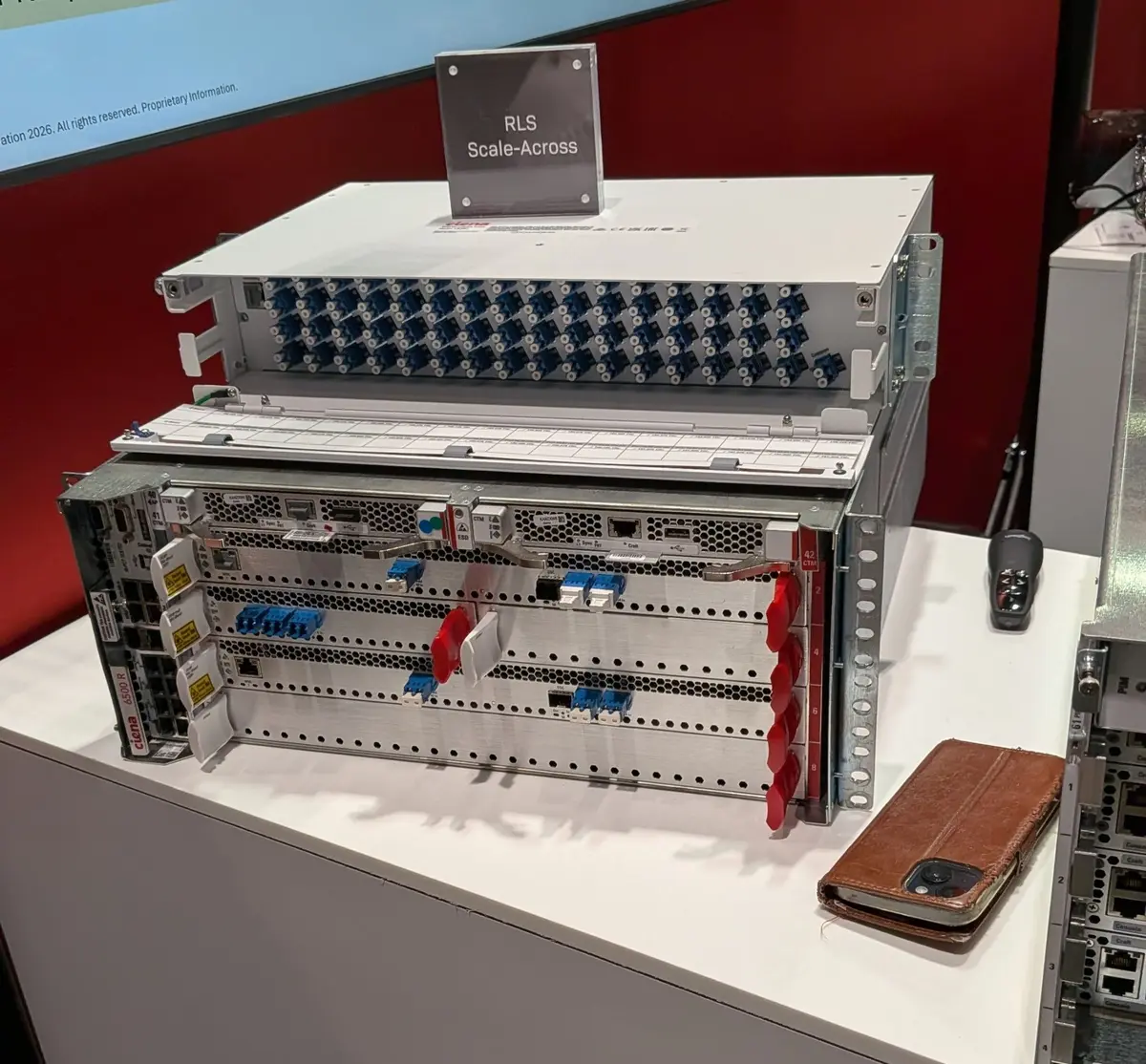
The semiconductor and modules for pluggables are on the way. The biggest change comes with the introduction of thin film lithium niobate (TFLN) modulators for better efficiency and bandwidth. Marvell says it will sample 1.6T TFLN modules for scale-across in Q1 2027.
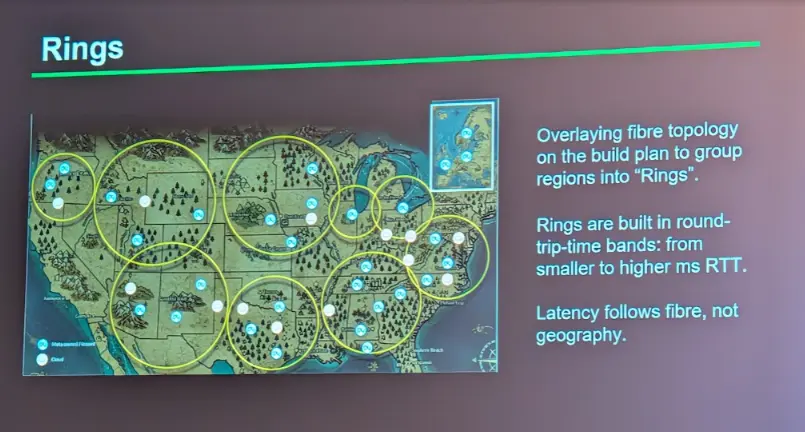
Meta, meanwhile, provided a glimpse into the architecture of scale-across networks with Rings in which computing domains are grouped geographically, i.e. storage is largely concentrated in a particular region while compute might be in another, to improve overall efficiency.
5. Fiber Management Gets More Focus
High-bandwidth scale-up networking is dramatically increasing the challenges of fiber management. Testing companies such as multiLANE argue that passive assembly will be instrumental in accelerating throughput to meet demand and achieving higher yields.
On the floor, new tray designs containing thousands of fibers—often developed in conjunction with connector experts like SENKO and Samtec—were pervasive.
Meanwhile, Corning discussed how its PRIZM TMT enables precise alignment through microlenses to reduce deployment time by up to 89% while improving density by 3x or more. More on this technology in a future article.
Analyst Take:
-
The extensive experimentation today will lead to far-ranging changes in underlying technology for interconnects by the end of the decade.
-
CPO and NPO adoption are inevitable, but they will co-exist with other technologies especially as the customer base expands beyond hyperscalers to large enterprises.
-
Expect to see collaboration between multiple companies. Optics truly is a team sport.
-
To get more on the changes in networking, including profiles of emerging companies such as Eliyan, Eridu and Avicena, go to the Optics, Interconnects and Networking Monthly Supply Chain and Market Pulse Index.