

- At Meta Connect 2025, Meta unveiled its next-generation AI glasses, including Ray-Ban Meta Glasses (Gen 2), Oakley Meta Vanguard, and Meta Ray-Ban Display with the Meta Neural Band.
- Ray-Ban Meta Glasses (Gen 2) represent a standard upgrade in Meta’s smart glasses product line, with improved battery life and photography performance, while Oakley Meta Vanguard glasses mark an expansion into the professional sports sector.
- The Meta Ray-Ban Display, powered by an LCoS light engine and geometric waveguide lens, is Meta’s first AI glasses with a high-definition display. Paired with the neural wristband, it was the highlight of the launch event, offering a prime example of the added benefits of AR smart glasses to justify the premium pricing.
- Although Meta did not introduce new VR/MR headsets at the event, advancements in the Horizon platform, including Meta Horizon Engine & Studio, Hyperscape Capture, and the new entertainment hub Meta Horizon TV, are expected to energize the XR content and developer ecosystem and enhance Meta’s competitiveness in the coming years.
Meta missed the smartphone revolution and has been playing catch-up ever since. However, the company believes that the next device to shape the world beyond smartphones will be some form of eXtended Reality (XR) device. Meta’s XR journey began with the acquisition of Oculus in 2014, leading to the successful Quest line of virtual reality (VR) headsets. These products have also driven the development of metaverse tools, including its Horizon line of virtual worlds.
Its second strategic approach has been a line of eyewear, best exemplified by the Ray-Ban Meta AI Glasses that have not hitherto offered any visual augmentation but have included cameras, microphones and loudspeakers and the ability to interact with Meta’s AI assistant.
In 2024, Meta showcased a prototype augmented reality (AR) glasses called Oryon, featuring silicon carbide–based waveguides for see-through displays. The company also introduced a neural wristband as a human-machine interface for interacting with content on the glasses.
At Meta Connect 2025, held on September 17-18 in Menlo Park, California, Meta revealed several new products, development tools and content partnerships. These announcements signal a major leap forward for the broader smart glasses and XR industry, which has experienced stagnation but now appears poised for a sharp upward inflection in both volume growth and strategic importance.
Is the smartphone under threat yet? Absolutely not, but what Meta announced shapes the path forward to a much more multi-device environment in the foreseeable future.
AI Glasses: Product Launches and Vision
Strategic Positioning of Glasses
Meta is positioning its glasses as the ideal form factor to interact with personal superintelligence – offering effortless access to AI, enabling people to remain present in the moment, enhancing communication, memory, and senses.
Meta stresses key design values that have always been a challenge with AR glasses to this point:
- Comfort: Glasses must be comfortable, aesthetically refined, and practical as daily wear.
- Invisible technology: The technology should be transparent – both to the wearer and people they are interacting with.
- Human-centric AI: AI should empower users and remain user-facing, not just a tool for automation.
Product Announcements
Ray-Ban Meta (Gen 2): Meta has refreshed the design of its hit Ray-Ban Meta AI Glasses which has sold over 3 million units since their launch in September 2023.
- The revised designs are sleeker and available in new colors, offering double the battery life, 3K video recording, and improved resolution and smoothness.
- Meta is also introducing practical and pragmatic software features including “Conversation Focus” that amplifies companions’ voices in noisy environments. Hearing aid manufacturers have offered this capability for years, and EssilorLuxottica has launched its own line of FDA-approved hearing glasses, Nuance Audio. Apple has added a similar feature to AirPods but wearing AirPods while conversing can come across as rude.
- Conversation Focus will be backported via a software update to existing AI glass models.
- Qualcomm Snapdragon AR1 Gen1 will remain the chipset supplier for the new edition.
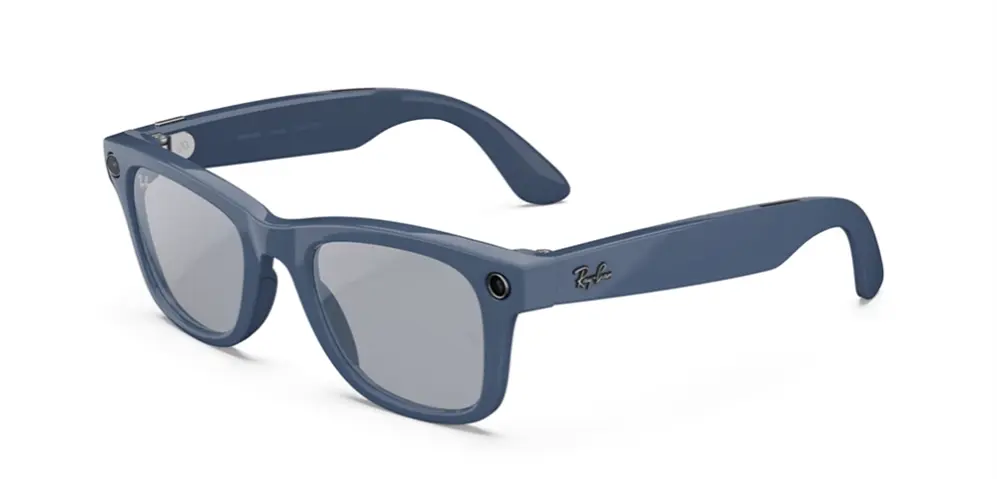
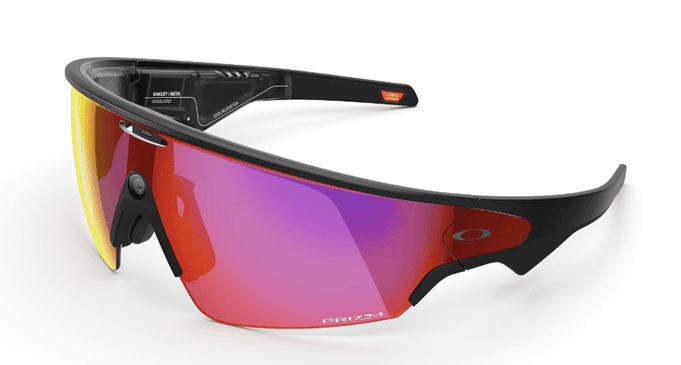
Oakley Meta Vanguard: This marks a significant expansion of Meta’s smart glasses lineup. Meta introduced the Oakley Meta HSTN glasses in June 2025, offering improved battery life and camera performance over the original Ray-Ban Meta glasses. The new Oakley Meta Vanguard line builds on this, combining performance with the iconic Oakley design aesthetic. These glasses are explicitly designed for sports and adventure, featuring an extended battery life of up to 9 hours (enough for two marathons on a single charge), a centralized 122-degree field-of-view camera, robust wind-noise-canceling microphones, IP67-rated sweat, dust, and water resistance, and video image stabilization.
- This means these glasses could become direct competitors to sports cameras from OEMs such as GoPro, DJI, and Insta360. Moreover, at a $499 price point, the Oakley Meta Vanguard glasses are within an acceptable price premium compared with those cameras while being better suited for athletes – offering a convenient first-person perspective for shooting and a wider range of functions tailored to sports scenarios.
- Additionally, the Meta Oakley Vanguard glasses integrate with Garmin smartwatches and cycling computers to provide users with real-time insights and alerts on their performance. Meta and Garmin also developed a new auto-capture feature that automatically records footage based on workout stats and milestones. Users can easily overlay performance metrics from Garmin devices or Strava onto the videos and photos they capture. The glasses also feature a peripheral LED to indicate whether users are on target for metrics such as pace or heart rate zones, along with swappable lenses for added versatility.
- These glasses are also based on Qualcomm’s Snapdragon AR1 Gen1.
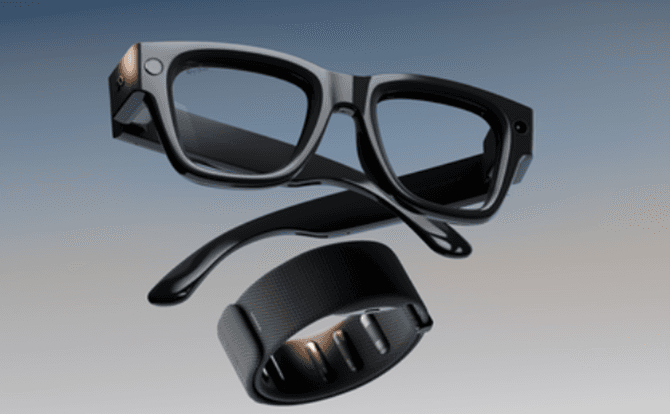
Meta Ray-Ban Display and Meta Neural Band:
This was the event’s biggest announcement, signaling the shift from AI smart glasses to ‘AI+AR’ smart glasses.
- The Meta Ray-Ban Display is Meta’s first AI glasses with a high-resolution display (42 PPD, up to 5,000-nit brightness), designed for single-eye, off-center, non-distracting overlays. While the field of view is narrow at 20°, the image is sharper than the mainstream Mixed Reality (MR) headsets. Meta opted for an LCoS component instead of the expensive MicroLED light engine that was demonstrated with Orion.
- The display is projected through a geometric waveguide, a technology that does not waste as much light as the diffractive waveguides found in other consumer AR glasses. Although there are some visible facets on the side of the lens, the waveguide exhibits almost no light leakage (eye glow) or rainbow effect, ensuring a natural look when using the display.
- Meta Neural Band: A wearable wristband with a neural interface (surface electromyography, or sEMG) for subtle, nearly silent control, replacing physical buttons. It offers an 18-hour battery life and is water-resistant. Users can interact with the glasses’ UI through the wristband and even reply to messages by handwriting gestures. This provides a significantly more convenient interaction method compared with most waveguide-based AR glasses, which still rely on touchpads or voice control.
- Meta showcased live demos of messaging, media control, and real-world translation/subtitling. While some demo glitches affected performance, enough functionality was working to make it appear convincing and usable.
- The charging case also has an innovative design that allows it to fold almost flat when the glasses are being worn, enabling it to beslip into a pocket.
- Vision correction, to a degree, is possible – Meta mentions a range of -4 to +4 diopters – though support for astigmatism or varifocal lenses is unclear. The lenses are standard transition lenses that remain clear indoors and darken in bright sunlight, ensuring the display is visible at all times.
Pricing and Availability:
Ray-Ban Meta (Gen 2): starting from $379; Oakley Meta Vanguard: $499 (preorder, ships October 21); Meta Ray-Ban Display with Meta Neural Band: $799, available from September 30.
The Meta Ray-Ban Display glasses require fitting and will initially be available at a limited number of US brick-and-mortar stores only, followed by Verizon as the first carrier to offer them. International availability, including Canada, the UK, France, and Italy, is planned for 2026.
Analyst take
- While the Ray-Ban Meta (Gen 2) represents a standard upgrade in the smart glasses lineup, the Oakley Meta Vanguard glasses signal an expansion into the professional sports sector, which is expected to help Meta grow its smart glasses user base and potentially attract sports enthusiasts who are less sensitive to price. The combination of technology, aesthetics, functionality, and an integrated application ecosystem should further drive adoption of Meta’s smart glasses.
- The industry also often asks: Is a display truly necessary for smart glasses? What benefits can justify the premium price and additional weight? We believe the Meta Ray-Ban Display provides, if not a perfect solution, one of the best answers currently available in the industry.
- By our definition (supporting an optical see-through experience), the Meta Ray-Ban Display represents Meta’s first commercialized AR smart glasses. The global AR smart glasses market remains small, with waveguide-based products accounting for only about 17% of total shipments in H1 2025. Most of these are monochrome AR glasses due to challenges in mass-producing full-color light engines and waveguide lenses.
- The Meta Ray-Ban Display stands out not only for its visual performance but also for enhanced human-content interaction – pairing with an sEMG wristband and supporting a broader range of applications. This expands use cases from simple information display to real-life social and life-assistance scenarios. Compared with display-less smart glasses, it enhances experience in navigation, messaging and AI-assisted tasks, optimizing information density while improving comprehension, providing users with greater ease and confidence by allowing them to see and hear the information.
- Meta’s focus on usability, design partnerships, expanding use cases, and meaningful upgrades demonstrates that its substantial investments in the broader XR and smart glasses ecosystem are starting to pay off. While the live demos at the launch event showed that Meta’s AI still requires improvement – which could benefit from the ongoing expansion of its data center infrastructure – we believe the company will continue enhancing performance through follow-up software updates.
Last Take
At Meta Connect 2025, Meta did not launch new VR/MR headsets. However, the Horizon platform continues to evolve, enabling creators to build immersive VR/AR experiences with AI-assisted tools, including typescript, audio, and skybox generation, all integrated into a unified workflow for faster development. The new Horizon Studio and Engine replaces Unity for specific VR/AR applications, offering faster loading, improved graphics and physics, and support for larger user concurrency, while the ‘Hyperscape’ feature accelerates the conversion of real-world environments into virtual spaces. Meta is also launching Horizon TV, a VR media hub featuring partners like Disney+ (including content from ESPN and Hulu), with support for Dolby Atmos and Dolby Vision. With upcoming collaborations with studios such as Universal Pictures, Nexus Studios, and the iconic Blumhouse, Meta aims to position films, sports, and concerts as key growth areas for VR content.
These efforts are expected to accelerate 3D content development for Meta’s AR/VR devices, attract more developers, and expand its immersive content library. They could also help Meta enhance competitiveness against Apple’s Vision Pro and draw more users to the XR ecosystem by delivering experiences beyond what traditional displays like TVs or PCs can offer. We look forward to seeing Meta’s new VR/MR lineup and the results of its content partnerships in 2026.
For now, the spotlight is on Meta’s AI glasses, particularly the Meta Ray-Ban Display. We are optimistic about the market performance of these new products and expect Meta, along with its supply chain and manufacturing partners, to continue enhancing production capacity, yield rates, and output to meet growing market demand.
Counterpoint Research will host the AI + XR 360 Summit on November 17 at the Santa Clara Convention Center in Silicon Valley, California. This in-person event will bring together leading analysts and companies in the fields of Artificial Intelligence, Smart Glasses and Augmented Reality to discuss how these disruptive technologies will create new opportunities in the consumer and enterprise markets.

