Consumers’ expectation for better performance will continue to drive up the demand for high-speed and high-bandwidth memory in smartphones in the coming years. As a result, we expect high growth in unit shipments of universal flash storage (UFS) and UFS-based multichip packages (uMCP). According to our estimates, between 2018 and 2023, shipments of UFS mobile memory units will grow at a CAGR of 23.2% while unit shipments of uMCP will grow at a CAGR of 150% over the same period.
Technology product management leaders in memory companies must prepare for this transformation in mobile memory solution. Counterpoint tracks the shipment of mobile memory every quarter. To provide the most accurate analysis for mobile memory, we analyze the sell-through numbers of all major smartphone models by interface and density. In addition, we also provide the forecast for the same categories on an annual basis, updated every quarter.
In this article, we give a brief look into the market statistics and forecast for four key mobile memory interfaces, listed out in Table 1.

Looking at the current market scenario, we see that the eMCP memory interface has been the mainstream choice in mid-to-low end smartphones. During Q1 2019, the share of eMCP memory solution in units accounted for 63.9% of the smartphone market. UFS memory solutions are particularly dominant in high-end smartphones and accounted for 10.9% share in the smartphone market. The share of uMCP remains quite low (0.27%) because the supported controllers have just come into the market.
However, given the changing consumer preferences of what they expect from a smartphone memory, OEMs’ choice for using eMCP, UFS, and uMCP will also change. Let us see how some of these changes will play out.
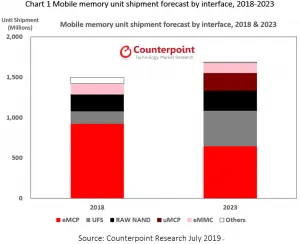
eMCP is a combination of eMMC and low-power DRAM(LPDRAM). Since 2014, eMCP has been widely used in smartphones because it can reduce OEMs’ costs in system design and reduces the PCB foothold area. The penetration rate of eMCP smartphones reached 61.5% in 2018. However, we expect this to fall to 38.2% by 2023.
uMCP is a combination of a UFS controller and low-power DRAM. It utilizes UFS's fast speed and MCP's advantages of a smaller footprint. This makes uMCP much faster than eMCPs and eMMC while reducing OEMs’ spends in system design. The share of uMCP was only 0.2% in 2018. However, we expect to see exponential growth for uMCP until 2023 and reach a market share of 13%. Only a limited number of smartphones like Vivo and Xiaomi use uMCPs. However, we expect to see strong growth of uMCP adoption in by Tier-II smartphone brands. In fact, we expect uMCPs to replace eMCPs in the mid-to-low range smartphone market.
UFS was first used only in Samsung's Galaxy S6. However, it has become the mainstream mobile memory interface for almost all high-end smartphones. This is because it has a higher read/write speed and input/output operations per second (IOPS), especially for applications that have to handle a large amount of data such as video and image. The penetration of UFS grew to 10.3% in 2018. We expect its use to keep increasing and its share to reach 26.0% by 2023. Almost all smartphone makers use UFS on their flagship phones. In addition to the fact that UFS can provide better performance. Another reason to adopt UFS is to compete with other smartphone brands in terms of specifications and marketing.
Clearly, mobile memory is undergoing a rapid transformation. Not only is the interface changing, but also the demand for high density is also increasing.
While, eMCP and UFS will continue to be the mainstream mobile memory solution for mid-to-low range and premium smartphones, respectively for the short-term, uMCP can take the advantages of both solutions and grow rapidly in the medium-term.
The comprehensive and in-depth report is available as link below for subscribing clients. Please feel free to contact us at [email protected] for further questions regarding our in-depth latest research, insights or press inquiries.
Global Smartphones NAND Memory Tracker and Forecast by Brand, Capacity & Interface: Q1 2019


