

- The global intelligent eyewear* market surged 83% YoY in Q1 2026, fueled by accelerating adoption of AR and smart glasses, while the VR segment continued to face weak consumer demand and limited product momentum.
- The Birdbath/Flat Prism AR segment remained highly concentrated among RayNeo, VITURE, and XREAL. Meanwhile, the waveguide-based AR market continued to diversify as a growing number of OEMs entered the category combining AI capabilities with see-through displays to unlock more immersive and context-aware AI experiences.
- Display-less smart glasses maintained strong growth momentum despite industry-wide cost pressures from rising memory prices, underscoring robust consumer demand for lightweight, AI-powered wearables.
- Meta retained its dominant position in the global smart glasses market with 84% share, but emerging ecosystems in China and India are gaining traction as local OEMs introduce region-specific products, services, and AI experiences tailored to domestic consumers.
Seoul, Beijing, Berlin, Buenos Aires, Fort Collins, Hong Kong, London, New Delhi, Taipei, Tokyo – June 24, 2026
Global intelligent eyewear shipments, including VR(Virtual Realities), AR(Augmented Realities) and smart glasses, grew by 83% YoY in Q1 2026, according to Counterpoint's latest XR 360 Research Service. Among the key product categories, the VR segment declined 17% YoY, while the AR glasses and display-less smart glasses market surged 136% YoY and 210% YoY, respectively.
Global Intelligent Eyewear Shipments by Product Type, Q1 2026
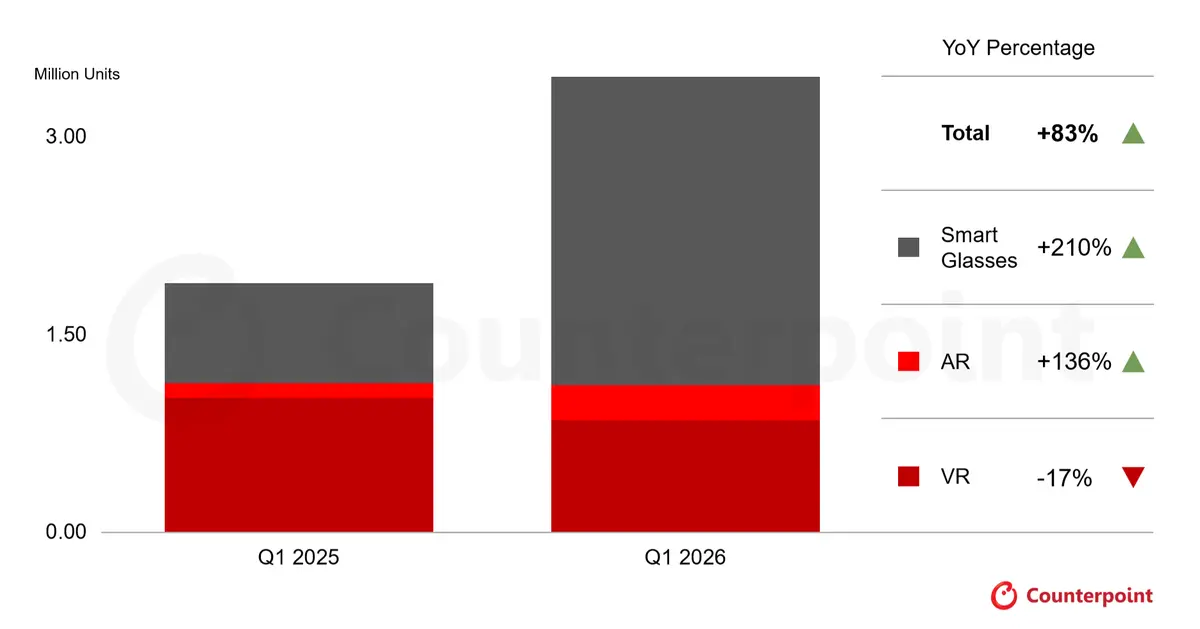
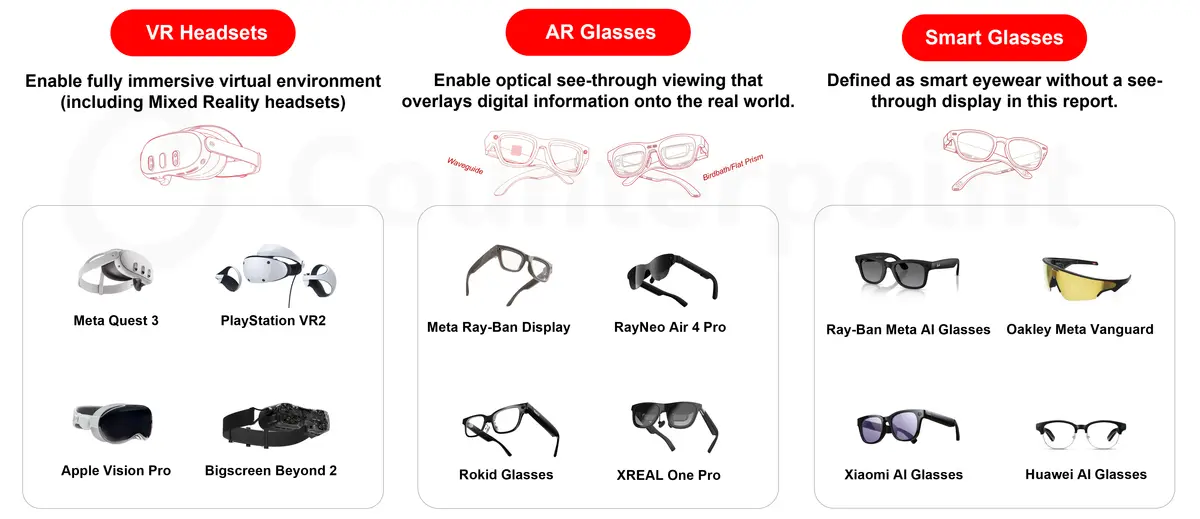
*Counterpoint’s segmentation of the intelligent eyewear market is illustrated at the end of the press release.
The VR category continued to decline in Q1 2026 amid an aging product cycle, limited new product introductions, and more conservative investment from leading vendors, while AR and smart glasses stood out as the main contributors to overall market expansion.
In the AR glasses segment, the more mature Birdbath/Flat‑Prism-based models continued to dominate with a 58% share in Q1 2026, down from 82% last year, while waveguide‑based AR glasses increased to 42% from 18%.
Global AR Glasses OEM Shipments Share, Q1 2026
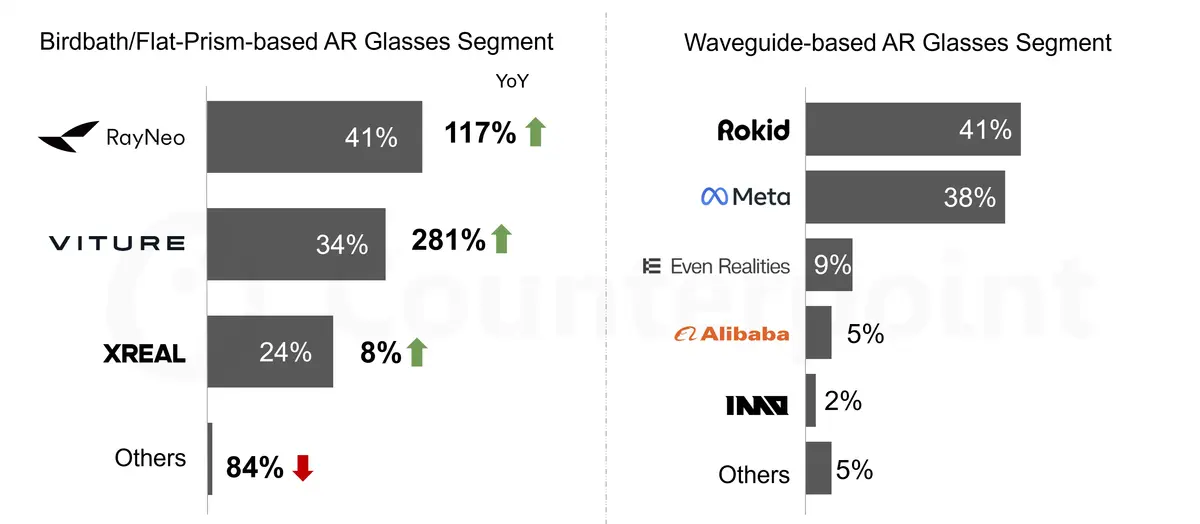
In terms of the competitive landscape, RayNeo, VITURE, and XREAL continued to dominate the Birdbath/Flat Prism AR glasses segment in Q1 2026. RayNeo maintained its dominance in Q1 with a 41% share, supported by an increasingly diversified product portfolio and broad market presence. VITURE emerged as the dark horse, surging 281% YoY to capture a 34% share, fueled by aggressive international expansion and continued investment in channel development. The company also topped AR‑glasses shipments in markets outside China during the quarter. While XREAL's growth moderated in Q1 2026, Counterpoint Research remains optimistic about its longer-term prospects as the company continues to broaden its product portfolio, strengthen ecosystem partnerships, and advance its market position as the first consumer AR glasses OEM to file for an IPO.
The waveguide-based AR glasses market is becoming increasingly diverse as more OEMs enter the segment, combining AI capabilities with see-through displays to enable richer and more intuitive interactions with AI assistants. Rokid ranked first globally with its Rokid Glasses, benefiting from continued overseas expansion and stronger offline channel penetration during the quarter. Meta captured a 38% share, though its growth remained constrained by limited production yields of key components for the Meta Ray‑Ban Display and by the product’s restricted availability in the US market. Even Realities and Alibaba followed as notable challengers, securing 9% and 5% market share, respectively, in Q1 2026. Looking ahead, Alibaba appears well positioned to strengthen its presence in the segment, particularly in China, as it consolidates its smart glasses portfolio under the unified “Qwen” brand and enhances its software experience through deeper service integration and more proactive AI capabilities.
In the display-less smart glasses segment, strong growth momentum persisted, even as the broader consumer electronics industry faced headwinds from surging component prices. Meta’s global dominance continued, with its market share rising to nearly 84% in Q1 2026 from 82% in the preceding quarter. Outside of Meta, other players remained relatively small globally, although competitive dynamics varied by country. The US remained the world's largest smart glasses market in Q1 2026. However, distinct regional ecosystems are beginning to take shape in smaller but rapidly evolving markets such as China and India. Regional players are increasingly standing out through stronger service localization, deeper ecosystem integration, and AI-driven experiences better aligned with local consumer behaviors and use cases.
Rising memory costs have emerged as a significant headwind for the XR and smart glasses industry in 2026. The VR segment has been affected most severely due to its substantially higher memory requirements, prompting several leading OEMs to raise product prices and further dampening demand in an already difficult market. By comparison, the AR and smart glasses segments have been more resilient, benefiting from lower memory content and stronger underlying demand. Nevertheless, rising component costs have led some OEMs to delay planned product launches, reduce investment commitments, or reassess product roadmaps amid concerns over profitability.
Despite these near-term challenges, Counterpoint Research remains positive on the outlook for the AR and smart glasses markets, as ecosystem development continues to accelerate. This is being supported by initiatives such as Qualcomm’s START program, which provides OEMs with reference designs, software toolkits, and ecosystem support to streamline device development and shorten time-to-market for AR and AI glasses.
Product segmentation in the intelligent eyewear market
About Counterpoint Research
Counterpoint Research is a global market research firm specializing in products across the technology ecosystem. We advise a diverse range of clients – from smartphone OEMs to chipmakers and channel players to Big Tech – through our offices located in the world's major innovation hubs, manufacturing clusters and commercial centers. Our analyst team, led by seasoned experts, engages with stakeholders across the enterprise – from the C-suite to professionals in strategy, analyst relations (AR), market intelligence (MI), business intelligence (BI), product and marketing – to deliver services spanning market data, industry thought leadership and consulting. Our core areas of coverage include AI, Automotive, Consumer Electronics, Displays, eSIM, IoT, Location Platforms, Macroeconomics, Manufacturing, Networks and Infrastructure, Semiconductors, Smartphones and Wearables. Visit our Insights page to explore our publicly available market data, insights and thought leadership, and to understand our focus, meet our analysts and start a conversation.