India Smartphone Shipments Fall 10% YoY in Biggest June Quarter Decline in Six Years
- Smartphone shipments in India fell 10% YoY in the June-ended quarter as rising device prices led to a decline in consumer demand.
- Chinese brands’ share reached its lowest ever for a second calendar quarter since 2020.
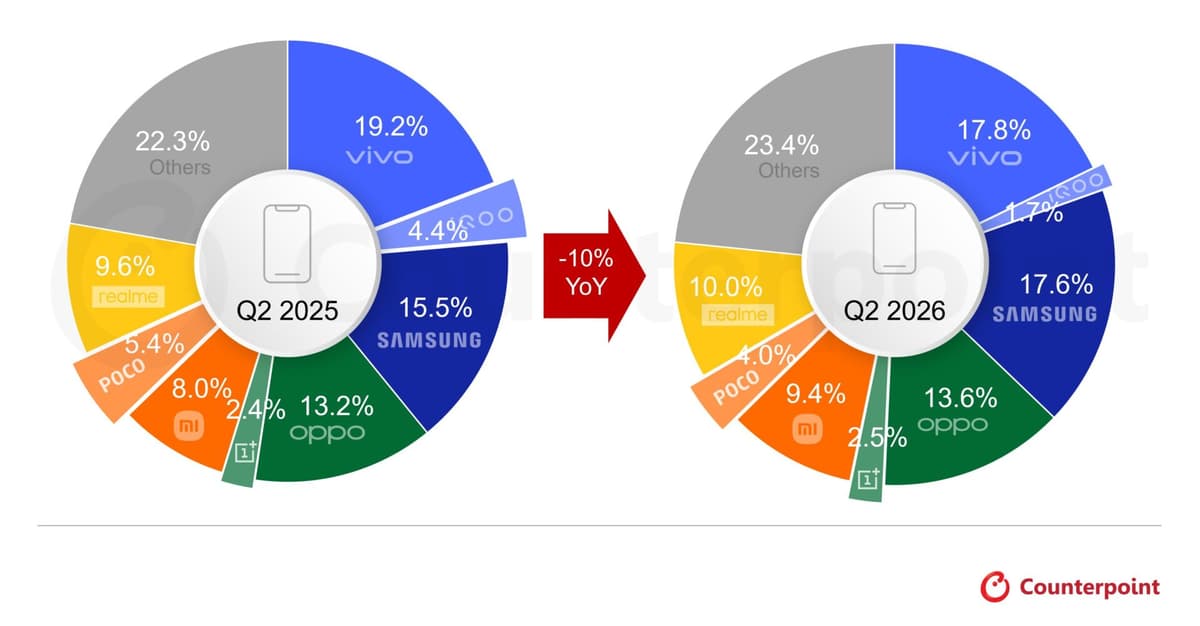
- vivo (excluding IQOO) continued to lead the market with an 18% share.
- Among the top five OEMs, Samsung was the only OEM that registered growth (2% YoY).
- Nothing was the fastest-growing brand with 105% YoY growth, driven by strong demand for the Phone (4a) series and its title sponsorship of the RCB cricket team during the Indian Premier League (IPL).
- Google Pixel showed the highest growth in the ultra-premium segment (>INR 45,000) at 68% YoY.
New Delhi, Beijing, Berlin, Buenos Aires, Fort Collins, Hong Kong, London, Seoul, Taipei, Tokyo – July 17, 2026
India’s smartphone shipments fell 10% YoY in Q2 2026 (April-June), according to Counterpoint Research’s Monthly India Smartphone Tracker. The decline, the biggest for a June quarter in six years, was mainly driven by record-high memory prices, which increased smartphone prices across almost all segments, weakening consumer demand and extending replacement cycles, despite promotions and financing initiatives.
Commenting on the market dynamics, Senior Analyst Prachir Singh said, “India’s smartphone market remained under pressure during the quarter, as both demand and supply were adversely affected. On the supply side, persistent increases in memory and other component costs prompted almost every major OEM to implement multiple rounds of price hikes, resulting in an average smartphone price hike of around 15% by the end of the second quarter. At the same time, macroeconomic headwinds, inflationary pressures and weak discretionary spending weighed on replacement demand. The mass-market segment (sub-INR 15,000) was the hardest hit, with its shipments declining 45% YoY. As most Chinese brands are heavily exposed to the entry- and mid-tier segments, their overall market share fell to its lowest level for a second calendar quarter since 2020. In response, many OEMs expanded their 4G portfolios in the mass-market segment to better address changing market conditions. While 5G remains the long-term growth driver, 4G will continue to play a critical role in serving value-conscious consumers until component costs stabilize.
Meanwhile, the ultra-premium segment (above INR 45,000) remained relatively resilient, supported by the growing adoption of financing options. These financing schemes reduced the upfront cost of premium smartphones, making them more accessible to consumers despite the broader pricing pressures.”
India Smartphone Market Volume Share by Brand, Q2 2026 vs Q2 2025

Commenting on the market outlook, Research Director Tarun Pathak said, “We expect India’s smartphone market to remain under pressure through the rest of the year, as elevated memory and component costs continue to keep device prices high. Smartphone memory prices have increased nearly 4x since September 2025 and are expected to rise further, potentially reaching 5x in the coming months. As a result, we expect the market to decline by 13% YoY for the full year.
Since component prices are unlikely to normalize before next year, affordability will remain the industry’s biggest challenge. As H2 accounts for the majority of annual smartphone sales, OEMs are expected to focus on portfolio optimization, financing-led affordability, and premium offerings to support demand. While the mass-market segment is likely to remain under pressure, the premium segment is expected to stay resilient, supported by financing options and rising consumer preference for high-value devices.”
Brand Dynamics
vivo (excluding iQOO) led India’s smartphone market in Q2 2026 with an 18% share, driven by strong momentum in the premium segment following the launch of the V70. However, its budget segment remained under pressure, as multiple price hikes across the Y and T series weighed on demand, resulting in a double-digit decline YoY.
Samsung narrowed the gap with vivo and retained the second position by growing 2% YoY. The brand's growth was supported by healthy demand across its Galaxy A series and flagship S series. Samsung remained one of the most aggressive during the summer sales, offering attractive promotions on key models, including the A07 5G, A17 5G, A37 5G, A57 5G and the flagship S25 and S26 series. The brand also strengthened its presence in the sub-INR 20,000 segment through its A, M and F series, making the INR 15,000-INR 20,000 price band its largest volume contributor during the quarter.
OPPO retained the third position with a 14% market share, driven by double-digit growth in the above-INR 20,000 price segment with models including the A6 series and K14 series.
Xiaomi (including POCO) ranked fourth with a 13% share, while realme ranked fifth. Both of these brands recorded YoY shipment declines as repeated price hikes across their entry- and mid-tier portfolios weakened demand, particularly in the sub-INR 20,000 segment. Xiaomi was impacted by the higher prices across its models, including the Redmi A7, POCO C71 and POCO C75, and realme by the P4 and C85 series, making the sub-INR 20,000 segment the weakest-performing price band for both brands.
Apple’s shipments declined 3% YoY in Q2 2026, with its market share reaching 7%. While consumer demand for the iPhone 17 series remained strong, persistent supply constraints and inventory shortages across online and offline channels limited the brand's shipment growth during the quarter.
Other key trends
- Nothing* was India’s fastest-growing smartphone brand in Q2 2026 at 105% YoY, driven by strong demand for the Phone (4a) and Phone (4a) Pro models, and enhanced brand visibility provided by its title sponsorship of the RCB cricket team during the Indian Premier League (IPL).
- MediaTek continued to lead India’s smartphone chipset market with a 49% shipment share.
- Smartphone financing (NBFC, credit/debit card EMI) accounted for over 50% of mainline smartphone sales in India in Q2 2026.
- Google emerged as the fastest-growing smartphone brand in the ultra-premium segment (>INR 45,000) in Q2 2026, posting 68% YoY growth. The brand benefited from strong marketing, rapid offline channel expansion and the absence of price hikes.
- AI+ delivered a strong performance during the quarter, supported by robust demand for its entry-tier smartphone portfolio with the AI+ Nova 2 and Pulse 2.
- Smartphone OEMs have implemented multiple rounds of price increases in 2026, with the highest increase exceeding 100% of the launch price. The hikes have been driven by surging DRAM and NAND prices, which have increased memory's share of the bill of materials (BoM) from below 20% to over 45% in the mass-market segment (INR <15,000).
Notes:
- Preliminary estimates; subject to revision
- *Nothing numbers exclude CMF
Feel free to contact us at [email protected] for questions regarding our latest research and insights.
About Counterpoint Research
Counterpoint Research is a global market research firm specializing in products across the technology ecosystem. We advise a diverse range of clients – from smartphone OEMs to chipmakers and channel players to Big Tech – through our offices located in the world's major innovation hubs, manufacturing clusters and commercial centers. Our analyst team, led by seasoned experts, engages with stakeholders across the enterprise – from the C-suite to professionals in strategy, analyst relations (AR), market intelligence (MI), business intelligence (BI), product and marketing – to deliver services spanning market data, industry thought leadership and consulting. Our core areas of coverage include AI, Automotive, Consumer Electronics, Displays, eSIM, IoT, Location Platforms, Macroeconomics, Manufacturing, Networks and Infrastructure, Semiconductors, Smartphones and Wearables. Visit our Insights page to explore our publicly available market data, insights and thought leadership, and to understand our focus, meet our analysts and start a conversation.
Follow Counterpoint Research
Receive our insightful weekly newsletter and stay ahead of the competition.
Author
Prachir Singh
Prachir is a Senior Research Analyst at Counterpoint Research based out of Gurgaon. In Counterpoint, he closely tracks mobile devices and ecosystem. He also tracks Emerging Tech Opportunities. He has a total of 10+ years of experience across various sectors like manufacturing, management consulting, strategy and operations. He is an engineering graduate from Indian Institute of Technology (IIT), Kharagpur.
Tarun Pathak
Tarun is a Research Director with Counterpoint Research, based out of Gurgaon (near New Delhi). Tarun has 10 years of work experience with a key focus on the evolving mobile device ecosystem with specialties in Emerging Markets. He understands specific mobile industry nuances, helping clients to navigate through the rapidly changing technological trends. As a Telecom Analyst he has been quoted extensively by the leading media platforms. Tarun holds a Post Graduate Diploma in Management, specializing in International Business from the Amity International Business School and is a graduate in Physical Sciences from Jammu University, Jammu in the northern Indian state of Jammu & Kashmir.