GenAI Smartphone Share to Rise to 45% of Global Shipments in 2026
1
June 22, 2026
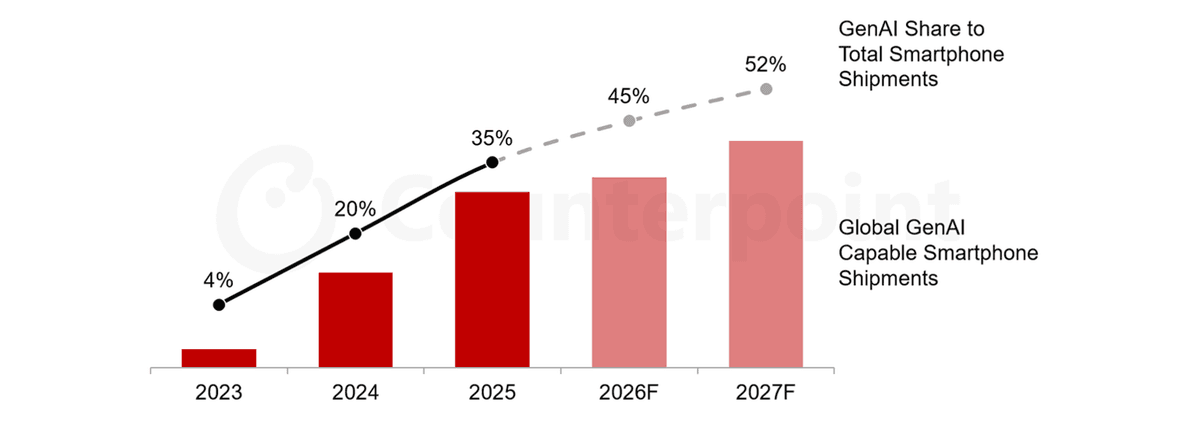
GenAI-capable smartphones are forecast to reach 45% of global shipments in 2026 and 52% in 2027.
Apple and Samsung lead the GenAI-capable smartphone segment on the strength of their premium portfolios.
GenAI capability has become standard in high-end smartphones priced above $400 wholesale, but it has yet to give consumers a compelling reason to upgrade.
Smartphone AI model layer increasingly centers on Google Gemini, supporting Apple's Siri, anchoring Samsung's Galaxy AI and powering major Chinese OEMs' overseas devices.
Memory will remain a key factor determining how quickly GenAI expands beyond the high-end segment.
Seoul, Beijing, Boston, Buenos Aires, Fort Collins, Hong Kong, London, New Delhi, Taipei, Tokyo – June 22, 2026
GenAI-capable smartphones are forecast to account for 45% of global shipments in 2026, up from 36% in 2025, according to the latest Counterpoint Research GenAI Smartphone Forecast. However, the ongoing memory supply crisis is expected to reduce total global smartphone shipments by 13.9% YoY to 1.08 billion units in 2026, the lowest level on record. GenAI’s share is expected to accelerate further, with GenAI-capable devices projected to account for 52% of global smartphone shipments in 2027, putting GenAI technology on track to become a standard feature across the market.
Global GenAI-Capable Smartphone Shipment Forecast, 2023-2027
Source: Counterpoint Research GenAI Smartphone Forecast by Brand, June 2026 Update
Apple and Samsung continue to lead the GenAI-capable smartphone segment, supported by their scale and strong premium portfolios. With the launch of the iPhone 17 series, GenAI capabilities are now available across nearly the entire Apple smartphone lineup. Meanwhile, Samsung has taken an early lead in deploying agentic AI features, expanding advanced AI experiences across its flagship devices.
Research DirectorTarun Pathak commented, "GenAI capability has become standard in high-end smartphones priced above $400 wholesale, but it has yet to give consumers a compelling reason to upgrade. A clear gap remains between devices that are GenAI capable and those on which users regularly engage with AI features. Bridging this gap will require practical, everyday use cases that deliver consistent value. All major OEMs are racing to embed GenAI features as core differentiators, shifting from cloud-dependent capabilities to on-device AI. Samsung and Google lead with generative photo editing, live translation and other features, while Apple recently announced it has redesigned Siri AI from the ground up."
Pathak added, “Apple’s redesigned Siri looks promising. Early beta reviews have been positive, suggesting a significant improvement in leveraging personal context and managing daily tasks. Its deep integration across Apple’s ecosystem and strong focus on privacy provide a distinct competitive advantage. If iOS 27 delivers the fully conversational Siri that Apple has promised, it could help support another iPhone upgrade cycle.”
Senior Analyst Karn Chauhan added, "The primary shift is now in the AI models powering smartphones, rather than the devices themselves. At the premium end, Google Gemini is central to this layer, supporting Apple's rebuilt Siri, anchoring Samsung's Galaxy AI, and powering overseas devices from major Chinese OEMs. However, this influence is not universal. Chinese brands continue to use their own models domestically, while Apple and Samsung retain proprietary on-device AI capabilities. The shared foundation largely ends at the model layer. OEMs still manage orchestration, user experience, and ecosystem integration, which determine how AI functions, what it can access, and how it interacts with users. This is where the next phase of competition will be decided.”
These changes are occurring alongside a significant increase in memory costs, which is shaping the market more than any feature trend. The entry-level segment faces the most pressure, as higher component costs are eliminating lower-priced devices. In contrast, premium GenAI models can better absorb these increases, strengthening their market position. For the first time in years, consumers will likely pay more while receiving fewer hardware upgrades. Although OEMs are reducing base memory, cameras, and SKUs, much of the cost increase will still be passed on to retail prices. As a result, Counterpoint Research expects the budget segment to shrink, the premium segment to grow, and the refurbished market to expand as buyers keep devices longer.
Over the longer term, memory will remain a key factor determining how quickly GenAI expands beyond the high-end segment. The additional DRAM required for model weights keeps these devices priced above $400 wholesale. As memory constraints ease and on-device model optimization advances, GenAI will become available on more affordable smartphones.
About Counterpoint Research
Counterpoint Research is a global market research firm specializing in products across the technology ecosystem. We advise a diverse range of clients – from smartphone OEMs to chipmakers and channel players to Big Tech – through our offices located in the world's major innovation hubs, manufacturing clusters and commercial centers. Our analyst team, led by seasoned experts, engages with stakeholders across the enterprise – from the C-suite to professionals in strategy, analyst relations (AR), market intelligence (MI), business intelligence (BI), product and marketing – to deliver services spanning market data, industry thought leadership and consulting. Our core areas of coverage include AI, Automotive, Consumer Electronics, Displays, eSIM, IoT, Location Platforms, Macroeconomics, Manufacturing, Networks and Infrastructure, Semiconductors, Smartphones and Wearables. Visit our Insights page to explore our publicly available market data, insights and thought leadership, and to understand our focus, meet our analysts and start a conversation.
Receive our insightful weekly newsletter and stay ahead of the competition.
Author
Tarun Pathak
Tarun is a Research Director with Counterpoint Research, based out of Gurgaon (near New Delhi). Tarun has 10 years of work experience with a key focus on the evolving mobile device ecosystem with specialties in Emerging Markets. He understands specific mobile industry nuances, helping clients to navigate through the rapidly changing technological trends. As a Telecom Analyst he has been quoted extensively by the leading media platforms. Tarun holds a Post Graduate Diploma in Management, specializing in International Business from the Amity International Business School and is a graduate in Physical Sciences from Jammu University, Jammu in the northern Indian state of Jammu & Kashmir.
Karn Chauhan
Karn is a Senior Analyst at Counterpoint Research, based in Gurgaon. He currently handles Global Devices and Ecosystems, Virtual Reality and Augmented Reality research. Karn has over 8 years of experience in the mobile device ecosystem space. He has a degree in Electronics and Communication.