When Frontier AI Meets Your Desktop Gemma 4, DGX Spark, and the Agentic AI Revolution
0
April 9, 2026
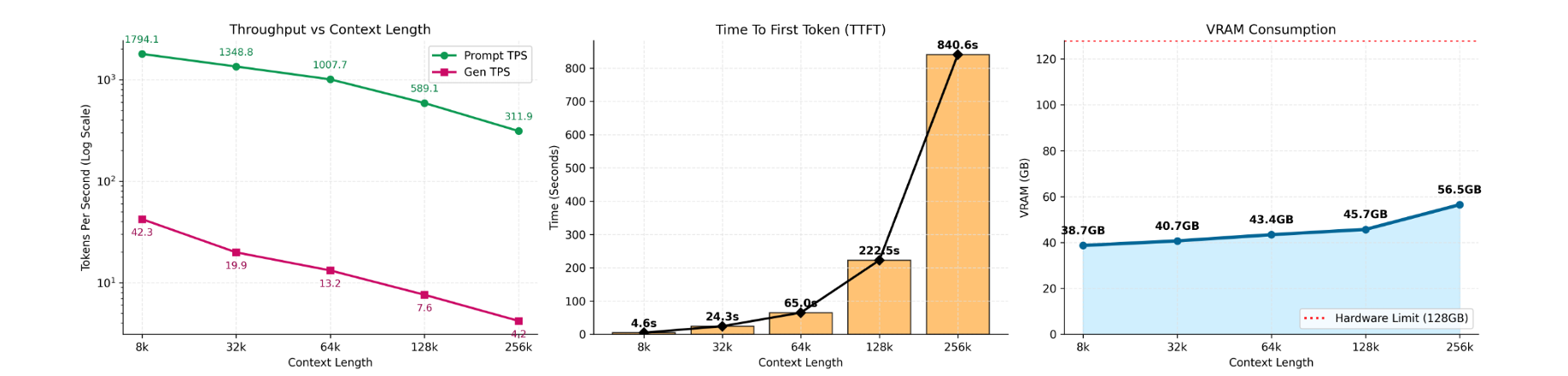
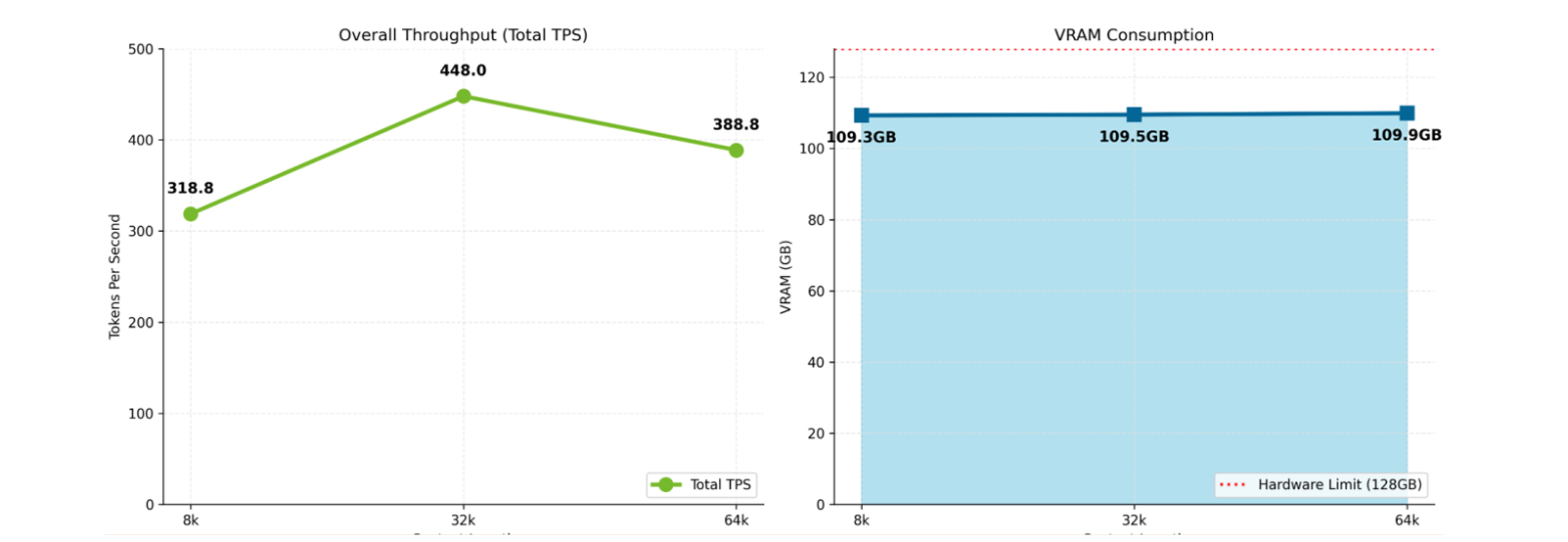
The convergence of Google’s Gemma 4 open-weight models, NVIDIA’s DGX Spark platform, and emerging agentic AI frameworks such as OpenClaw establishes a compelling foundation for on-premise enterprise AI deployment. Benchmark data indicate that Gemma 4’s Mixture-of-Experts (MoE) architecture delivers strong performance on a desktop supercomputer-class system, achieving 1,794 prompt tokens per second at an 8K context while utilizing 56.5 GB of the DGX Spark’s 128 GB unified memory. In parallel, NVFP4 quantization implemented via vLLM enables the 31B dense model to reach 448 TPS, representing a 31% performance uplift relative to Ollama’s 341 TPS baseline.
These results signal a paradigm shift: frontier-class AI inference is now economically viable on desktop hardware, with on-premise deployments breaking even with the cloud in as little as four months for sustained workloads. Gemma 4’s Apache 2.0 license—a first for the Gemma family—removes all commercial restrictions. The model’s τ2-bench score of 86.4% (up from Gemma 3’s 6.6%) represents a thirteen-fold improvement in autonomous task completion, making it genuinely viable for production-grade agentic workflows.
Key Takeaways
MoE architecture is uniquely suited to resource-constrained desktop platforms like DGX Spark — 1,794 prompt TPS at 5.3x the throughput of the Dense equivalent.
NVFP4 quantization on Blackwell improves throughput and efficiency versus traditional formats while maintaining competitive accuracy, though real-world gains vary by model and workload
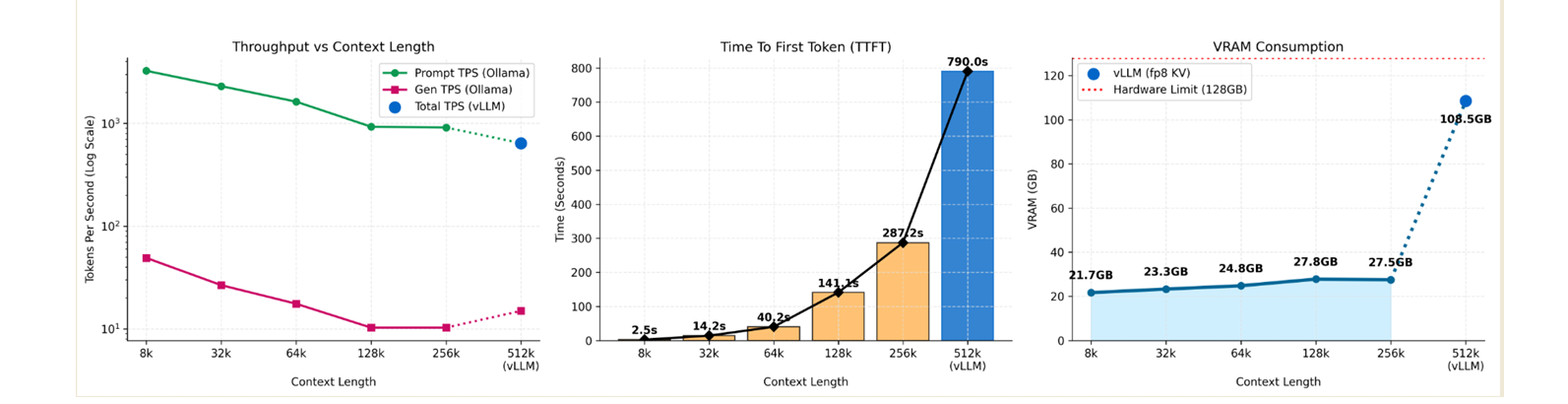
FP8 KV cache in vLLM enables longer context windows on unified memory architecture (UMA) systems (e.g., 128GB), with models such as E4B demonstrating ultra-long context capability in optimized setups.
Gemma 4's Apache 2.0 license and 86.4% τ2-bench score make it one of the leading open-weight models for unrestricted commercial agentic deployment.
Frameworks like OpenClaw and NemoClaw, combined with zero marginal token cost and rising data sovereignty requirements, position on-premise inference as increasingly competitive versus cloud at scale.
The DGX Spark: Redefining Desktop AI
NVIDIA's DGX Spark, powered by the GB10 Grace Blackwell Superchip co-designed with MediaTek, packs a petaflop-class AI system into a 150 mm × 150 mm × 50.5 mm chassis weighing 1.2 kg. The platform combines a 20-core Arm-based Grace CPU with a Blackwell GPU featuring 6,144 CUDA cores and 5th-generation Tensor Cores, which natively support FP4, FP6, and FP8 precision.
Its 128 GB of unified LPDDR5x memory, coherently shared between the CPU and GPU via NVLink-C2C, eliminates the VRAM limitations typical of consumer GPUs. Two units can be clustered via ConnectX-7 SmartNICs to provide up to 256 GB of combined memory, enabling support for models with up to 405 billion parameters. Priced at $4,699, the system ships with DGX OS 7, includes pre-installed Ollama, supports vLLM, and comes with a 90-day NVIDIA AI Enterprise license.
Gemma 4 Arrives with Apache 2.0 and Agentic Superpowers
Google released Gemma 4 on April 2–3, 2026 as four models spanning edge to workstation tiers. The 31B Dense model (30.7B parameters, 256K context) delivers raw power, while the 26B A4B MoE (25.2B total, ~3.8B active per token, 256K context) achieves near-equivalent quality at dramatically lower inference cost.
The licensing shift to Apache 2.0 is strategically significant — previous Gemma versions carried commercial restrictions. For agentic AI, Gemma 4 supports native function calling with dedicated special tokens, structured JSON output, configurable thinking mode, and multi-turn tool interaction protocols. The τ2-bench score jumped from 6.6% (Gemma 3) to 86.4% (Gemma 4 31B), signaling a model capable of genuine agentic planning.
Benchmark Reality: Three Critical Patterns on DGX Spark
Figure 1 — Gemma 4 26B MoE Performance: MoE Architecture is the Efficiency King
The 26B MoE model (Q4_K_M quantization) achieves exceptional throughput at minimal VRAM cost. Thanks to activating only ~3.8B parameters per token, it operates at '4B-class' bandwidth cost with '27B class' intelligence, remaining stable all the way to 256K context.
Gemma 4 26B (MoE) Performance on DGX Spark
Figure 1 · Gemma 4 26B MoE on DGX Spark (Ollama, Q4_K_M) — Throughput vs Context Length (left), TTFT (center), VRAM Consumption (right) Source: Counterpoint AI Server Research
Figure 2 — Gemma 4 31B Dense (NVFP4 on vLLM): NVFP4 is Essential for Dense Models
The 31B Dense model under Ollama delivers 341 prompt TPS at 32K context. Switching to vLLM with NVFP4 quantization — Blackwell's native E2M1 4-bit floating-point format — pushes total throughput to 448 TPS, a 31% improvement, by eliminating the dequantization overhead of traditional quantization formats.
Gemma 4 31B Dense (NVFP4 on vLLM) Performance
Figure 2 · Gemma 4 31B Dense NVFP4 on vLLM — Overall Throughput Total TPS (left), VRAM Consumption capped at ~109 GB (right) Source: Counterpoint AI Server Research
Figure 3 — Gemma 4 E4B: The Throughput and Long-Context Champion
The E4B model at BF16 achieves 3,250 prompt TPS at 8K context via Ollama. Via vLLM with FP8 KV cache, it sustains 641.7 TPS at 512K context — a single-card record. It uses only 21–28 GB VRAM under Ollama, making it ideal for always-on agentic workloads.
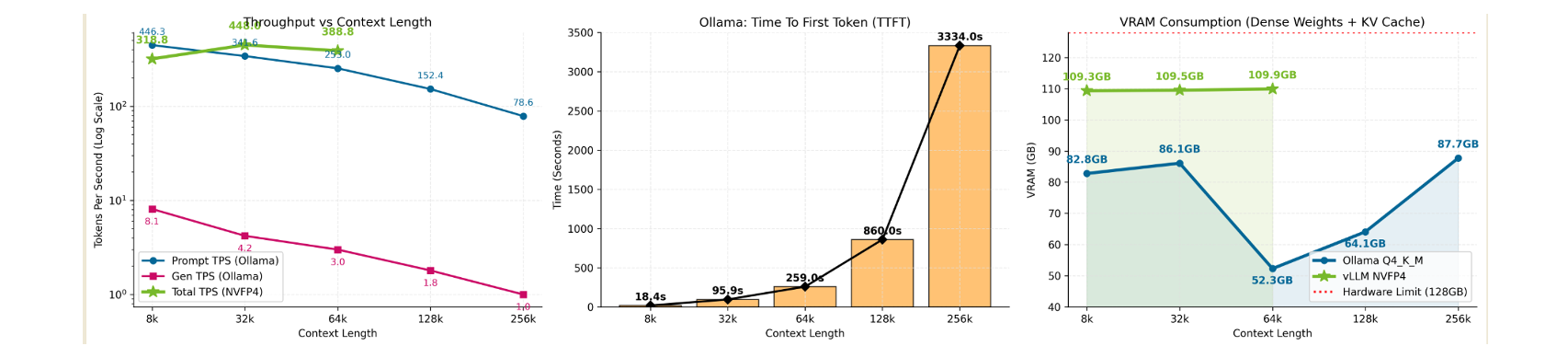
This composite chart directly contrasts the two inference stacks across the full context range. The NVFP4 stars (vLLM) float far above the Ollama curves at every context length, while the TTFT chart exposes the catastrophic 3,334-second (55-minute) first-token latency of the Dense model at 256K under Ollama — the definitive argument for NVFP4.
Figure 4 · Gemma 4 31B Dense — Combined comparison: Prompt/Gen TPS + NVFP4 Total TPS (left), Ollama TTFT (center), VRAM for both engines (right, green stars = vLLM NVFP4) Source: Counterpoint AI Server Research
OpenClaw and the Agentic Framework Ecosystem
OpenClaw has emerged as the most significant open-source agentic AI project in history. Created by Peter Steinberger (founder of PSPDFKit), it has accumulated over 310,000 GitHub stars and 58,000 forks since its November 2025 debut — with Jensen Huang calling it 'probably the single most important release of software ever' at GTC 2026.
Unlike chatbots, OpenClaw is an always-on autonomous agent: reading and writing files, sending messages across WhatsApp/Telegram/Slack/Discord and 15+ platforms, executing scripts, browsing the web, and calling external APIs. It supports model-agnostic inference via Ollama or any OpenAI-compatible server, enabling full local deployment on DGX Spark.
NVIDIA's NemoClaw is an open-source enterprise stack wrapping OpenClaw with privacy controls, network guardrails, policy enforcement, and NVIDIA OpenShell for sandboxed agent execution — supporting Gemma 4, Nemotron, Qwen, and Mistral running entirely on DGX Spark with no external API dependencies.
The Economics Tilt Toward On-Premise Inference
According to Lenovo's 2026 TCO analysis, on-premise infrastructure reaches breakeven against hyperscale cloud in as few as four months for workloads exceeding 20% sustained utilization. At $4,699 purchase price plus ~$25/month electricity, DGX Spark amortizes to $136–160/month over three years. Cloud H100 rental stabilized at $2.85–$3.50/hour — $684–840/month at 8 hours/day.
The critical insight is zero marginal token cost. An OpenClaw agent running 24/7 generates no additional cost beyond electricity. At 50 million tokens per day, per-token API costs from any major provider would dwarf the hardware amortization.
Data sovereignty is becoming a compliance imperative. The EU AI Act reaches full applicability for high risk systems on August 2, 2026, with penalties up to €35M or 7% of global turnover. Running inference locally eliminates entire categories of compliance risk: no data in transit to external parties, complete audit control, and full geographic containment of sensitive information.
Conclusion
The DGX Spark is not the fastest AI inference platform — data center GPUs with ten times its memory bandwidth hold that distinction. But it may be the most strategically important. By making 128 GB of Blackwell-accelerated unified memory available at $4,699 on a desk, NVIDIA has created the hardware substrate for a fundamental shift in how enterprises consume AI.
The critical insight from real benchmark data is that architecture matters more than raw size on bandwidth constrained platforms. The 26B MoE model's 1,794 prompt TPS versus the 31B Dense model's 341 TPS — a 5.3x ratio — represents a fundamentally different efficiency frontier that makes local agentic AI practical rather than theoretical.
The market opportunity lies in enabling entirely new categories of deployment: always-on personal AI agents, sovereign enterprise inference, edge intelligence in regulated industries, and development workflows that keep proprietary code and data within organizational boundaries. The technology stack is ready. The economics work. The regulatory tailwinds are strengthening.
Category
Industry
Semiconductors
Service
Premium
Report Type
Report
Time Period
Other
Receive our insightful weekly newsletter and stay ahead of the competition.
Author
Brady Wang
Hi, I’m Brady Wang, a seasoned professional with over 20 years of experience in the high-tech industry, spanning semiconductor manufacturing, market intelligence, and strategic advisory roles. Currently, I serve as an analyst at Counterpoint Research, where I specialize in semiconductors with a focus on advanced applications such as automotive, server platforms, and cutting-edge process nodes.
My core research centers on AI servers and their key components, including GPUs, custom accelerators, high-bandwidth memory (HBM), CPUs, and advanced packaging technologies. I also track the evolution of AI server architectures, interconnect technologies, and data center deployment trends. By combining deep technical knowledge with market insight, I help clients navigate the fast-changing AI infrastructure landscape and make strategic, data-driven decisions.