

The Vietnamese smartphone market grew by 11% YoY in H1 2017. We expect the market to continue heating up in the second half thanks to the appearance of new high-spec smartphones at affordable prices. However, this growth will mainly be driven by global and Chinese smartphone brands; local brands will further lose in the coming months. The right go-to-market strategy and experience are the factors helping global and Chinese brands gain an edge over Vietnamese brands.
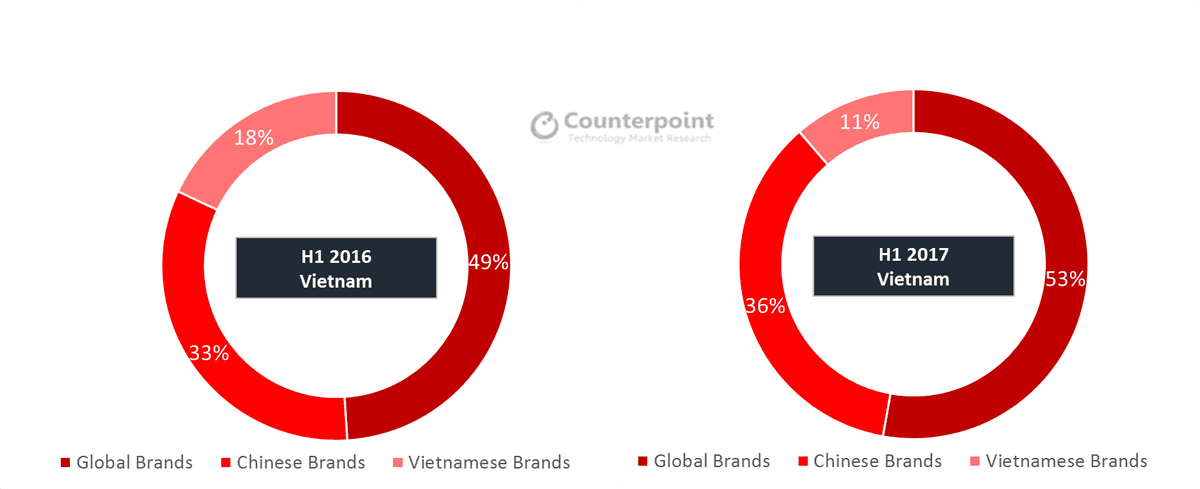
Global and Chinese brands grew YoY but Vietnamese brands’ market share declined from 18% to 11% YoY.
Exhibit 1: Smartphone market share of Global vs Chinese vs Vietnamese brands
This decline was due to the following factors:
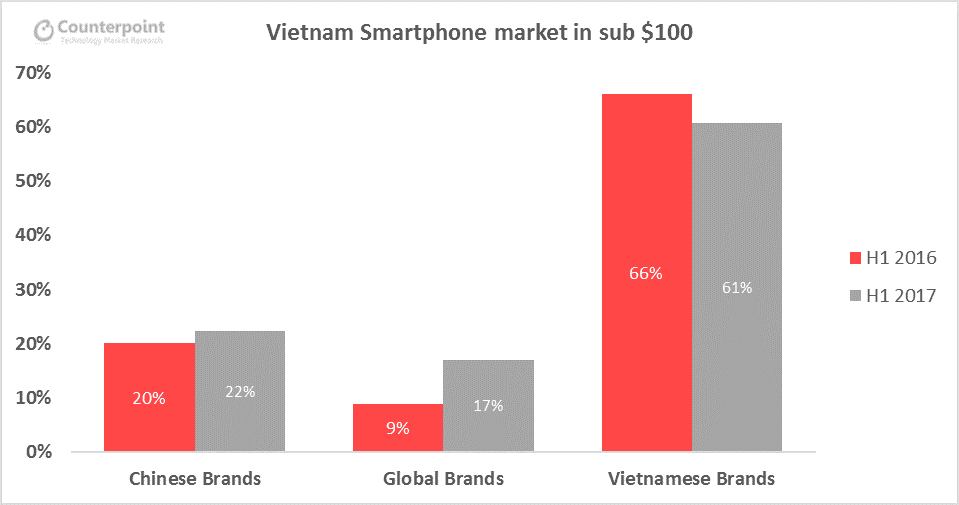
- In the important sub $100 price band, which is contributing to 14% of the total smartphone shipments, Vietnamese brands’ market share fell to 61% from 66% a year earlier. Popular foreign smartphone brands cemented their position in Vietnam by launching smartphones with relatively high-end specs at very affordable prices.
Exhibit 2: Smartphone market in Sub$100 price band
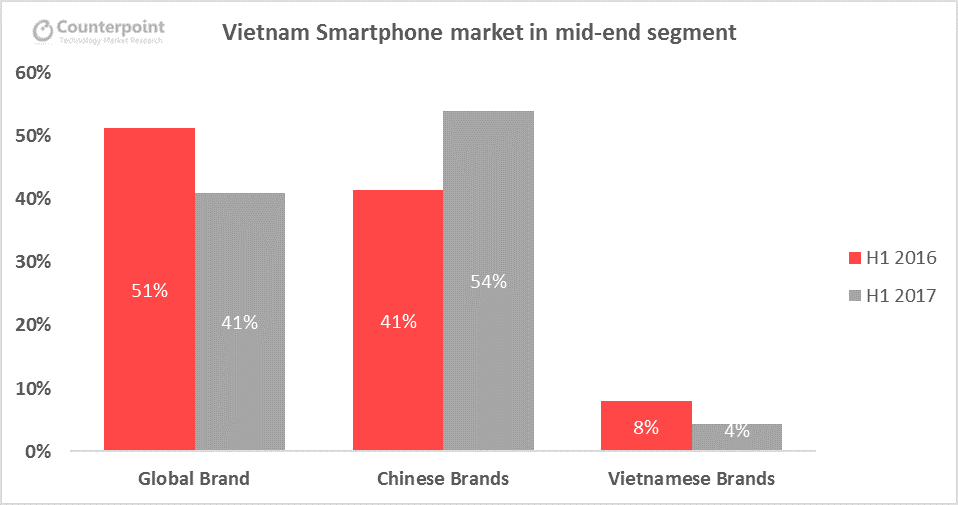
- The mid-end segment is mostly captured by Chinese brands with Vietnamese brands only able to capture 4% of the segment. Chinese and international brands like Oppo, Samsung, Vivo and Huawei offer smartphones with high-end specs like dual cameras, larger screen size, monolithic metal bodies, fingerprint sensors, large capacity batteries etc. However, local Vietnamese brands fail to offer smartphones with these features to consumers.
- Refurbished iPhones in Vietnam in mid-end segment are very popular. Consumers who cannot afford to pay >$600 price for an iPhone can get a refurbished iPhone at almost a third of the price.
Exhibit 3: Smartphone market in mid-end price band
- In Vietnam, mobile distribution is dominated by FPT trading, Petrosetco (PET) and Digiworld (DGW). FPT Trading recently sold a 47% stake to an American ICT company, Synnex after experiencing a loss of profit. The profit decline was due to changes in Apple’s distribution policy. FPT Trading was no longer the only company that could distribute iPhones in Vietnam; Apple allowed other local retailers to import products directly from Apple. After losing the “Apple” brand, it further lost Microsoft which stopped trading on Lumia phones.
- The revenues of major Vietnamese distributors could decrease further as big brands like Oppo and Samsung have expanded their distribution networks by appointing sales agents or directly distributing their products to retailers.
- Recently, Xiaomi appointed Digiworld as its local distributor in Vietnam and Lazada as its online platform. These partnerships, will help Xiaomi promote its smartphones at a larger scale. Tie-ups with local distributors and leading online platforms have helped Xiaomi expand outside China. The influence of online channels on consumer purchase behaviour has been increasing with Lazada the No. 1 platform in the country.
- While online has been expanding, the offline channel still accounts for almost 90% of sales in Vietnam. Chinese and global brands are therefore attacking the offline market by opening branded retail stores and offering improved after sales services. This will further boost their presence and help them to expand, further pressuring local brands.
- Local Vietnamese brands like BPhone & Vivas recently launched smartphones targeting the premium price segment. However, this band is already dominated by leading brands like Samsung and Apple and it is difficult for them to gain popularity as it requires substantial efforts to attract consumers towards them and build confidence.
- Chinese and global brands are more aggressive in spending on marketing and promotional activities whereas Vietnamese brands have less budget to invest in brand development. They are easily overtaken due to the powerful finances capabilities and experience of foreign brands.
The low-end and mid-end price segments will be the major battlefield for manufacturers during the remainder of 2017. Manufacturers will keep targeting these segments with refreshed product portfolios that have upgraded technology in smartphones, lucrative offers and easy installments.
To regain and retain market share, Vietnamese brands must come up with affordable smartphones equipped with high specs and substantial investments on marketing to get noticed by consumers and get them to make a purchase. No easy matter and one that we expect them to fail to manage.


