
- US smartphone shipments fell 9% YoY in Q3 as rising memory costs weighed on Android OEMs, especially at the low end.
- Apple grew its share from 50% to 57% YoY, and was the only major OEM not hit by a shipment decline.
- Samsung held 25% share, up from 24% YoY, supported by a mix of flagship Galaxy S and Z series and low-end Galaxy A-series devices.
- Motorola's share fell to 8% as memory costs squeezed its low-end portfolio, reversing the expansion in share from Q2 2026.[GS1.1][EH1.2]
- Smartphone sales for the Big Three carriers declined 4% YoY in Q3.
Boston, London, Berlin, Beijing, Buenos Aires, Fort Collins, Hong Kong, New Delhi, Seoul, Taipei, Tokyo – November 26, 2026
US smartphone shipments declined 9% YoY in Q3 2026, according to Counterpoint Research's latest US Market Monitor data. Rising memory costs put pressure on Android OEMs, particularly in the low-end segment where margins are thinnest, while Apple's relative resilience pushed its share of the market to 57%.
US Smartphone Shipments Share by OEM, Q3 2025 vs Q3 2026
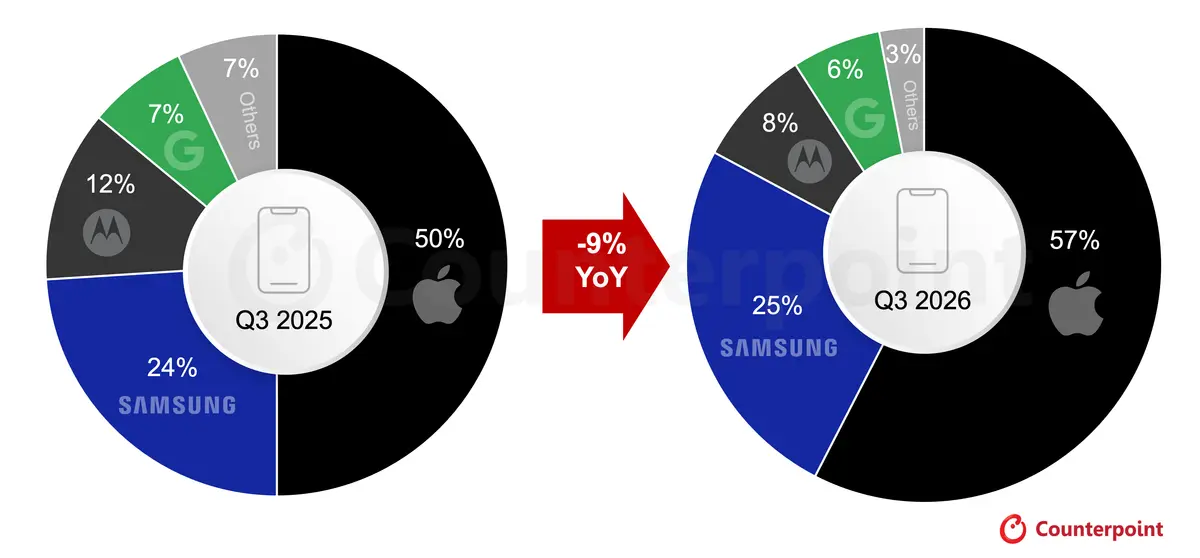
Source: Counterpoint Research Market Monitor Q3 2026
Percentage totals may not add up to 100% due to rounding.
Commenting on the market's performance, Senior Analyst Emily Herbert said, "Q3 2026 was the quarter in which rising component costs heavily impacted the US smartphone market. Higher memory prices hit the low end of the Android market hardest. There, OEMs have little room to absorb a higher bill of materials without raising prices or cutting volume. Apple was the only major OEM to avoid a shipment decline. This resilience lifted its share to 57%, up seven points YoY. Samsung held its ground at 25%, up a point YoY, helped by a portfolio spanning flagships and the low-end Galaxy A-series. Motorola took the biggest hit, as its share fell four points YoY to 8%. After growing shipments YoY in Q2, its low-end-heavy lineup was squeezed by memory costs. Meanwhile, Google's Pixel 11 launch was not strong enough to prevent a slight YoY decline in share."
Senior Analyst Maurice Klaehne added, "Q4 is typically the strongest quarter of the year in the US for smartphones, thanks to holiday promotions and a full quarter of new iPhone sales. However, memory costs are expected to stay elevated, and MSRP increases across Android and iOS are here to stay. US carriers will likely be more selective with promotions this holiday season. According to the Counterpoint US Channel Share Tracker, smartphone sales for the Big Three carriers declined 4% YoY in Q3, and we expect sales to be weak in Q4 as well. Consumers are timing their purchases around the best deals more than ever, if they buy at all. This year's holiday sales cycle will look quite different from usual."
About Counterpoint Research
Counterpoint Research is a global market research firm specializing in products across the technology ecosystem. We advise a diverse range of clients – from smartphone OEMs to chipmakers and channel players to Big Tech – through our offices located in the world's major innovation hubs, manufacturing clusters and commercial centers. Our analyst team, led by seasoned experts, engages with stakeholders across the enterprise – from the C-suite to professionals in strategy, analyst relations (AR), market intelligence (MI), business intelligence (BI), product and marketing – to deliver services spanning market data, industry thought leadership and consulting. Our core areas of coverage include AI, Automotive, Consumer Electronics, Displays, eSIM, IoT, Location Platforms, Macroeconomics, Manufacturing, Networks and Infrastructure, Semiconductors, Smartphones and Wearables. Visit our Insights page to explore our publicly available market data, insights and thought leadership, and to understand our focus, meet our analysts and start a conversation.
Follow Counterpoint Research


