Insight
US Smartphone Market: After Q1 Drop, Postpaid to Provide Strong Momentum in Q2
0
May 20, 2022
The US smartphone market was off to a slow start in 2022, falling 6% YoY due to various factors. But postpaid momentum is expected to push growth in Q2 2022. Below is a quick recap of Q1 2022 from the perspective of carriers, MVNOs and retail channels, as well as some early views on April and Q2 expectations.
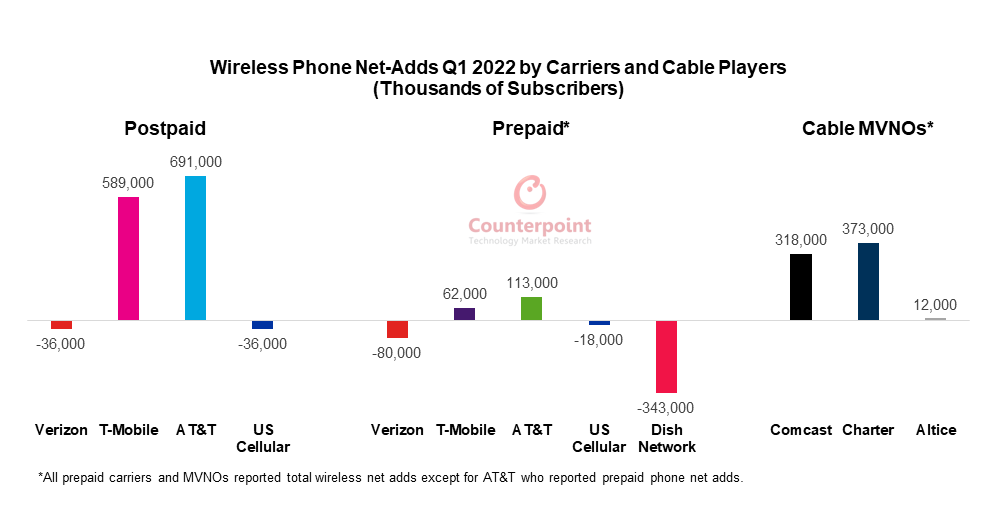 AT&T wins postpaid subscribers as T-Mobile growth slows. Verizon and US Cellular posts net-add losses
AT&T wins postpaid subscribers as T-Mobile growth slows. Verizon and US Cellular posts net-add losses
- AT&T saw 691,000 postpaid net adds, its best Q1 in a decade. The operator’s consistent promotional offers for both new and old subscribers helped it win share from other carriers.
- T-Mobile saw 589,000 net postpaid phone adds, a 23% YoY decrease, due to less aggressive switcher offerings and a higher focus on strengthening Sprint customer relationships.
- Verizon saw 36,000 net postpaid phone losses. Consumer postpaid phone net losses were 292,000, partially offset by strong business net additions of 256,000. Verizon lost postpaid subscribers, especially to AT&T.
- US Cellular had 44,000 net postpaid phone losses, citing increased competition in the market.
- There was strong prepaid-to-postpaid migration, affecting prepaid sales. Q1 2021 also had stimulus money that fueled the economy, which was absent this year, also impacting sales of prepaid devices.
- Cricket net phone adds were down 45%, T-Mobile saw a 59% YoY decrease but remained net positive.
- On the other hand, Verizon lost 77,000 TracFone subscribers and a further 3,000 Verizon Prepaid subscribers, US Cellular had 18,000 net losses while Dish saw another 343,000 net losses which it attributed to CDMA shutdown effects.
- Comcast, Charter, and Altice combined had over 8.4 million subscribers in Q1 2022. While Comcast had the biggest subscriber share at 52%, Charter followed closely behind with 47%.
- Comcast saw over 39% YoY subscriber growth, Charter 47% and Altice grew 14%. Comcast’s Xfinity set a new net-add record for the company while Charter’s Spectrum Mobile revenues reached $690 million, an increase of 40.2% YoY. Altice net adds were 12,000 in Q1 2022. It aims to strengthen its retail positioning by opening 75 more retail locations this year.
- Sales in channels such as Best-Buy, Walmart and Target were weak as inventory was impacted post-holiday sales and some stores limited hours due to Omicron spikes in January. Prepaid demand in these channels remained soft, affecting most of the sales volumes.
- Overall smartphone sales rebounded in April and are expected to rise mid-single digits in Q2 from the slump in Q1, heavily driven by strong postpaid momentum. The promotions environment has improved — Verizon began offering the iPhone 13 for free to existing customers with a trade-in instead of just switchers, for example.
- AT&T and Verizon both are increasing service or administrative charges for their postpaid plans due to inflationary pressures. Nevertheless, we don’t expect this to have a significant effect on consumer behavior in postpaid. It may cause some people to switch to different plans, but we don’t see postpaid-to-prepaid migration happening.
- Prepaid will remain soft, however, even as supply chain issues lessen. This is where inflation may cause more headwinds, especially since smartphone costs have gone up by 10% for some OEMs.
- Carriers may begin decreasing their portfolios in Q2, which would affect white-label and low- to mid-end devices. Fewer SKUs give carriers more bargaining power on volume deals.
Receive our insightful weekly newsletter and stay ahead of the competition.
Author
Maurice Klaehne


Maurice Klaehne is a Senior Analyst with Counterpoint Research, based out of Boston, USA. He has spent more than five years working as a market researcher and strategy consultant, heavily focused on emerging markets and uncovering new growth opportunities for his clients, which include business service, CPG, healthcare, and life science companies. Maurice holds a Master's degree in International Development and Management from Lund University in Sweden, and an undergraduate degree in Political Science and International Development from McGill University in Canada. He is a native German speaker and also speaks fluent French.