The US smartphone market was defined by several key trends in 2021, including strong promotions from Verizon, T-Mobile and AT&T; LG, the former number three smartphone brand in the US, leaving the smartphone business; and the ongoing component shortages. As 2021 fades into the rearview mirror, it is worth taking a preemptive look at the trends that are likely to define the US smartphone market in 2022.
Strong promotions continue in postpaid market as Dish emerges as postpaid carrier
AT&T changed the game in 2021, offering strong trade-in promotions on flagship devices to both new and existing customers throughout the year, challenging T-Mobile and Verizon to do the same. These promotions are likely to continue through the year as the postpaid carriers battle over high ARPU customers to help pay for their ongoing 5G buildouts, especially Verizon and AT&T which will push to expand their midrange 5G coverage.
There will be added ferocity over winning new customers as Dish launches its postpaid services in 2022. As Dish rolls out its 5G network in Q1 and expands coverage throughout the year, the “big 3” will be closely monitoring their churn and offering strong promotions to new and existing customers to keep them from jumping ship to their new competitor. Consumers will be thrilled, especially those looking to ditch their old LTE device for a new future-proof 5G device.
Fierce competition among prepaid OEMs
LG left the smartphone market back in 2021 but the ramifications will continue to stretch out into 2022. The immediate winners of LG’s exit appear to be Samsung and Motorola, whose respective Galaxy A-series and Moto G series were among the most popular devices in the prepaid segment. But competition among OEMs in the prepaid segment is likely to pick up in 2022.
Toward the end of 2021, TCL entered Boost and Metro T-Mobile with the TCL 20 XE. Also, at the CES this year it announced that there would be a wider distribution of the 30 series in 2022. Nokia HMD launched the Nokia X100 in T-Mobile and Metro T-Mobile in Q4 2021 and released several devices for Tracfone. These relationships will help Nokia grow its share throughout 2022 with a wider distribution. Meanwhile, AT&T has been pumping out a stream of white-label devices that continue to see success in retail channels as well as at Cricket prepaid stores. Tracfone may also see new devices from OEMs like ZTE and Orbic due to Verizon’s work with them in the past, which will introduce even more competition to the prepaid market. While none of these brands are likely to take the position of Samsung or Motorola in the prepaid market, they will duke it out to pick up share. It is possible that these brands could cause trouble for OnePlus, which saw significant success at Metro by T-Mobile in 2021.
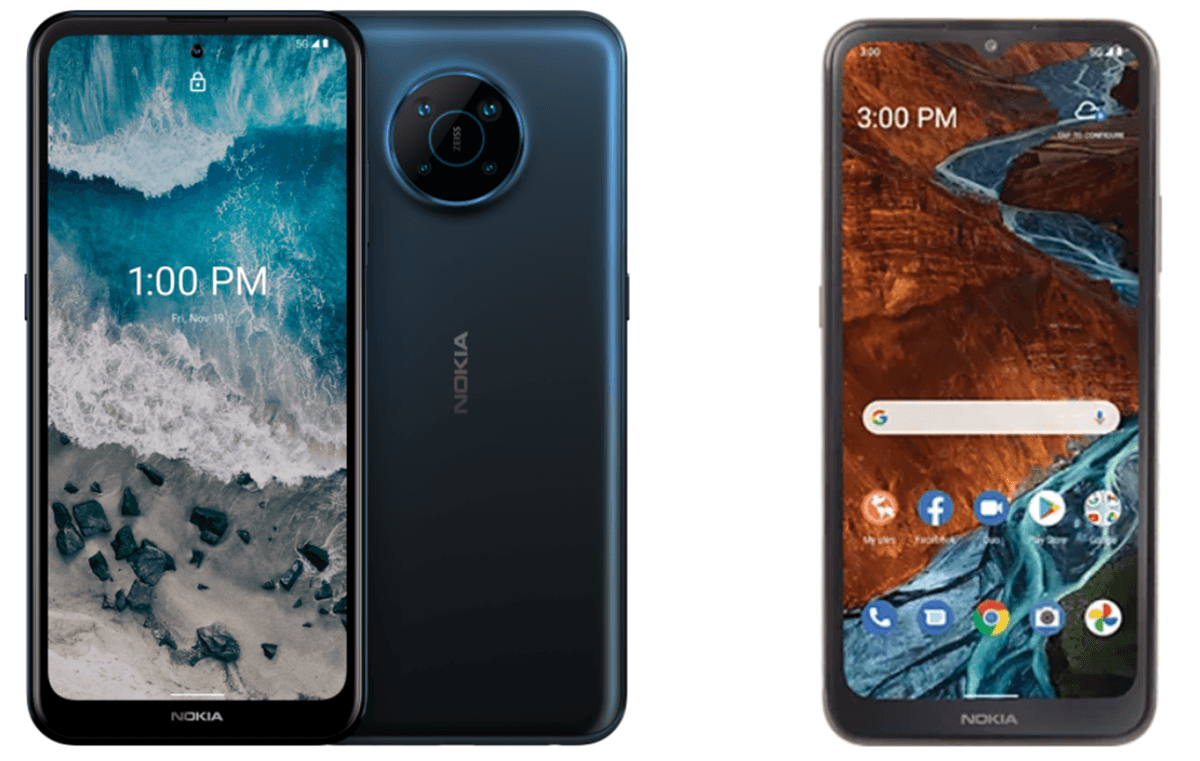
Nokia X100 5G (left) and Nokia G300 5G
Shortages continue to challenge OEMs
Supply chain disruptions will continue to pose challenges for OEMs through 2022. OEMs and chipmakers will prioritize high-revenue devices and chipsets, meaning that flagship models from Apple and Samsung will be less impacted. The low end of the market, especially LTE devices, will face steep shortages, however.
As the carriers near their CDMA network shutdowns during the first half of 2022, they will need a significant supply of low-cost 4G devices to give out to customers who stand to be impacted, increasing demand at a time when supply is already under constraint. Additionally, Verizon’s acquisition of Tracfone will require an ample supply of low-cost devices that are compatible with its network to help migrate Tracfone customers with devices that currently function on AT&T and T-Mobile’s networks. These demand drivers, on top of regular consumer demand, will lead to a significant gap between supply and demand in the first half of 2022.
The trends described above will help define the smartphone market in 2022 but are far from an exhaustive list. Other foreseeable trends include: 5G penetration to continue to rise in 2022 as 5G component prices erode, increasing pressure on OEMs to provide low-cost mmWave capable devices, and greater competition at retailers like Walmart with the entry of T-Mobile and Metro by T-Mobile and whatever Verizon has planned for Straight Talk. But the year ahead also features uncertainty, as a new wave of COVID-19 threatens fresh safety measures that could disrupt retail shopping even as inflation continues to climb, eroding the purchasing power of American consumers.


