

1. Global Smartphone Market: Performance and Regional Forecast
Overall Market Recovery
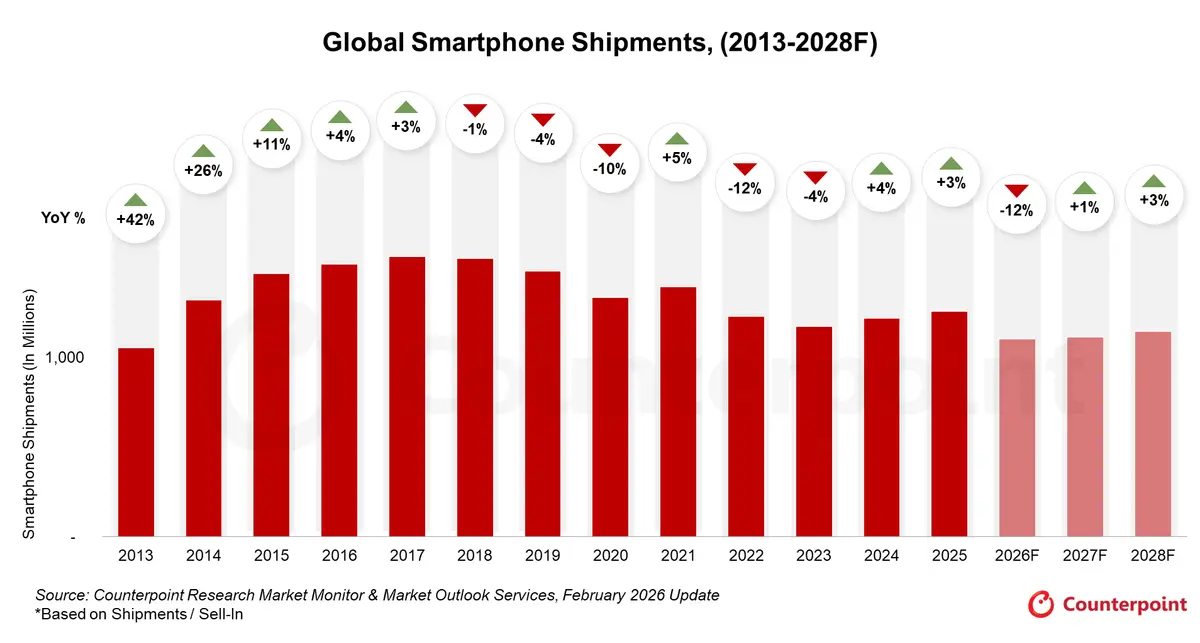
After two consecutive years of annual growth, the 2026 global smartphone market is poised for a 12% decline according to Counterpoint Research's Market Outlook service (reported in March 2026).
Memory shortages due to the AI boom are shrinking the DDR4 supply. Rising component costs are negatively affecting the low-end, sub $200 segment of the market while the premium segments remain more resilient.
Despite a decline in shipments, which is projected to drop below 1.1 billion units, lowest annual volume since 2013, global ASPs will continue to increase, reaching $414 in 2026, from $370 in 2025. Emerging markets, including the Middle East and Africa (MEA), Latin America and Asia Pacific are the hardest hit regions due to the memory crunch and projected OEM consolidation in the low-end. According to Counterpoint, the $1,000 and above smartphone price band represents the largest segment by volume outside of devices under $200, making up 10% of all shipments in 2025. This segment will remain key in 2026 and beyond as memory shocks are less prevalent there and consumer demand continues to rise for ultra-premium devices due to unique form factors, top of the line cameras, and best-in-class performance.
Key Brands and Regional Dynamics
The top five OEMs globally in Q1 2026 (Apple, Samsung, Xiaomi, Oppo, vivo) made up 72% of all shipments and make up a higher proportion of $1,000 and above smartphone shipments, indicating a highly concentrated market with clear user preference for ultra-premium devices. However, the competitive landscape beyond the top five is also shifting and showcasing divergent growth strategies. Honor, Google, and Nothing were among the fastest-growing OEMs in Q1, each focusing on different approaches. Honor pushed expansion into non-Chinese markets, while Google doubled down in focus on its existing strongholds. Nothing showcased that consumers are looking for niche designs and concepts as consumers resonated with its continued focus on brand positioning.
Regionally, markets that are driving the highest ASPs are North America, Western Europe, and the Middle East.
- North America: North America has the highest smartphone ASP, forecasted to reach $745 in 2026, according to Counterpoint. The carrier device subsidy model and high upgrade rates support above-average ASPs. However, there is extremely strong consolidation in the market, with Apple, Samsung, Motorola, and Google having over 90% market share in 2025.
- Western Europe: Western Europe has the second highest regional forecasted smartphone ASP at $618 in 2026. The market is characterized by Apple and Samsung dominance in the premium tier, with Honor holding a competitive mid-range position. Extended software support and easier repair requirements are emerging purchase criterions among European consumers and backed by the EU, which may drive up ASPs further in years to come.
- The Middle East: Although making up smaller overall volumes compared to other regions, countries in the Middle East like Saudi Arabia, the UAE, and Qatar boast some of the highest shares of $1000 and above smartphone sell-ins globally. This makes the region an important market segment for ultra-premium smartphone brands due to the increased demand from consumers for high-end smartphones.
2. The $1,000+ Tier: Premium Market Deep Dive
Market Scale and Growth
The ultra-premium tier is the most strategically significant price band in the global smartphone market, especially now with looming memory price shocks and OEM low-end consolidation on the horizon in 2026.
There are several consistent premium purchase drivers in the $1,000+ tier:
- Camera and imaging excellence: Imaging remains the most visible competitive battleground among ultra-premium brands, with each major OEM anchoring its premium narrative around camera system advancements.
- Design and materials: Titanium chassis adoption across Apple and Samsung's top-tier models reflects consumer willingness to pay for premium materials. Design differentiation is an increasingly important purchase signal.
- Software longevity: Multi-year OS and security support commitments are now a competitive requirement at the premium tier.
- Foldable form factors: Foldables remain a niche but growing category. Foldable devices accounted for less than 2% of global shipments, but their above-average ASPs continue to pull up the ultra-premium average.
- GenAi: While it was a big buzzword in 2025, current consumer adoption of GenAI use cases remains limited. However, OEMs are continuously evolving their GenAI capabilities. Agentic AI is emerging as the next unique offering in premium smartphones, aiming to go beyond GenAI assistants by enabling more autonomous, context-aware, and action-oriented AI experiences.
3. Ultra-premium Segments: Characteristics and User Profiles
The global smartphone market has undergone significant segmentation, with leading OEMs differentiating their flagship offerings around distinct use cases to stand out amongst the crowd. Several mainstream positioning clusters that are shaping product strategy and marketing across the ultra-premium price tier are:
Business and Productivity
Business-oriented smartphones prioritize security architecture, long software support commitments, and deep integration with enterprise productivity tools. Samsung's Galaxy S-series (with Knox security) and Apple's iPhone (with the Secure Enclave) are the dominant players in this segment. The typical buyer is a corporate professional who values reliability, ecosystem integration, and multi-year software support. Agentic AI here also shows the clearest benefit to users in their daily interaction with their device. Foldable smartphones have also seen greater adoption due to their focus on productivity use-cases due to the novel form factor.
Photography and Imaging
Camera capability is one of the most powerful purchase drivers in the premium and ultra-premium tiers. Imaging as a key differentiator when choosing between flagship devices. This segment is driven by the professional creator economy, social media content production, and the growing expectation that a flagship smartphone can substitute for dedicated cameras.
Brands most associated with imaging leadership include Huawei (Leica-tuned systems on Pura and Mate series), vivo (Zeiss collaboration on X-series), Apple (Computational Photography and Cinematic Mode), and Google (Pixel's strong imaging software stack).
Luxury and Prestige
The luxury segment is defined by materials (titanium, sapphire glass, premium leather finishes), exclusivity, and brand narrative rather than specifications alone. The ultra-premium category makes up +40% share within the broader premium segment ($600+) in 2025 — a reflection of how status-driven purchase motivations are intensifying at the top of the market. Apple's titanium-framed iPhone Pro series, and foldables from Samsung, Oppo, vivo and Xiaomi, exemplify this trend. Consumers here not only want the best smartphone in terms of specs, but they also pay close attention to how these smartphones reflect style, fashion, and prestige.
4. DREAME AURORA: A New Challenger in the Ultra-Premium Space
Entering a Consolidated Market
DREAME AURORA is a newly launched high-end mobile phone brand that has positioned its debut flagship, the DREAME AURORA NEX LS1, directly in the $1,000+ ultra-premium segment. This is one of the most difficult markets to enter, given the dominance of the top 5 OEMs in this space having significant brand equity and ecosystem depth these incumbents have accumulated over decades.
For DREAME AURORA, there are several additional challenges the brand needs to face in this segment. Brand mindshare is heavily contested in the premium tier. Brands like Apple and Samsung have spent decades building trust, heritage, and ecosystem depth to bolster their mindshare.
In addition, the iOS software ecosystem strength (apps, OS maturity, developer support) is a known friction point for Android OEMs who want to convert Apple users.
Nevertheless, DREAME AURORA may have found a market entry point that is arguably more favorable today than at any point in recent years. The ultra-premium segment is experiencing structural growth, not cyclical growth — driven by durable shifts in consumer preference, financing accessibility, and the premiumization across developed and emerging markets. A brand that enters with the right mix of technology differentiation and design narrative may have some chance of gaining a foothold. DREAME AURORA’s focus on industrial design innovation, advanced imaging module, and on-device AI processing could fit very well into the ultra-premium space.
5. Conclusion
The global smartphone market in 2025 was defined by premiumization, the rise of GenAI, and growing competition for the loyalties of the highest-value consumer cohort. The $1,000+ ultra-premium tier represents one of the strongest segments for growth momentum in 2026 and beyond. Brands that operate in this space have some of the deepest consumer brand loyalties, and the greatest potential revenue returns in a declining market amidst memory pricing shocks.
Brands that win the $1,000+ tier will be those that most clearly deliver a differentiated technology and design experience that justifies the premium price of the device. Companies like DREAME AURORA have identified the right battleground but whether it can execute at the pace and consistency required to convert its technology bets into lasting consumer trust will be the defining question of its next years to come.

