
- Singapore and Seoul held on to first and second place, respectively, for the second year running on the strength of wider AI adoption.
- Abu Dhabi jumped to third from eighth and Dubai held fourth, putting both UAE cities ahead of every US and Chinese city.
- The US and China each place four cities in the top 15, with US strength led by San Francisco and China’s broadening beyond Beijing as Shanghai and Shenzhen close in.
- Europe’s presence has consolidated entirely around London, while slower implementation is holding the region back.
- India makes its debut in the top 15 as Bengaluru enters the rankings, with Delhi and Mumbai gaining momentum.
Beijing, Berlin, Buenos Aires, Los Angeles, Hong Kong, London, New Delhi, Seoul, Taipei, Tokyo – November 24, 2026
Singapore retained the top ranking ahead of Seoul, repeating the 2025 ranking order, according to Counterpoint Research’s 2026 Global AI Cities Index, in what remains a close race. Further, the UAE has emerged as the leading hub, with Abu Dhabi rising into the top three, and both Abu Dhabi and Dubai are now ahead of every US and Chinese city.
Building on its inaugural edition, the index returns for a second year of global analysis, assessing AI adoption across the world’s 100 largest metropolitan areas through a 10-factor framework. This year’s edition analyzed more than 6,000 public and private sector AI initiatives, up from about 4,800 last year. Further, it adds new categories including AI City Apps and Physical AI.
Looking at how the rankings have evolved, Research Director Marc Einstein said, “The global AI city landscape is becoming more competitive. The cities pulling ahead are the ones where government, industry and infrastructure move together, and Singapore and Seoul show what that looks like in practice. Further, Abu Dhabi and Dubai show how quickly focused investment can translate into results.”
“The gap between AI ambition and AI implementation is becoming more pronounced,” Einstein added. “The cities that close it fastest will be the ones climbing the index in the years ahead.”
Counterpoint Research’s Top 15 AI Cities Rankings, 2026
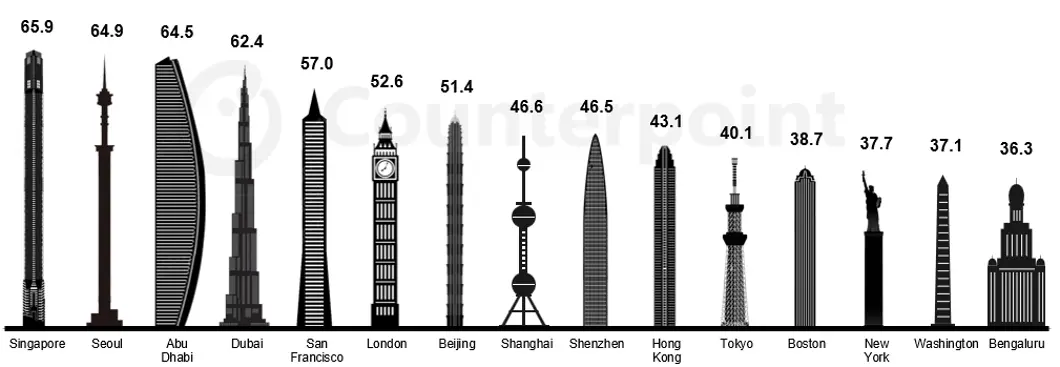
Source: Counterpoint Research AI 360 Practice – Global AI Cities Report 2026
*Scoring measures the development of AI in each city; maximum score 100.
AI CITIES INDEX LEADERS
Asia still leads, but the top spot is a two-city race. Asia and the Middle East now hold the entire top four.
- Singapore sustains its leadership, reflecting a model in which public investment turned into private momentum. In the last study for the calendar year 2024, AI activity was led by the public sector, as government programs, funding and policy set the direction for AI adoption across the city. In the current study, enterprises are following the lead. Private-sector initiatives have overtaken public ones, driven largely by healthcare, followed closely by company expansions, as foreign firms open AI centers, research labs and regional headquarters in the city. This shift suggests that public investment is paying off. The government created the conditions, and global businesses are now choosing Singapore as their base for AI in the region. Taken together, the findings point to momentum concentrated among a select group of anchor institutions: IMDA, MAS, Synapxe and AI Singapore on the public side, and DBS, Grab, Google and Microsoft on the private side, with Singtel’s Nxera adding AI data-center capacity, positioning Singapore as Asia Pacific’s leading AI hub heading into 2026.
- Seoul holds second place, driven by the public sector, with government-led AI initiatives growing by more than two-fifths in 2025, and hence, outnumbering private sector activity. Education is the top category on both sides. On the public side, it leads in public funding, government efficiency, and public safety, and on the private side it leads in AI software innovation and healthcare. Scale, government momentum, and shared focus add up to Seoul’s strong position in the index. Overall, Seoul’s AI activity was shaped by the Seoul Metropolitan Government, the Seoul AI Foundation and Seoul AI Hub on the public side, and Naver, LG, Samsung and newly arrived OpenAI scaled commercial adoption, with SK Telecom adding an AI curriculum with Seoul National University.
- Abu Dhabi records one of the biggest gains and captures the third spot. Its momentum centered on AI software innovation and investment, data-center infrastructure, financial services and healthcare, led by firms including G42, Presight, PureHealth, Microsoft, Oracle, and Khazna. Public entities advance AI adoption across essential services via the TAMM app, while private firms provide capital, technology, and infrastructure, collectively strengthening Abu Dhabi’s AI ecosystem.
- Dubai held fourth place, driven by government-led AI activity. AI initiatives rose by more than half in 2025. Public initiatives grew faster than private ones and made up more than half of the new activity. The gains are concentrated in city management, public safety, and government efficiency, with Dubai Police, RTA, DEWA, and Digital Dubai each expanding their AI services during the year. Private initiatives also grew strongly, and Dubai and Abu Dhabi now both rank ahead of every US and Chinese city.
- San Francisco is the only North American city in the top five. Boston, Washington D.C., and New York City all sit in the lower half of the top 15. US cities lag mainly because local governments are doing relatively little. Strong growth in data center capacity keeps the US competitive overall.
- Europe’s position has narrowed to London, which takes sixth place. London is the only European city in the top 15 after Paris and Madrid dropped out. The region has plenty of AI initiatives, but implementation is lagging.
- China’s AI leadership is broadening beyond Beijing, as the capital moves down the rankings and Shanghai and Shenzhen advance, with China’s four ranked cities now clustered together in the top 10. Overall, the country’s AI activity is led mainly by public-sector initiatives.
- India makes its debut in the top 15, with Bengaluru securing a spot in the rankings. Notably, Delhi and Mumbai are gaining momentum, though they have yet to break into the top tier.
WHAT’S NEW IN 2026
To rank the top 100 AI cities in the world, Counterpoint Research developed a methodology to quantify how the world’s largest metropolitan areas are embracing AI. To do this, we ranked each city on the basis of public sector and private sector initiatives across various categories. New for 2026, the index adds AI city applications and Physical AI categories to capture more of how cities put AI to work.
AI City Index Categories
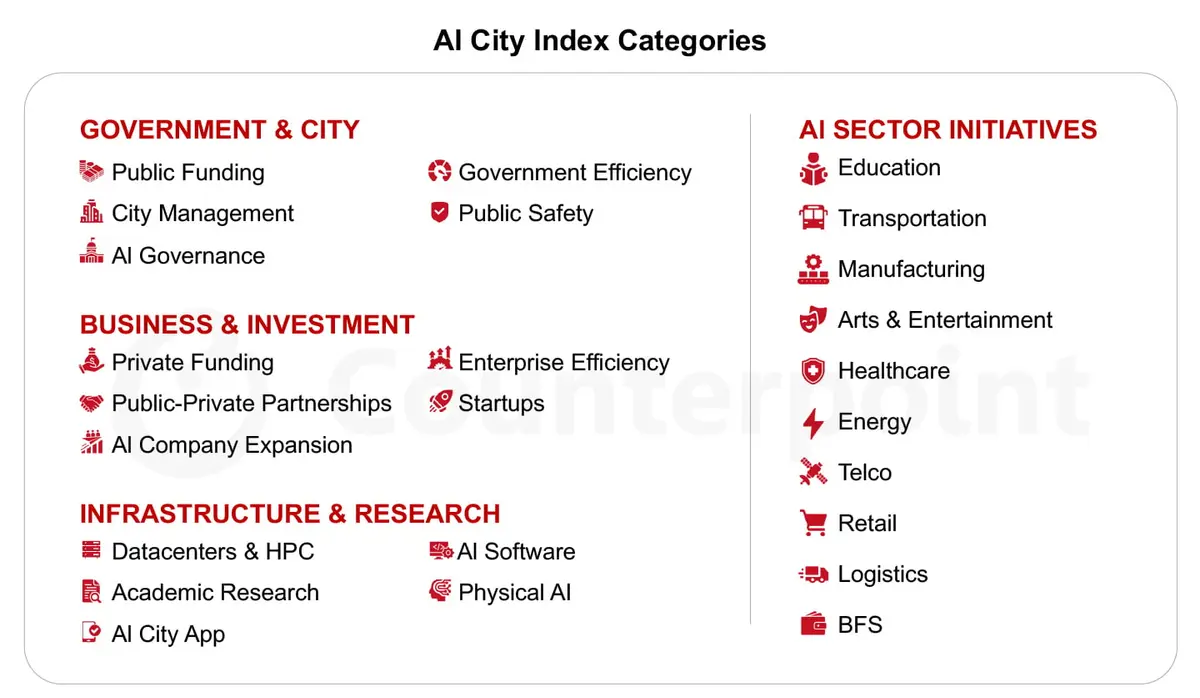
Source: Counterpoint Research AI 360 Practice – AI Smart Cities Report 2026
Press Enquiries:
For additional information please contact us at [email protected]
Analyst Contact
Marc Einstein, Research Director
[email protected]
■ Related Service: AI 360
About Counterpoint Research
Counterpoint Research is a global market research firm specializing in products across the technology ecosystem. We advise a diverse range of clients – from smartphone OEMs to chipmakers and channel players to Big Tech – through our offices located in the world's major innovation hubs, manufacturing clusters and commercial centers. Our analyst team, led by seasoned experts, engages with stakeholders across the enterprise – from the C-suite to professionals in strategy, analyst relations (AR), market intelligence (MI), business intelligence (BI), product and marketing – to deliver services spanning market data, industry thought leadership and consulting. Our core areas of coverage include AI, Automotive, Consumer Electronics, Displays, eSIM, IoT, Location Platforms, Macroeconomics, Manufacturing, Networks and Infrastructure, Semiconductors, Smartphones and Wearables. Visit our Insights page to explore our publicly available market data, insights and thought leadership, and to understand our focus, meet our analysts and start a conversation.

