- Rocket Lab’s proposed $8-billion buyout of Iridium shows the growing consolidation trend where firms are scrambling to establish vertically integrated space companies.
- Iridium is the global operator of L-band spectrum, its 66-satellite pole-to-pole LEO constellation, 2.55 million users, and its recurring revenues-based business that took decades to develop.
- The buyout makes Rocket Lab an end-to-end satellite connectivity company that covers launch services, spacecraft, spectrum, satellite constellation management, and recurring connectivity services.
- With the advancement of 3GPP NTN technology and growing usage of direct-to-device services, Counterpoint predicts more than 970 million IoT connections that can leverage satellite services by 2030.
Over the past 3 years, the space industry has witnessed a wave of consolidation and strategic investments. Following SES-Intelsat, Eutelsat-oneweb, Viasat-Inmarsat, Amazon LEO’s proposed acquisition of Globalstar, and now Rocket Lab’s proposed of Iridium for around $54 per share, valuing the company at $8 billion, is generating significant attention across the satellite and telecom sector. This deal is about more than just M&A. It marks one clear trend on how the future of the space industry will be defined by Vertical Integration. Companies are racing to control more of the space value chain, from spectrum and satellite constellations to launch and connectivity services.
What Iridium Brings
Globally Licensed L-Band Spectrum
Iridium controls the globally licensed L-band spectrum (1,616 MHz to 1,626.5 MHz), which is one of the most strategic assets in satellite communications for IoT and direct-to-device (D2D) services. For Rocket Labs, it will likely take decades to secure international regulatory approvals.
Pole-to-Pole LEO Constellations
Iridium has a constellation of 66 LEO satellites with true pole-to-pole global coverage, with no dead zones or coverage gaps, something no other commercial operator offers. For government, defense, and maritime customers, this level of coverage is non-negotiable, making Iridium a strategic partner to the US government and military. Iridium also hosts Aireon's aviation safety payload on each satellite, a space-based receiver that tracks aircrafts in real time. With this acquisition, Rocket Lab will also gain a global aviation surveillance platform.
Emerging NTN Direct to Device
With the ongoing traction of 3GPP NTN standardization, Iridium has also positioned itself through partnerships with multiple MNOs, including Deutsche Telekom and Vodafone, to enable 3GPP NB-IoT Direct capability to extend pole-to-pole coverage to any standard IoT hardware. This acquisition allows Rocket Lab to secure a strategic position in the emerging NTN-Direct and mission-critical IoT market.
Revenue Base and Million+ Subscribers Across High-value Verticals
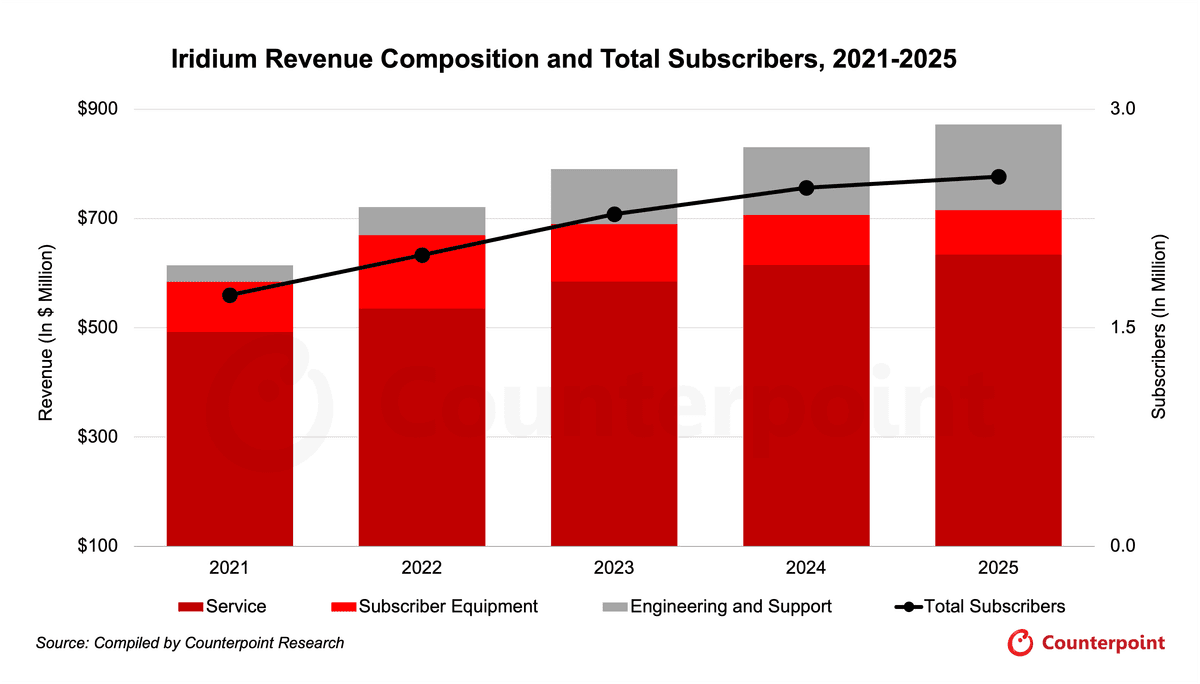
Iridium has built a strong recurring revenue base, generating $872 million in revenue in 2025 with a 2.55-million subscriber base, with IoT accounting for 79% of its commercial subscribers. Iridium's customer base is not only consumers but also governments, defense, maritime, IoT, and emergency services, making it more mission critical. These customers are highly sticky and have high switching costs, which results in predictable recurring revenue.
The Partner Ecosystem
Iridium has more than 500 channel partners who resell and integrate its network services, which has taken decades for Iridium to build. Rocket Lab can now gain leverage from and access this partner ecosystem.
What Rocket Lab Gains
Before this acquisition, Rocket Lab was one of the leading space launch companies. With its Electron launch vehicle, it has completed more than 60 successful launches, making it one of the world's leading small launch vehicles. It also has the Neutron medium-lift rocket currently under development, the Photon satellite platform (spacecraft bus), in-house satellite and key space component manufacturing capabilities. By adding Iridium, Rocket Lab moves beyond launch and manufacturing into recurring satellite service revenues while gaining the ability to design, build, launch, and operate its own constellation. More importantly, Rocket Lab is acquiring three assets that typically take decades to build – globally licensed spectrum, a recurring subscriber base, and trusted government and defense relationships.
Another interesting advantage is that when Iridium's current LEO constellation eventually reaches the end of its operational life and requires replacement, Rocket Lab can manufacture and launch the next-generation constellation using its own spacecraft platforms and launch vehicles. This reduces dependence on third-party launch providers while allowing Rocket Lab to capture the launch revenue internally.
Where the Competitive Landscape is Heading
SpaceX has built an end-to-end ecosystem covering launch, satellite manufacturing, Starlink broadband, and Direct-to-Cell services, with 96 mobile operator partnerships. So, Rocket Lab will not compete in the broadband space, although their paths may cross in future D2D services, where Iridium's L-band spectrum could be a sweet spot.
Amazon Leo is also following a similar concept by acquiring Globalstar's L- and S-band spectrum, with the same vertically integrated strategy, combining launch capability through Blue Origin, a broadband constellation of 3,236 satellites, and Apple's relationship through iPhone satellite services in the consumer market.
AST SpaceMobile remains focused on broadband direct-to-device using existing smartphones via its BlueBird LEO satellites. With nearly 60 commercial operator partnerships and strategic investors, including AT&T and Verizon, it is well positioned in the consumer broadband D2C segment.
Rocket Lab and Iridium can focus on narrowband communications, IoT, resilient PNT, and D2D services. While each company is targeting differentiated positions, they are all pursuing the same objective – to control more of the satellite connectivity value chain.
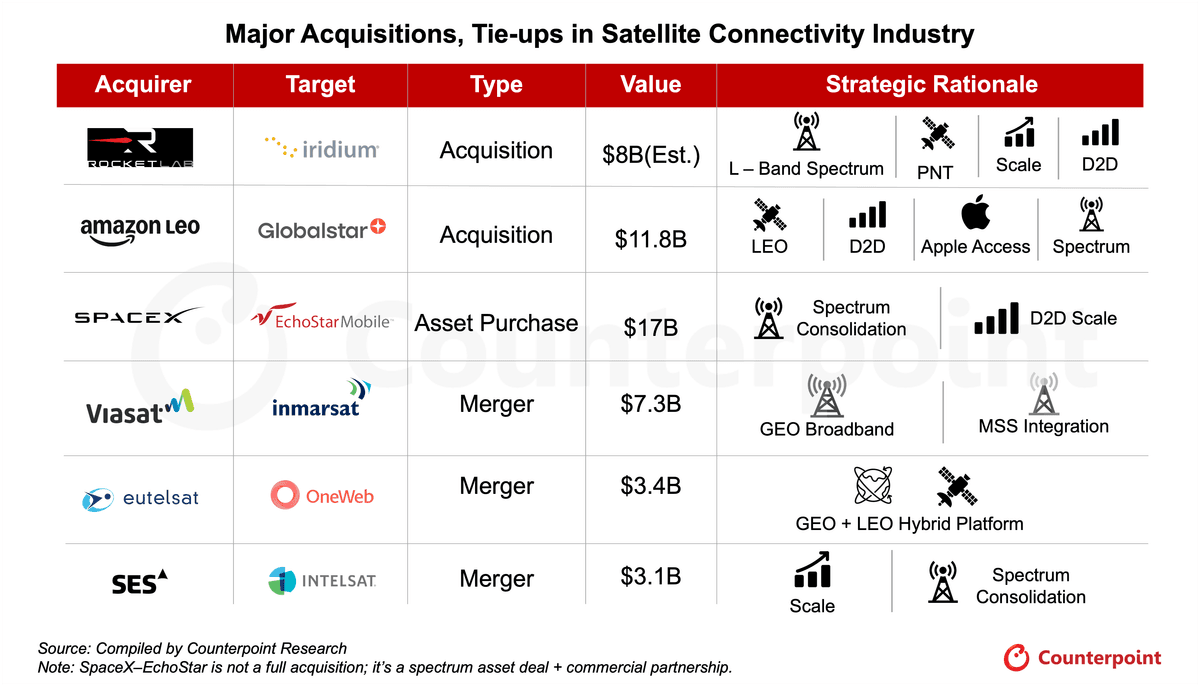
The broader context here is that the satellite industry has found a whole new level of competitive advantage where vertical integration throughout the entire space value chain and the consolidation wave highlights companies racing to lock in their position before the window narrows. With satellite and terrestrial networks increasingly converging, as 3GPP NTN standards become more mature, direct-to-device becomes the norm in all new smartphones and IoT connectivity expands across every industrial vertical, Counterpoint’s Latest Satellite IoT report estimates there is a potential opportunity of more than 970 million IoT connections addressable by satellite by 2030, making this one of the biggest growth opportunities in the technology sector over the next decade.


