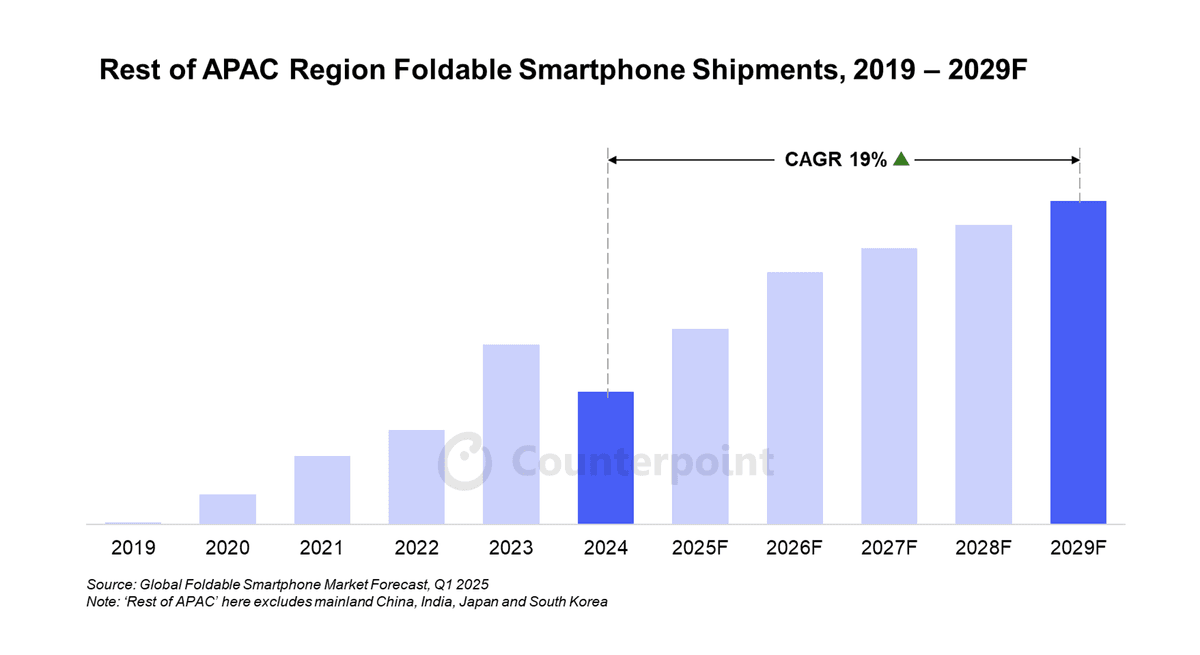
- Foldable smartphone shipments in the Rest of APAC region (Asia-Pacific excluding mainland China, India, Japan and South Korea) have grown at a 95% CAGR from 2019 to 2024 and are expected to maintain a 19% CAGR through 2029.
- Chinese OEMs are aggressively advancing into the high-end segment of the Southeast Asian and broader Rest of APAC region, delivering premium foldable devices that balance accessibility and cutting-edge design.
- Continuous breakthroughs in handheld user experience, battery technology and hardware reliability have alleviated consumer anxieties about foldable smartphones. Foldables are no longer an alternative, luxury option for APAC consumers, especially in Southeast Asia, where they are gradually becoming the primary device for daily use.
- Tailored software ecosystems, such as Origin Workbench, and AI-driven features are transforming foldable phones into versatile productivity tools, fostering user loyalty by adapting to local preferences and usage habits.
Foldable smartphone shipments have been growing rapidly in the Rest of APAC region (Asia-Pacific excluding mainland China, India, Japan and South Korea), with a compound annual growth rate (CAGR) of 95% from 2019 to 2024. This momentum is expected to continue with an estimated 19% CAGR from 2024 to 2029, according to Counterpoint Research’s latest Global Foldable Smartphone Market Forecast. Consumers, influenced by continuous brand and market education, are gradually embracing foldables as they increasingly seek premium experiences — high in quality, though not necessarily in price. At the same time, Chinese OEMs are actively expanding into the APAC market to diversify product offerings.
Foldables come with a usage learning curve, as they operate differently from traditional bar-type phones. Further, as a representative of the high-end category, foldables come with a long checklist of consumer expectations – brand image, top-tier hardware, dependable quality, and a noticeable upgrade to daily life. This mindset is precisely what drives OEMs to push the boundaries of product development. As the world’s largest foldable smartphone market, China has pushed its brands to be even more attentive to discerning high-end users. Brands like Huawei, OPPO, vivo and Xiaomi consistently tailor each new release to address the key pain points of their target audience. Moreover, OEMs like vivo are keen to democratize book-type foldables without compromising on premium quality and product tonality. Thus, foldable flagship products are no longer just a “novelty” – they are becoming the “go-to” devices for a broader range of consumers in the region.
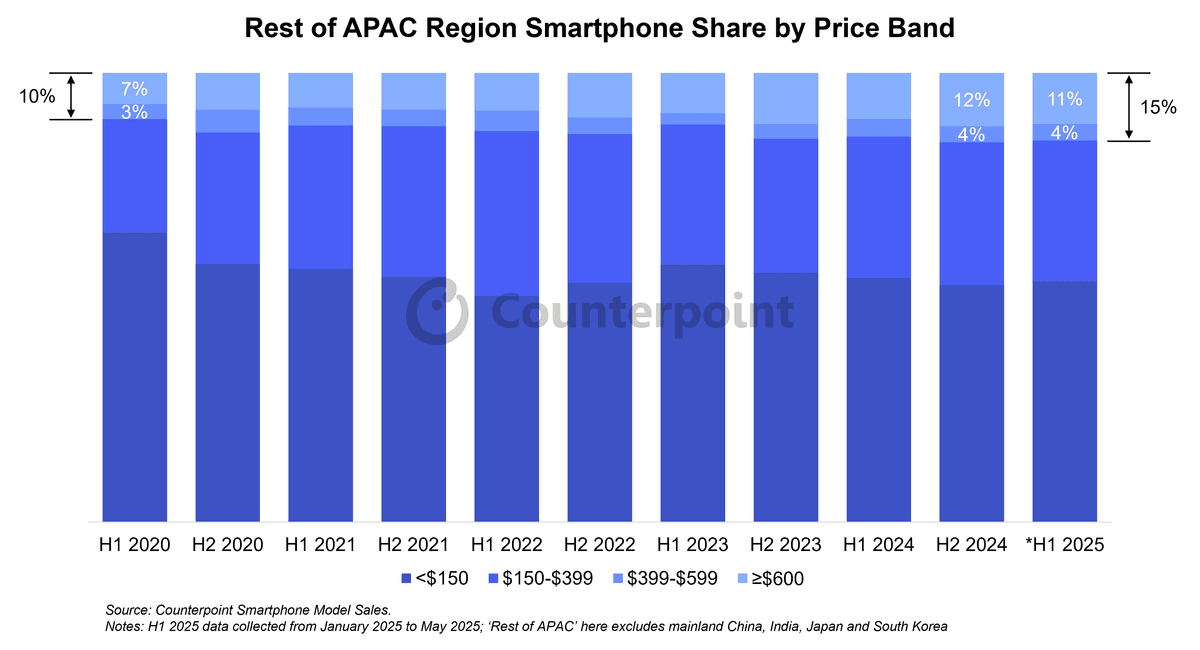
Additionally, it is worth noting that as of the first half of 2025, the Rest of APAC market for devices priced above $600 has held steady at 11% share, while the $399–$599 “upper-midrange” segment sits at 4%. In other words, as the Rest of APAC economies stabilize and gradually shift toward the premium tier, the combined share of current and potential $600+ buyers is set to exceed 15% in the following years. Apple commands over 60% of the high-end market, with Samsung a distant second at about 20%. As for foldables, they represent one of the more promising growth opportunities, with even Apple reportedly planning to launch its first foldable in 2026. Clearly, the market will benefit from more participants in the premium segment, fostering healthy competition and offering consumers a wider range of choices.
Early-generation foldables were bulky and heavy, often uncomfortable to hold for extended periods. In 2025, foldables have entered a new era – devices weighing under 220 gm (standard iPhone 16 Pro Max weighs 227 gm) and the folded thickness dipping to 9.x mm or even 8.x mm. Single-handed use is now a realistic experience. In other words, foldables have reached the dimensions and weight class of regular high-end bar-type phones. These advancements are especially significant for Southeast Asia, where the slimmer, lighter form factors better align with the preferences and usage habits of local users.
Consumers today also expect parity with bar-type flagships when it comes to core hardware – from internal components like SoCs, RAM and batteries to external components like display and cameras. Chinese OEMs have taken a bold and aggressive approach. For instance, the newly launched vivo X Fold5 features flagship-level specifications. More impressively, it manages to pack an equivalent 6000 mAh BlueVolt battery. This leap was made possible by breakthroughs in battery energy density, a result of close R&D collaboration between OEMs and suppliers. Despite having ultra-thin unfolded bodies (as slim as 4.x mm), these models also bring wireless charging to foldables, an area where some global brands still lag behind. These enhancements address battery anxiety, a particularly pressing concern in Southeast Asia where some regions still struggle with stable electricity infrastructure. Heavy users now expect their devices to last well beyond a full day on a single charge.
Southeast Asia poses unique environmental challenges – high temperatures, humidity, pollution, and dusty conditions due to underdeveloped infrastructure. These factors are driving stronger demand for device durability and reliability. Consumers perceive foldables to be more fragile, given their complex hinges and moving parts — and truthfully, early models did struggle with hinge wear, screen durability, and overall drop resistance. Chinese brands have systematically addressed these concerns by investing across the entire supply chain. Collaborative engineering breakthroughs have enabled devices to achieve high standards in waterproofing, dust resistance, drop protection, and screen scratch resistance. For example, vivo has crafted an industry-leading lightweight and durable kinematic hinge that withstands 600,000 folds in its latest X Fold5 model. It also stands out as the first foldable offering IPX8 + IPX9 water resistance and IP5X dust protection. In addition, with the advanced material application, the phone can be used in low temperatures, with resistance till -20°C.
Counterpoint’s market research indicates photography is one of the top purchase considerations for high-end phones across the APAC market. Users constantly share photos and videos, whether during professional events or everyday moments, on their social media accounts. This makes camera performance one of the quickest ways to earn trust – or attract criticism. Chinese OEMs have poured resources into imaging innovations, ensuring every generation of their high-end (including foldable) devices showcases cutting-edge camera technology. In the case of vivo, its latest foldable features a ZEISS co-engineered imaging system with ZEISS T* coating, designed to reduce flare and ghosting while improving color fidelity and contrast to deliver the signature “ZEISS Look”. Powered by vivo’s self-developed AI-enhanced imaging algorithms and ZEISS’ long-standing imaging capabilities, the output quality has significantly improved. Signature features such as Stage Mode and ZEISS Multifocal Portrait allow users to effortlessly capture precious moments, whether at work, in daily life, or enjoying time with friends or family.

In addition to hardware, software plays a crucial role in securing user loyalty. It is worth noting that some Chinese brands, such as vivo, adhere to a philosophy of long-termism and embrace a “More Local, More Global” localization strategy. Some of these brands have already established Southeast Asia-based R&D teams to focus on consumer research and deliver a localized user experience. These teams work closely with ecosystem partners to adapt software experiences to local user preferences. As usage patterns and popular apps evolve, their operating systems also evolve, often quietly solving user pain points in intuitive ways. For instance, vivo has taken a step forward with the X Fold5’s comprehensive productivity suite, which includes Origin Workbench, vivo DocMaster, Smart Call Assistant and AI Transcript Assist. Designed with professionals and creators in mind, it elevates usability across multitasking and multiple scenarios.

The APAC region remains a core focus for both Chinese brands and other brands. The region’s proximity, both geographically and culturally, to the Chinese OEMs’ home market makes it a natural battleground for them. As foldables become more productivity-focused, especially with book-type designs that unfold into larger screens, we expect them to resonate more with users in regions where digital productivity and content consumption are rising. In this context, vivo’s X Fold5 is reshaping the foldable category into an all-rounder flagship experience – thinner, stronger, smarter and long-lasting. Professionals can now choose foldables as their everyday flagship. Within the Rest of APAC region, markets with higher overall spending power will likely see faster growth in foldable adoption.
* This blog is in collaboration with vivo
