

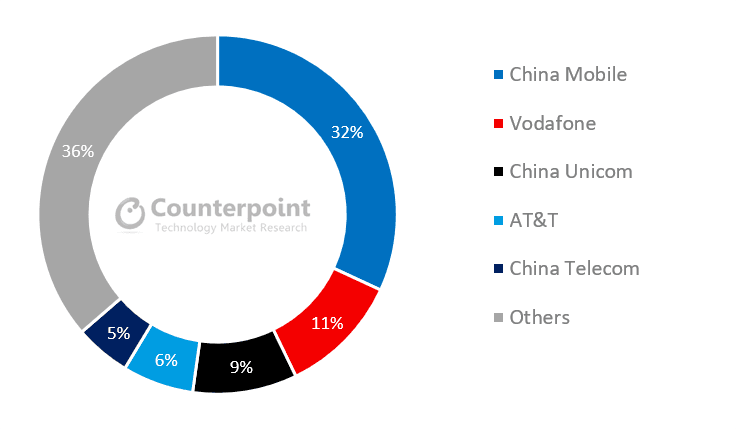
Global IoT cellular connections grew 41% annually to the end of 3Q 2017, having already crossed the half billion mark earlier in 2017. At the end of 3Q 2017, Chinese operators dominated the market holding more than 46% of IoT cellular connections. China Mobile was the world’s leading operator in terms of IoT connections. However, outside China, Vodafone leads in IoT cellular connectivity globally.
Cellular IoT acts as the backbone in driving secure connectivity for different devices to the internet and across different verticals. The type of access used will depend on the nature of the application. 3GPP WAN technologies like GSM (2G), WCDMA (3G), 4G LTE and upcoming 5G technologies, operate in licensed spectrum and have primarily targeted high-quality mobile voice and data services. However, they are being complemented with new functionality and the new radio access standards like EC-GSM, LTE-M and narrowband IoT (NB-IoT), specifically tailored to be an attractive solution for emerging low power wide area (LPWA) applications that will be the key IoT connectivity drivers alongside 5G in coming years.
At the end of 3Q 2017, 4G LTE connections were leading, accounting for more than half the cellular IoT connections and registering 84% YoY growth. Today, 4G LTE supports IoT with legacy 4G and LTE-Cat1 connections. The main application areas are for Energy Utilities and Remote Asset Monitoring. However, going forward most of these applications will be supported by cellular LPWA technologies like EC-GSM, LTE-M and NB-IoT, especially for low-power, low-data, battery-powered use-cases. These cellular LPWA connections are in the early deployment or trial phase and amount to less than 1% of the total cellular IoT connections.
Exhibit 1: Global IoT Connections Share by Cellular Access Technology
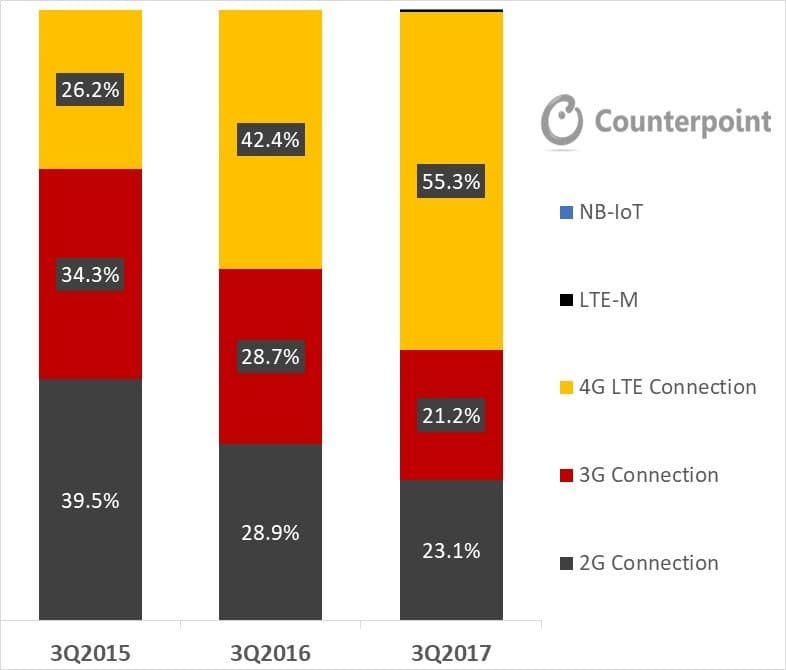
IoT cellular connectivity has been modest so far, but we expect the next half billion IoT cellular connections to be added by 2020. The upcoming dual-mode modules supporting both LTE-M and NB-IoT will further drive LPWA connections, and we will see a decline in legacy connections, as most of the earlier M2M type applications will migrate to LPWA networks. Players such as Vodafone will be able to accelerate the NB-IoT roll-outs across multiple countries, leveraging global scale to accelerate the cellular LPWA adoption internationally. China serves as a model, where Chinese operators such as China Mobile and China Telecom are ramping up the roll-out and deployments at a rapid pace. This is also having a knock-on impact of lowering the overall module (see here), device and service costs
Cellular IoT operators are well-positioned to become a single and preferred source for IoT solutions by bundling IoT devices, secure connectivity, platform and data management. While some operators might lead in offering end-to-end IoT solutions for specific verticals e.g. connected cars or asset tracking, for some verticals operators will still depend on system integrators and other solution providers to help customers deploy the complete solution. Having said that, operators are better positioned to capture maximum value in IoT, unlike in the smartphone space where much of the business opportunity was captured by OTT players. We should see a more integrated play by leading operators in the IoT space in mid- to long-term, at least is some application areas.
Exhibit 2: Global Cellular IoT Connections Share by Operator in 3Q 2017
IoT Connectivity Market Analysis – Q3 2017
- China Mobile grew 21% QoQ and leads the market with 32% share of connections. China Mobile has leapfrogged global operators, exercising enormous domestic scale, quickly transitioning to 4G LTE IoT connections and now aggressively rolling out NB-IoT connections to further exploit the IoT opportunities. China Mobile was a bit late starting its NB-IoT service but is now aggressively pursuing the service rollout. In August 2017, China Mobile issued RFPs (Requests for Proposals) for two projects, worth a combined total of CYN 39.6 billion (US$ 6 billion) to achieve nation-wide NB-IoT commercialization by early 2018:
- Wireless and core network equipment for cellular IoT 2017-2018
- Procurement of NB-IoT antennas 2017-2018
- Vodafone grew 37% YoY and holds the second position with 10.9% market share. As of 3Q2017, Vodafone had launched NB-IoT in four countries including, The Netherlands, Ireland, Czech Republic and Spain. Vodafone added commercial NB-IoT networks in Turkey and Australia in early 4Q 2017.
- China Unicom grew 39% YoY and holds third position with 9.4 % market share. China Unicom announced pre-commercialization of NB-IoT in May. Shanghai became the first trial city for its pre-commercial network. China Unicom is still in the pre-commercial stage with no officially announced tariff plan. It will have pre-commercialization in 10 domestic cities by the end of 2018.
- AT&T grew 23% YoY and holds fourth spot with 6.4 % market share. AT&T’s LPWA IoT strategy currently is focusing on LTE-M, which the operator began rolling out in 2Q 2017 with initial applications being asset tracking (pallet tracking) and smart meters.
- China Telecom grew 17% YoY and holds fifth place with 5% market share. In terms of NB-IoT, it was the fastest developing company for NB-IoT connection among Chinese operators. It completed network coverage of 800 million people under NB-IoT by the end of June 2017, and announced commercialization of NB-IoT in July. In so doing it became the first operator in China to officially kick-off the commercialization of an NB-IoT service.
- Asia grew 64.2% YoY and dominates cellular IoT connections with a 57.2% share. China is the major contributor with 81% of Asian connections and grew 75% YoY:
- Japan And South Korea grew 15 % and 25 % YoY respectively. Japan holds 5% share and South Korea holds 2% share within Asia.
- In terms of LPWA development, South Korea is ahead of Japan. S.K.Telecom, LG U+ and KT Corp commercialised their NB-IoT services in 3Q 2017. KT Corp also commercialised LTE-M in 2Q2017. South Korean Operators are looking forward to driving their LPWA connections in 2018 with specific focus areas being agriculture and energy utilities.
- Americas grew 20% YoY and holds second position with a 19.6% share. The USA’s four operators account for 68% of the connections in the Americas region. The US grew 17% YoY:
- AT&T and Verizon are the only US operators that have so far commercialised LTE-M networks – both in 2Q2017. Within the US, these two operators hold 72.5% of IoT cellular connections.
For our detailed analysis on Global Cellular IoT Connections Tracker, you can access the full report on our Insights Portal


