

- The MEA smartphone market declined 7% YoY in Q1 2026 after several quarters of growth. The pullback is strongly driven by the downturn in the entry-tier, impacted by rising smartphone prices, limited entry-tier model availability, and escalating regional conflicts.
- Compounded by the regional uncertainty and the memory crisis, MEA shipments are expected to decline further in Q2 2026, notably due to a lack of promotions and sales-driving occasions.
- Samsung grew 19% YoY, maintaining volume leadership in the region, supported by relatively stable prices and stronger inventories. Other Chinese OEMs, like Transsion and Xiaomi, have limited product availability and empty shelves in some cases.
- HONOR sustained a 154% YoY growth, driven by effective inventory levels, and continued momentum in the region’s premium markets, the GCC in particular.
Dubai, Beijing, Berlin, Buenos Aires, Fort Collins, Hong Kong, London, New Delhi, Seoul, Taipei, Tokyo – June 11, 2026
The Middle East and Africa (MEA) mobile shipments declined by 7% YoY in Q1 2026, marking the region’s first quarter of decline after a strong 2025, according to Counterpoint’s latest Market Monitor. The decline was due to increasing prices stemming from the memory crisis, as well as the regional conflict in the Middle East which led to skyrocketing shipping prices, and weakened market performance in several countries.
MEA Smartphone Shipments Market Share, Q1 2026 vs Q1 2025
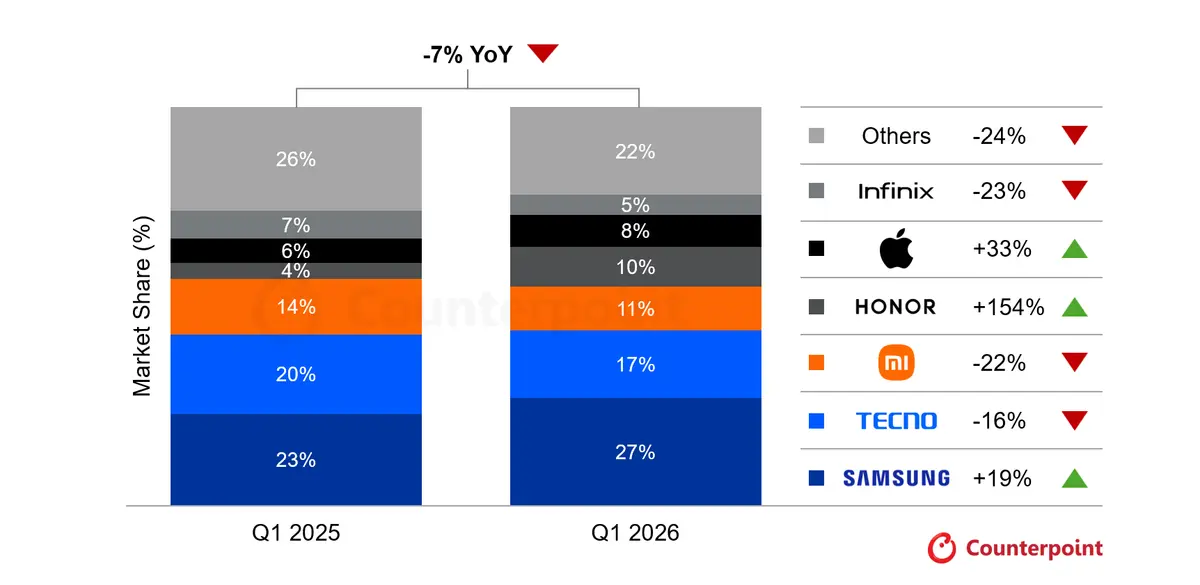
Note: Values may not add to 100% due to rounding
Commenting on the market dynamics, Research Analyst Ahmad Shehab said, “The region’s Q1 2026 performance came in below earlier expectations, with the surging memory prices being the primary headwind. Furthermore, the escalating conflict in the Middle East began to weigh heavily on the regional markets toward the end of March. These factors are more likely to exert greater pressure in Q2 2026 and the second half of the year.”
On the macro side, Shehab Added, “rising layoffs and corporate downsizing are pushing unemployment higher in the GCC’s premium markets, particularly the UAE, Qatar, and Bahrain. Furthermore, the spikes in fuel and logistics prices are adding another layer of cost on consumer goods prices across the region. Collectively, these factors are expected to lead to a net effect: a significant squeeze in purchasing power throughout the region. More critically, uncertainty has begun reshaping the market performance, particularly across emerging markets, where purchases are likely to become driven by need rather than premiumization or upgrades.”
The $50-$99 price band saw a 41% YoY decline, impacting overall smartphone market performance in Q1 2026. This segment was particularly the most exposed to regional conflicts and the memory crisis-related price increases. Looking ahead, volume declines are also expected to extend to higher price tiers in Q2 2026, hurt by the seasonality, as well as the ongoing geopolitical and macroeconomic difficulties.
Despite the overall market downturn, 5G adoption continues to gain momentum across the region. The growth in 5G adoption is particularly prevalent in the region’s emerging markets due to the expanding coverage and strategic 2G and 3G sunset plans across several countries in the near future. These factors have driven a 42% YoY growth in 5G shipments in the MEA.
Moreover, AI-capable smartphones have seen a significant 64% YoY growth in Q1 2026. However, most of this growth is still happening at the higher end of the market, i.e. the $400 and above price range, meaning the premium segment continues to capture the bulk of the AI impact in the region.
Insights on Key Brands During Q1 2026
- Samsung maintained its leadership position in terms of market share, with a remarkable 19% YoY growth in its share, supported by the relatively stable prices and stronger inventories, as well as its broader premium portfolio that limit the brand’s exposure to the memory crisis. The launch of the new premium S26 lineup also contributed to Samsung’s performance.
- Chinese OEMs, like Transsion and Xiaomi, remain the region’s most affected brands, leaving their retail shelves empty in some cases, particularly in the Middle East. Meanwhile, the impact of the memory crisis is less visible on Transsion in Africa compared to the Middle East, whereas Africa is considered the primary market for brands like TECNO and itel, as Transsion started in Africa before China, with customized and localized devices that are specifically designed for the African market.
- HONOR recorded notable growth in its market share in the MEA, surging 154% YoY. This growth has come as a result of HONOR’s strategy to build up the brand in the region’s premium markets, strengthening its position among the premium audience more than the mass market.
The comprehensive and in-depth Market Monitor - Market Analysis and Insights, Q1 2026 is available for subscribing clients.
Feel free to contact us at [email protected] for questions regarding our latest research and insights.
The Market Monitor research relies on sell-in (shipments) estimates based on vendors’ IR results and vendor polling, triangulated with sell-through (sales), supply chain checks and secondary research.
You can also visit our Data Section (updated quarterly) to view the smartphone market shares for the World, US, China, and India.
About Counterpoint Research
Counterpoint Research is a global market research firm specializing in products across the technology ecosystem. We advise a diverse range of clients – from smartphone OEMs to chipmakers and channel players to Big Tech – through our offices located in the world's major innovation hubs, manufacturing clusters and commercial centers. Our analyst team, led by seasoned experts, engages with stakeholders across the enterprise – from the C-suite to professionals in strategy, analyst relations (AR), market intelligence (MI), business intelligence (BI), product and marketing – to deliver services spanning market data, industry thought leadership and consulting. Our core areas of coverage include AI, Automotive, Consumer Electronics, Displays, eSIM, IoT, Location Platforms, Macroeconomics, Manufacturing, Networks and Infrastructure, Semiconductors, Smartphones and Wearables. Visit our Insights page to explore our publicly available market data, insights and thought leadership, and to understand our focus, meet our analysts and start a conversation.


