
Over the past few days, we have spoken with journalists, supply chain partners, and industry clients about Jensen Huang’s sudden resignation as NVIDIA’s President, Chief Executive Officer (CEO), and board member. This is more than a leadership change at one company; it will reset the pace of the entire AI value chain.
Chief Financial Officer (CFO) Colette Kress is now Interim CEO, and veteran semiconductor executive Harvey Jones is NVIDIA’s first Board Chair. For three years, Jensen did more than run NVIDIA. He set the annual rhythm for the whole AI industry, pulling foundries, memory makers, packaging partners, and hyperscalers along on a one-year cadence.
As the industry moves from one shared rhythm to many speeds, we see six implications:
1.A Solid Near-Term Roadmap Before the Rhythm Decouples
NVIDIA’s roadmap from Blackwell to Vera Rubin is locked in, and its deep engineering bench should keep the ecosystem moving for the next 18 to 24 months. After that, much depends on the permanent successor. 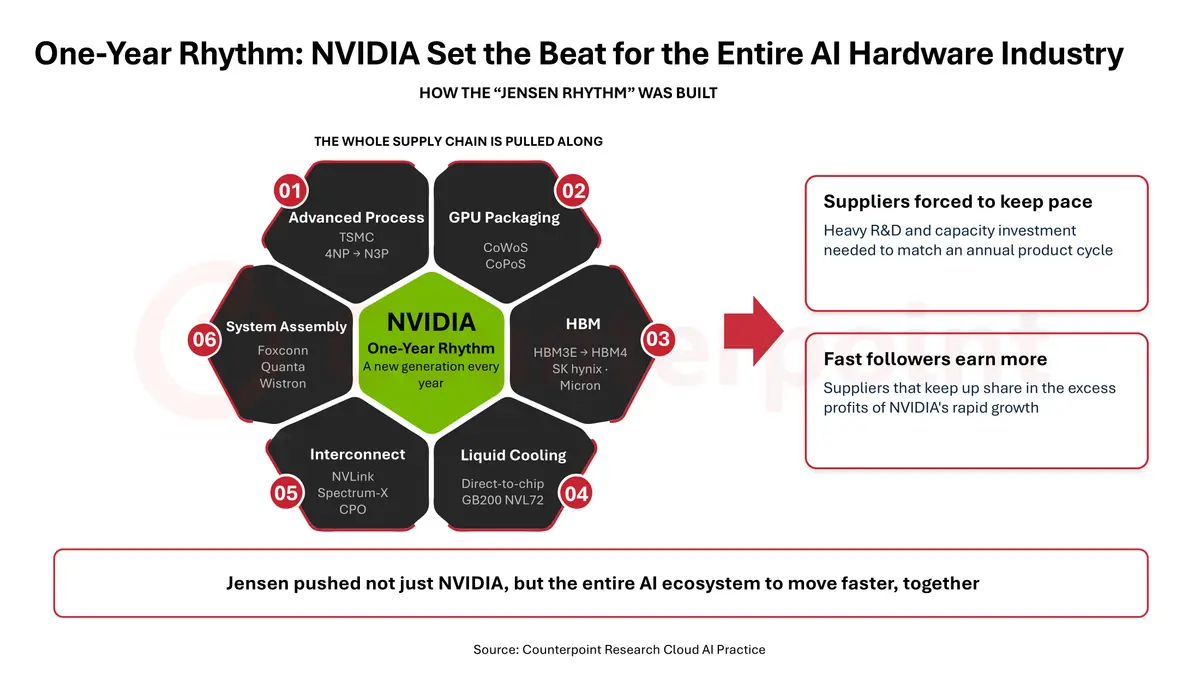
Under Jensen, NVIDIA put the whole ecosystem on an annual cycle, from TSMC’s advanced process nodes (4NP/N3P) and CoWoS packaging to SK Hynix and Micron’s HBM3E/HBM4 memory, NVLink/Spectrum-X interconnects, direct-to-chip liquid cooling, and original design manufacturer (ODM) rack assemblers such as Foxconn, Quanta, and Wistron.
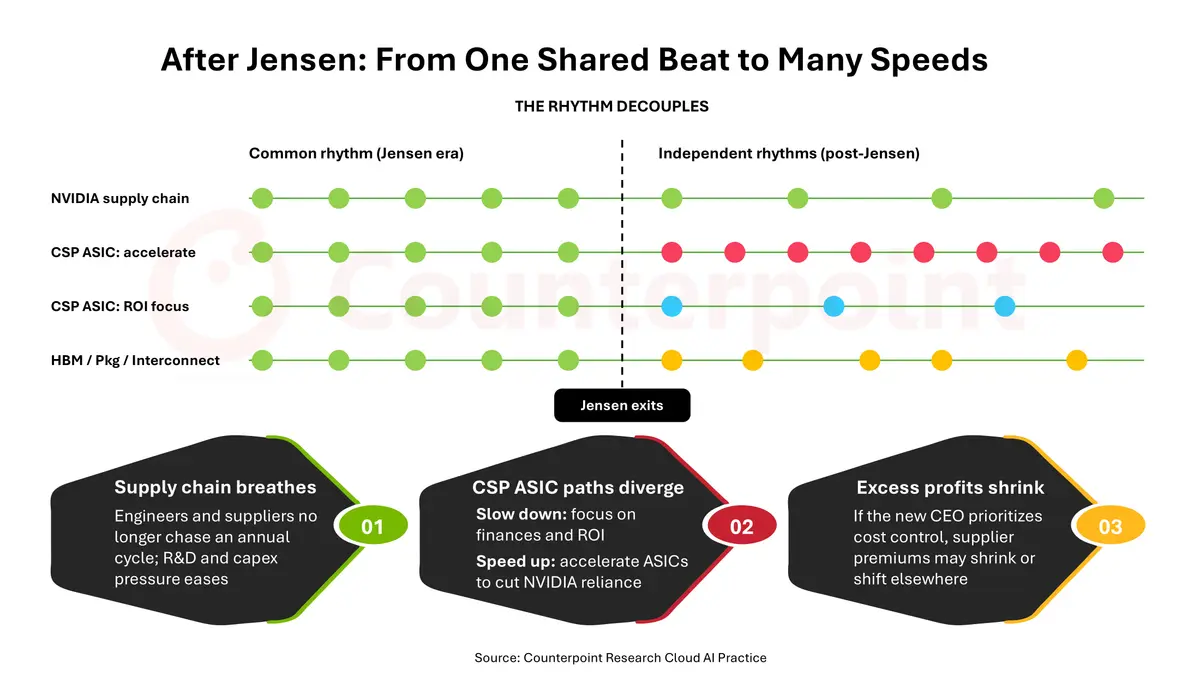
- What to watch: A pause on new, founder-driven experiments while interim and incoming leaders focus on execution and governance. If the shared rhythm slows over the medium term, suppliers and engineers get breathing room and less pressure on research and development (R&D) and capital spending. The cost is slower quarter-on-quarter growth for the supply chain.
2. The Leadership Vacuum Across the Five-Layer AI Cake
Jensen held every part of NVIDIA together. He was its technical visionary, evangelist, sovereign dealmaker, ecosystem financier, and supply chain negotiator. No single successor can cover all of that.
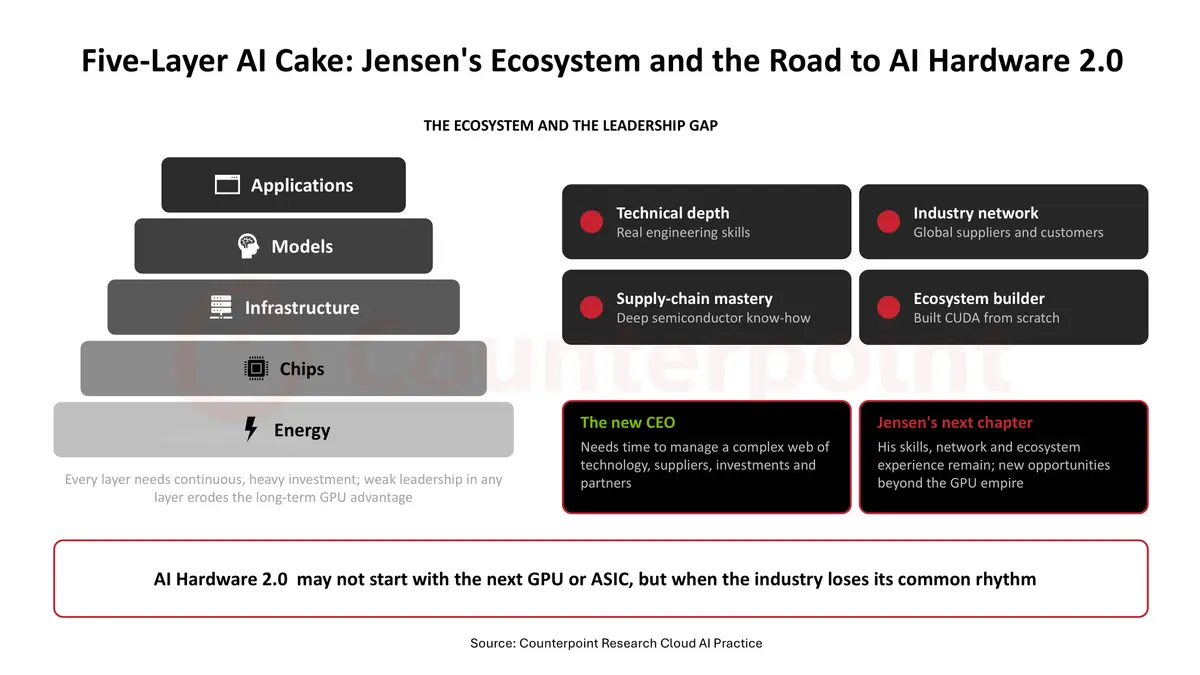
NVIDIA’s lead rests on every layer of the stack: Energy, Chips, Infrastructure, Models, and Applications, all tied together by CUDA. Each layer needs heavy investment, and weak leadership in any one erodes the GPU advantage.
- What to watch: Slower progress on sovereign AI deals and neocloud financing until a permanent leader sets the direction. Jensen’s own next move is also a wild card. He leaves with deep technical knowledge, a strong network, and years of ecosystem experience.
3. Organizational Friction & Retention Risk
For decades, NVIDIA ran on a flat structure: dozens of senior executives reported directly to Jensen, and there was no named successor. Moving to a traditional hierarchy will test the organization as long-time lieutenants adjust to new reporting lines and compete for leadership roles.
- What to watch: Senior departures in the coming quarters as the board searches for a permanent CEO.
4. Shifting Supply Chain Dynamics & Margin Compression
In conversations across the component and server supply chain, there is a mix of caution and quiet opportunity. Like Apple’s suppliers, NVIDIA’s partners have lived with a dominant customer, sharing in the profits only if they kept up with Jensen’s annual pace.
5. An Opening for Competitors & Diverging CSP ASIC Paths
This transition gives rivals, from AMD to hyperscaler custom silicon teams, their best opening in years. It strengthens our Counterpoint Research forecast that server AI application-specific integrated circuits (ASICs) will overtake GPU unit shipments next year.
Cloud service providers (CSPs) are likely to split into two groups:
- Accelerate ASICs: Hyperscalers invest more in custom chips, such as Google’s TPUs and AWS Trainium, to reduce reliance on NVIDIA.
- Focus on Finances and ROI: Other buyers slow spending and look harder at return on investment, especially as power grid limits and permitting delays in major U.S. data centre hubs push out deployments.
- What to watch: More multi-vendor chip buying in 2027 and 2028 budgets as buyers avoid depending on one supplier.
6. Tighter Global Regulations & "Export Controls 2.0"
The governance controversy around Huang’s departure has also changed the regulatory climate for AI infrastructure. Washington is moving from policing physical shipments ("Export Controls 1.0") to verifying end users and remote access ("Export Controls 2.0").
-
What to watch: More Know-Your-Customer (KYC) audits at international cloud hubs and neoclouds, longer lead times for smaller buyers, and possible regional shipment caps while regulators decide who can access AI compute. Large, compliance-cleared telecom and enterprise operators will become trusted partners, while opaque resellers will struggle.
The Bottom Line: From Founder to Scale Operator
Visionary founders such as Gordon Moore, Steve Jobs, Bill Gates, and Jensen Huang start revolutions. Disciplined operators turn them into multi-trillion-dollar institutions.
AI Hardware 2.0 may not start with the next GPU or custom ASIC. It may start now, as the industry loses its shared rhythm. The question for NVIDIA’s board is whether it can find its Tim Cook, Satya Nadella, or Sundar Pichai: a calm, technically credible operator who can lead the company into its next decade.
For detailed research, refer to the following reports available to subscribers:


