

MWC 2025 proved to be pivotal in understanding the progress of 5G-Advanced and maturity of Wi-Fi 7 markets on the connectivity side, and how different flavors of AI (ML, generative to agentic) are proliferating across categories, from RAN to routers to robots. Beyond terrestrial networks, a notable trend was interest in NTN and satellite networks, along with supporting devices from IoT to smartphones. As MWC 2026 draws close, we discuss below the topics that will likely dominate the event.
Agentic AI
This year, we will be hearing more about how CSPs, ISVs and vendors are building solutions to leverage agentic AI across the stack from RAN to OSS/BSS. Key vendors to look out for include NVIDIA, Qualcomm, Google Cloud, Microsoft Azure, Amdocs, Huawei, ZTE, Nokia, Ericsson, Netcracker, NTT Data, TCS, Ciena (Blue Planet), Deutsche Telekom, SK Telecom, Telefonica Tech, Fabrix, Kentik and Extreme Networks.
Automation
Agentic AI adoption will drive L3+ automation of networks. However, with so many solutions from different vendors, it will be very important to have some sort of standardization and openness so that different multi-vendor or multi-CSP agents can talk to each other securely and efficiently. This is where the ecosystem will have to work together with AI hyperscalers, network infrastructure vendors, OSS/BSS vendors, ISVs and organizations such as TMForum, GSMA and arXiv.
Semiconductors
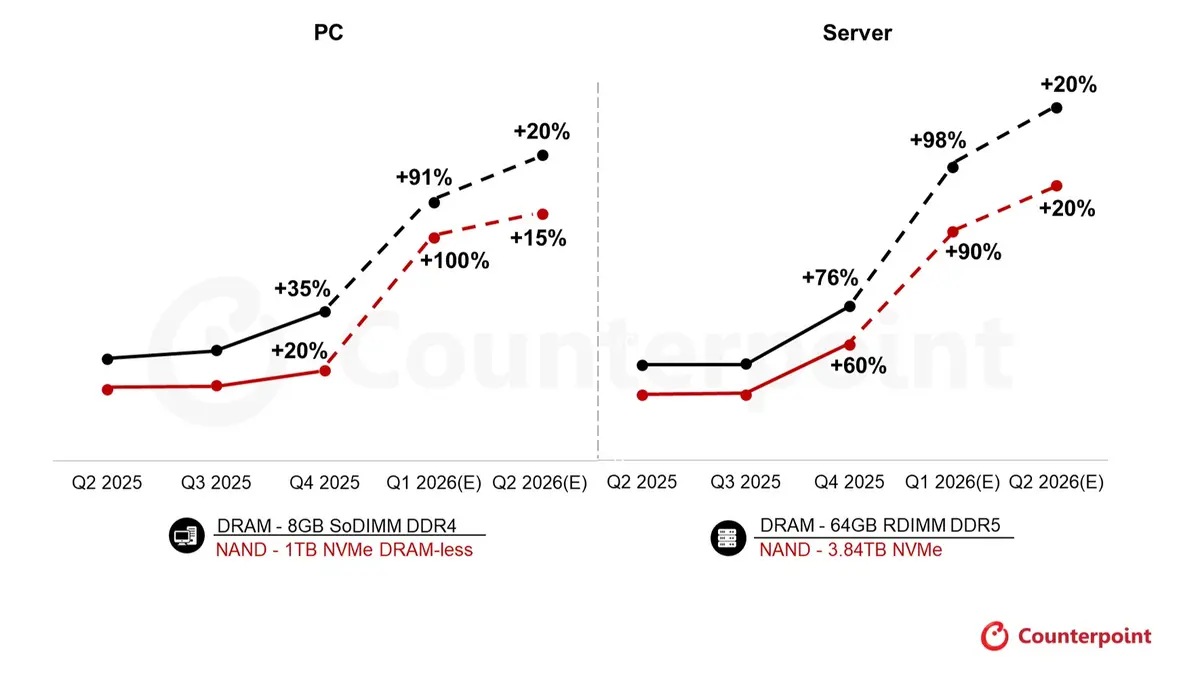
The biggest tech story this year has been the “memory winter” caused by insatiable demand for, mostly, general-purpose server DRAM. It is suffocating supply across most industries, even as prices continue to surge at an unprecedented rate. Broadband providers are also feeling the pinch, with set-top boxes and routers hit hardest by the supply crunch.
Price Trends for PC and Server Memory, Q2 2025 - Q2 2026E
AI data centers
Smart networking: Last year, major server vendors were displaying their latest and most powerful AI data center servers, with compute performance very much at the forefront. However, expensive AI clusters can underperform not because of insufficient compute but due to inefficient networking resources. AI at scale is a systems-level engineering challenge with networking at the heart of it. By eliminating data bottlenecks, boosting utilisation and delivering predictable performance, smarter networking enables more predictable AI with a faster time to insights and a better ROI on XPU infrastructure. We expect to see a greater focus on networking innovations at this year’s event.
Transition to optical-based scale-up: At the heart of smart networking is the scale-up network linking GPUs to each other. As the size of AI models continues to grow, data center operators need to scale up their networks to increase compute performance. Scale-up networks today are evolving from single racks into multi-rack compute systems, with hundreds or even thousands of XPUs. Although 224G SerDes is the state-of-the-art solution for copper-based interconnects today, the industry will transition to 448G SerDes in two to three years, for which optical interconnects using Co-Packaged Optics (CPO) will become mandatory. Expect to see server vendors showing their roadmaps for commercial CPO deployment at MWC this year.
AI server cooling: As AI workloads push the boundaries of data center infrastructure, cooling has emerged as one of the most critical challenges. Traditional cold plate-based single-phase cooling systems cannot accommodate the escalating power densities of next-generation accelerators. For example, NVIDIA’s Rubin Ultra GPU is estimated to have a Thermal Design Power (TDP) of 3.6 kW, while the Vera Rubin VR200 superchip is expected to have a staggering TDP of 5 kW. To address these challenges, the industry must turn to advanced cooling technologies such as two-phase cooling, immersion cooling, and even embedded cooling based on microfluidics, whereby cooling channels are etched onto the processors or packaging. It will be keenly watched how various server vendors are responding to these challenges and what their preferred solutions are in the short and medium terms.
AI devices
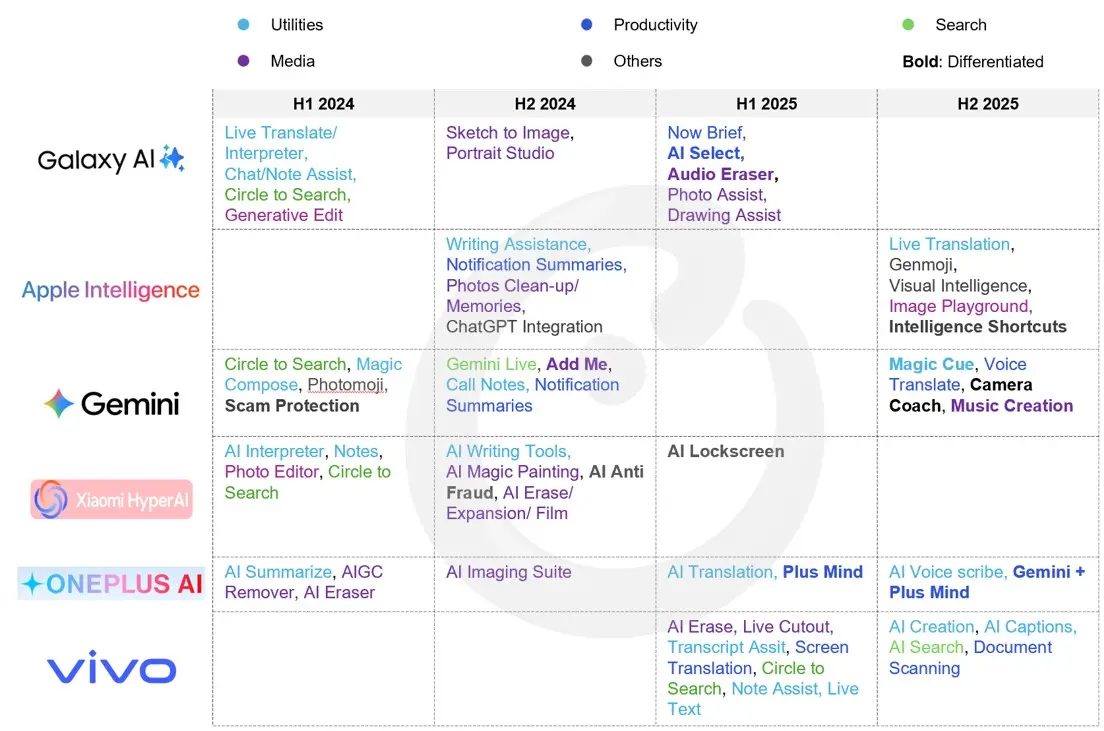
AI Feature Rollout Timeline by Key Smartphone OEMs
Consumer devices
Faced with a memory crunch and rising hardware expenses, MWC 2026 is expected to reflect a shift towards economic pragmatism rather than technological leaps. From devices, we expect key flagship launches or previews to take place (Xiaomi, Samsung, HONOR, Motorola and others) and lay a foundation for the rest of the year. We expect continued evolution of AI capabilities (either on device or in the cloud) to reach further into the overall user experience, enabling users to do more with AI in more places and, critically, with easier learning curves for users. It will also be keenly watched what type of services operators showcase, taking advantage of 5G-A and NTN, which can create new experiences that might not solely rely on increased on-board memory across device price segments to run advanced AI use cases.
Share of Book-type Foldables in Foldable Smartphone Shipments, 2020-2026(F)
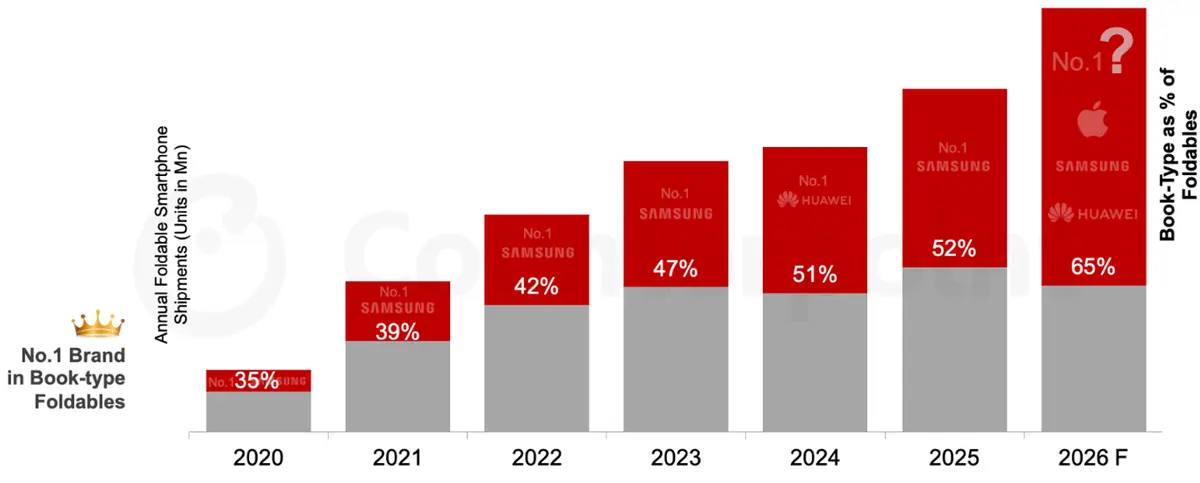
There will also be additional focus on foldable devices as the year started with Motorola’s entry into book-type foldables and Samsung launching its tri-fold in more countries. We expect companies like Huawei to also show off their tri-fold devices and other OEMs to highlight their approach towards foldables, especially when 2026 is widely expected to be the year of Apple’s foray into the segment.
Some recent trends have been noticed in the wider device ecosystem in terms of specifications. Expect a surge in Silicon-Carbon (Si/C) batteries, which allow for slimmer, lighter phones with higher capacities, alongside a focus on sustainable build quality. While still niche, Sony and Samsung are expected to show progress in glasses-free 3D/holographic displays as the “next” interface after foldables. We also expect discussions around smartphone bill of materials (BOM) trends to continue at MWC 2026 as companies look for differentiation they can control completely, without relying on memory suppliers or platform enhancements by a third-party OS developer.
Given the memory crunch, it will be keenly watched whether OEMs and AI platform providers continue to explore new AI form factors, like Lenovo’s Project Maxwell, in a meaningful way for near-term deployment.
In general, we are expecting smartphones and other devices with cameras to drive AI capabilities further into the user experience, beyond offering editing tools and moving the agentic AI interface promise forward by adding the camera feed as a key input method on which interactions are based.
Over the years, many smartphone OEMs have displayed their wider device ecosystem at the show; this year, we are interested in seeing how glasses and XR experiences evolve, now that Samsung’s Galaxy XR has been available for some time.
CES 2026 edge AI announcements
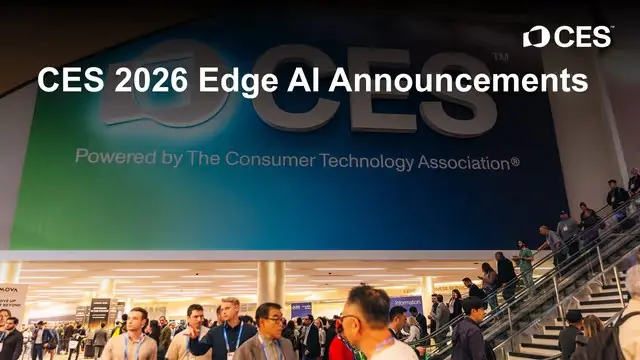
Edge AI: If previous years were about conversational AI and AI agents, this year, there will be a significant focus on edge AI. We got an early glimpse of industry focus on edge AI at CES 2026. The edge AI narrative at MWC 2026 is expected to center on embedding intelligence deeply into networks and distributed systems to enable ultra-low latency inference and autonomous decisioning on-device rather than relying solely on centralized cloud. Power-constrained personal devices and IoT sensors are likely to get special focus during one-to-one discussions. Major players like Qualcomm and Arm will be at the forefront from devices perspective, while the telcos will position themselves as infrastructure providers for edge inferencing.
Physical AI: Physical AI will undoubtedly creep more into the narrative at MWC 2026, as it did at CES a few months ago. Vendors will be exhibiting their latest innovations in AI-driven robotics, drones, cameras and vehicles as the conversation around AI is shifting back towards the physical domain. Telcos and enterprises will be keen to understand how these devices can be monetized, particularly using AI agents. Even if they aren’t on display, there will be much discussion on the upcoming AI devices from the likes of Apple and OpenAI and what their impact will be.
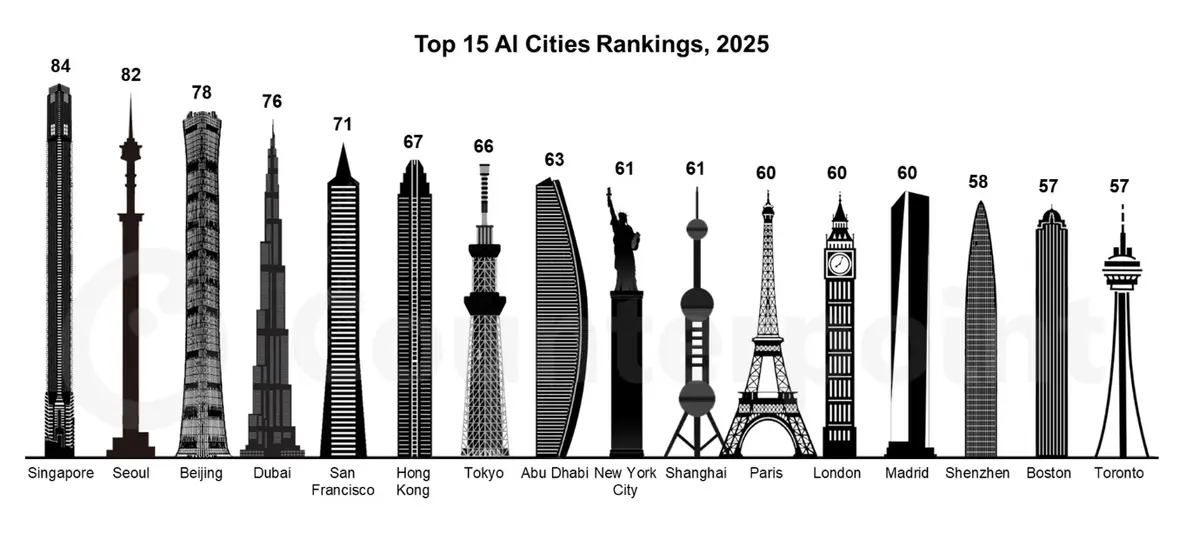
*Scoring measures the development of AI in each city; maximum score 100
Sovereign AI
Halls 6 and 7 are always buzzing with country pavilions showing off their best startups and government initiatives. We expect to see more from them on how they are using sovereign AI infrastructure to secure data, offer localized solutions and improve social infrastructure. Middle Eastern countries will be the most vocal about their progress, but it will also be telling to watch how much European nations have advanced in their plans.
6G
The next generation of mobile technology hasn’t featured strongly at the show as 5G and 5G-A still have a long way to go. But as standardization efforts move forward, we expect to hear more about it. Much of the talk will focus on the inherent technology, especially native-AI capabilities and NTN integration, but we expect a few new ideas on how these networks will monetize as well.
IoT connectivity
The theme for this year’s MWC is IQ Era, which signals the fusion of AI and connectivity as a continuing trend. We expect IoT connectivity providers to highlight their AI capabilities through connectivity management platforms (CMPs). Leading players will talk about how AI is moving beyond providing chatbots for customer service to managing operations and errors. Besides, the convergence of connectivity layers will be a key theme. Integration of cellular technologies with satellite and non-terrestrial networks (NTNs) will be a highlight, with the industry moving towards ubiquitous coverage for mission-critical use cases. Sony Altair, Murata, Skylo and MNOs such as T-Mobile and Vodafone are likely to showcase NTN and direct-to-device satellite capabilities. The new eSIM standard for IoT, SGP .32, is likely to be highlighted by key players such as Cisco, Idemia, Kigen, Vodafone, Telenor and Valid, as it simplifies remote provisioning and device interoperability across regions, essential for global IoT fleets and roaming devices.
Broadband
The broadband focus at MWC 2026 will be on the continued proliferation of FTTH access with FWA to complement operator portfolios. We expect the focus to center on next-generation FTTH solutions such as 25G-PON and 50G-PON as vendors look to enable their customers to deploy robust networks for home and enterprise use cases. Countries that adopted FTTH early are now in the upgrade phase, rolling out the next generation in fiber technology. FWA will remain in focus as operators look to extend their customer base beyond their physical network footprint. FWA will also increasingly be relevant in underserved broadband areas, where physical network deployment involves prohibitive costs.
Wi-Fi 7 will be the mainstream technology among most CPE vendors, with adoption of the new standard expected to ramp up rapidly. CPE vendors will also showcase early Wi-Fi 8 solutions, demonstrating their technological capabilities to their service provider customers.
Memory price impact
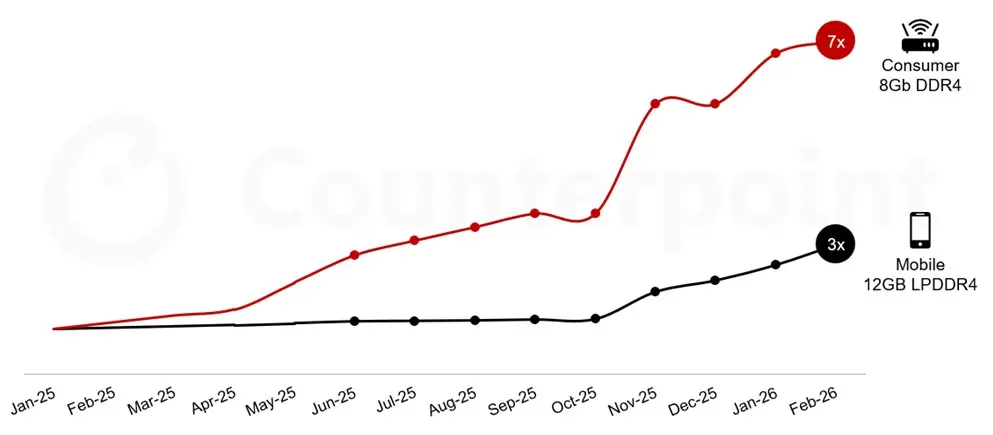
We are also being asked about memory price impact on hardware, so expect us to talk about 7X increases we are seeing in consumer 8GB DDR4 prices, and what this will mean for your business. This may adjust some of the calculus around AI CPE strategies through the short and possibly medium term.
Beyond hardware, the key theme and point of differentiation will be software and AI integration in both FTTH and FWA CPE. Vendors will either deploy their own solutions or partner with third-party software specialists to deliver compelling features. This integration will enable operators to address key pain points in today’s networks, while delivering additional services and securing new revenue streams in the future.
Consumer and Mobile DRAM Prices Skyrocketing
Wi-Fi
Wi-Fi 8 solutions will be a key theme of MWC 2026. Qualcomm is expected to showcase its solutions, following recent announcements by both Broadcom and Mediatek. While early, these demonstrations will enable device vendors to showcase their own capabilities and build strong competition in the market. Despite this, commercialization at any real scale is not expected until 2027, with the first retail Wi-Fi 8 access points expected by the end of 2026.
While Wi-Fi 8 announcements will steal the headlines, the ramping up of Wi-Fi 7 adoption will be simmering under the surface. Access point and device vendors will be utilizing Wi-Fi 7 as standard in their latest hardware. This trend will be seen across CPE, consumer devices, and some enterprise/industrial use cases.
Explaining SGP.32: How it’s Shaping Connected Device Ecosystem
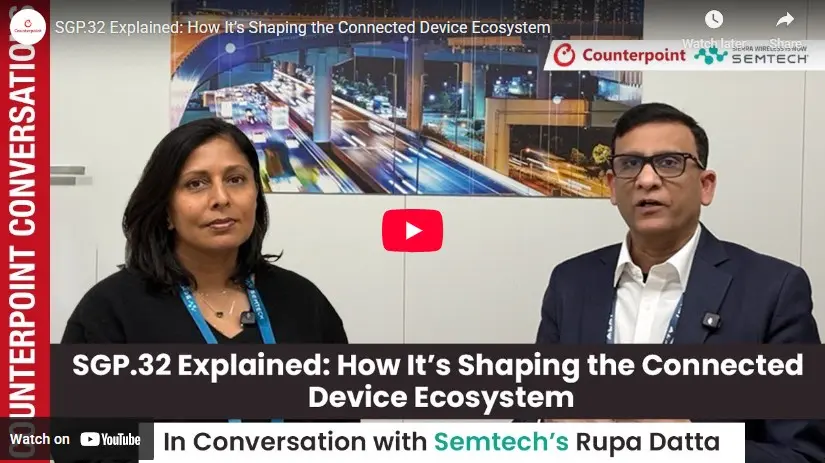
Source: ‘The SGP.32 Playbook’ White Paper – Enterprises’ Guide to Deploying New eSIM IoT Standard
eSIM
A key theme for eSIM platform vendors this year will be to showcase or highlight case studies done on SGP.32 in 2025. Beyond this focus, we expect many vendors to showcase enhancements in orchestration solutions in both consumer and IoT domains to streamline customer and device onboarding journeys. Use of AI to enhance customer experience, fraud detection and anomaly detection is among the expected use cases to be showcased. Further adoption of AI in managing inventory at the eSIM profile level could also be highlighted. A lot of platform vendors are expected to showcase travel eSIM-based solutions for MNOs, MVNOs, MVNAs and enterprises such as airlines and third-party hotel booking apps. In 2025, there has been a marked increase in transactions related to travel eSIM and vendors are eyeing this end of the market to be a revenue driver in the near term until eSIM in IoT takes off.
Sustainability and circularity
With AI accounting for an ever-increasing proportion of mindshare, we expect sustainability to take a back seat at MWC, again. There will no doubt be lots of talk around using AI to make networks and operations more efficient, but that will probably be the extent of it. But one area that could, and should, be higher on the agenda this year is device circularity. With rising memory costs inevitably leading to higher prices of new devices for consumers, more will be turning to refurbished devices this year than ever before. Device refurbishing and repair was there as an undercurrent at previous MWCs, but we expect it to be more prevalent this year.
Consumer perception
Understanding what consumers expect from new technology and what their experience is remains of critical interest as it shapes demand and can highlight opportunities for products and services. Research conducted by Counterpoint in 2025 showed that a quarter of GenAI-aware respondents do not use GenAI due to limited use cases and concerns around privacy and scams. However, the use of GenAI in emerging markets is higher where respondents use go-to features like image and video generation, along with the leading writing assistance tools.
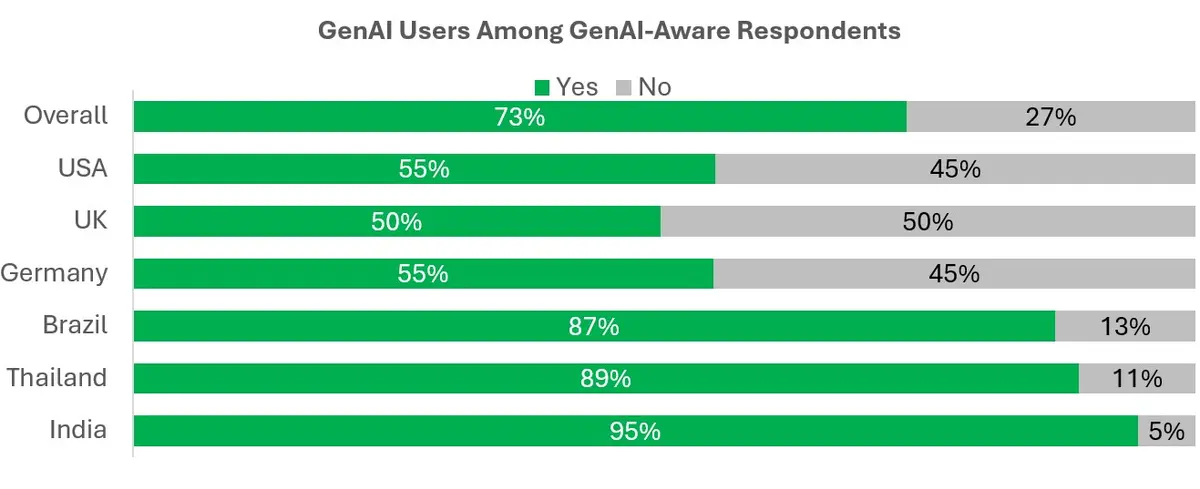
With increasing accuracy, availability and consumer understanding of use cases as well as the development of agentic AI, consumer adoption of AI tools in everyday life will increase and change quickly as the value proposition is enhanced. Whether this will drive productivity or dependency remains to be seen and has to be monitored through consistent primary research. Some key factors impacting deployment and adoption include the UI/UX of agentic AI across the spectrum of call centers, vehicles, smartphones, wearables and IoT devices. Applying learning from business use cases, for instance, in a core BSS/OSS network operation center will influence consumer applications due to the persistent drive to increase efficiencies in enterprises, which accelerates deployment.


