Jensen Huang is traveling through Korea making much fanfare on his four day trip which started June 5th. He is holding back-to-back meetings with the heads of major conglomerates over chicken and beer, the pairing called Chi-maek in Korea. This is right after Computex, Taipei so this signals the significance of Korea to Nvidia’s future strategy alongside Taiwan.
Source: NvidiaNaver chairman Lee Hae-jin, LG Group chairman Koo Kwang-mo, SK Group chairman Chey Tae-won, NVIDIA founder and CEO Jensen Huang
The Itinerary: Memory, Robots, Hyperscalers to Gaming
Looking at the itinerary, this trip was both a trip to secure supply and accelerate demand for the next wave of AI.
Hyperscalers: Dinner with the heads of LG, SK and Naver.
Gaming: PC café visit with Chairmen of NCsoft and Krafton, Korea’s top gaming companies.
IndustrialRobots & Automation: First pitch at baseball game with Doosan group chairman alongside individual sessions with Hyundai Motor Group.
Memory Supply & more: Separate meetings SK Hynix to Samsung Electronics
Most important priorities and drivers for this visit thus far:
Supply Side: Securing Memory (HBM) for Next Generation NVIDIA AI Factories Infrastructure:
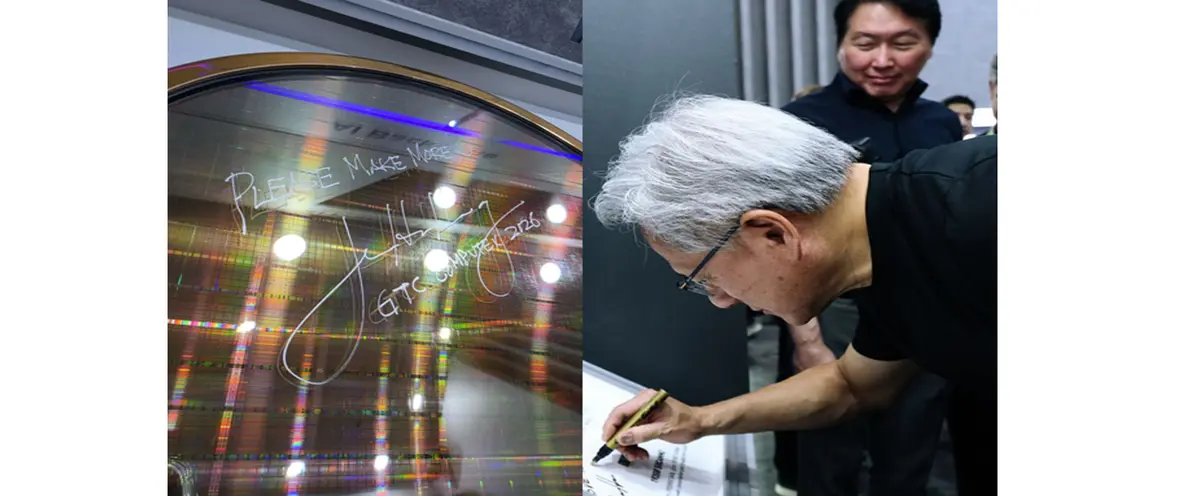
The keys to memory lies with Korea to break the “memory wall”. During Computex 2026 Jensen wrote "PLEASE MAKE MORE" on a wafer in front of SK group Chairman Chey revealing his desire to source more. Nvidia is taking this opportunity to deepen its ties with Korea.
Source: SK Hynix
Jensen Huang (NVIDIA CEO) handwrites on an HBM4E wafer while visiting the SK hynix booth at the Nangang Exhibition Center in Taipei, Taiwan during Computex 2026.
With Vera Rubin ramping, HBM4 supply from SK hynix and Samsung alongside growing DRAM content for the Vera CPUs in Agentic Era is going to be the key choke points for NVIDIA's revenue. According to Counterpoint’s Memory Tracker SK Hynix controls 57% of the global HBM market and Samsung aims to take some share away with HBM4 wins at NVIDIA. However, the bit and packaging remain the bottleneck. NVIDIA needs to guarantee priority allocation for upcoming HBM4 and HBM4E nodes, where design integration moves from traditional memory interfaces to advanced foundry base dies. This trip also gives Jensen, key insight into progress of Samsung’s HBM qualification status.
Demand Side: Physical AI & Sovereign AI are the key next markets with Korea a great case study for NVIDIA
Physical AI is also an important reason for Jensen’s visit to Korea. Hyundai's robotics center, Doosan's humanoids, Boston Dynamics' Atlas hint that NVIDIA is considering Korea as a manufacturing-and-robotics proving ground. Korea's combination of heavy industry, automotive scale, and robotics gives it a unique angle that the US and Taiwan lack. For NVIDIA, owning the software/simulation layer (Omniverse, foundation models) of the emerging humanoid industry is a strategic land-grab beyond GPUs for AI LLMs.
Jensen told media that “Robotics is going to be the next major sector here in Korea — this is a great opportunity for Korea to invest in AI.”
Doosan and NVIDIA have been expanding cooperation since declaring a strategic physical-AI partnership in October last year. Doosan is using NVIDIA's physical AI models on its construction, power, and robotics data.
Hyundai and NVIDIA signed an MOU to advance domestic physical AI capabilities and agreed to invest $3 billion to establish an NVIDIA AI Technology Center and a Hyundai Motor Group Physical AI Application Center in Korea.
Meetings with Naver focus on securing localized LLMs optimized for East Asian enterprises. By supporting Naver, NVIDIA ensures high-margin infrastructure demand from regional enterprises that prefer domestic and sovereign cloud providers over US hyperscalers due to regulatory and data compliance mandates.
Key Takeaways:
Jensen’s trip through Korea is still ongoing and we expect these visits to accelerate AI growth as Nvidia’s contribution spans beyond GPUs in data centers focusing on Agentic AI to Physical AI. Consumer spend on generative AI will balloon to $700B per year by 2030 (at minimum) and enterprise spend will be even larger than consumers.
AI demand is driving overall semiconductor revenue up to record levels each quarter. It started with GPU then HBM now overall DRAM and NAND. We expect this to trigger high growth in ASICs this year which will also warrant a separate HBM/DRAM supply as hyperscalers look to diversify with heterogeneous AI infrastructure with chips designed in-house. So, NVIDIA, has to keep the suppliers closer to NVIDIA and secure as much supply.
Jensen is also astutely lending his influence and vision for the market to think bigger that AI growth story has just started and is a significant boom market to make case for massive multi-trillion dollar valuations for NVIDIA partners in this AI gold rush.
Author
Tom Kang
Tom is an expert in the telecoms industry with 14 years of experience. He provides practical advice for the short-term goals of clients as well as insights for long term vision. Previously he was a celebrated world-renowned analyst at Strategy Analytics. He first introduced value share and profit share. He also created the Smartphone Strategies service and headed the research growing it to become the largest service in the company. Tom also worked for LG Electronics within the Mobile Communications Company in various roles.