

- Carriers boosted Pro Max maximum subsidies by 10% YoY across the big three US carriers, making Pro Max models more attractive to high-value customers.
- T-Mobile is targeting switchers with a deal of four iPhone 17s with four new lines for $100 a month, breaking from competitors' trade-in-heavy strategies.
- Carriers are gating promotional offers behind their top-tier plans, a strategy designed to maximize customer lifetime value.
The 2025 iPhone 17 launch season has become a decisive moment for US carriers, as they compete for new subscribers. The first wave of post-launch promotions highlights intense competition among the top operators as they strive to attract and retain high-value customers in high-tier plans.
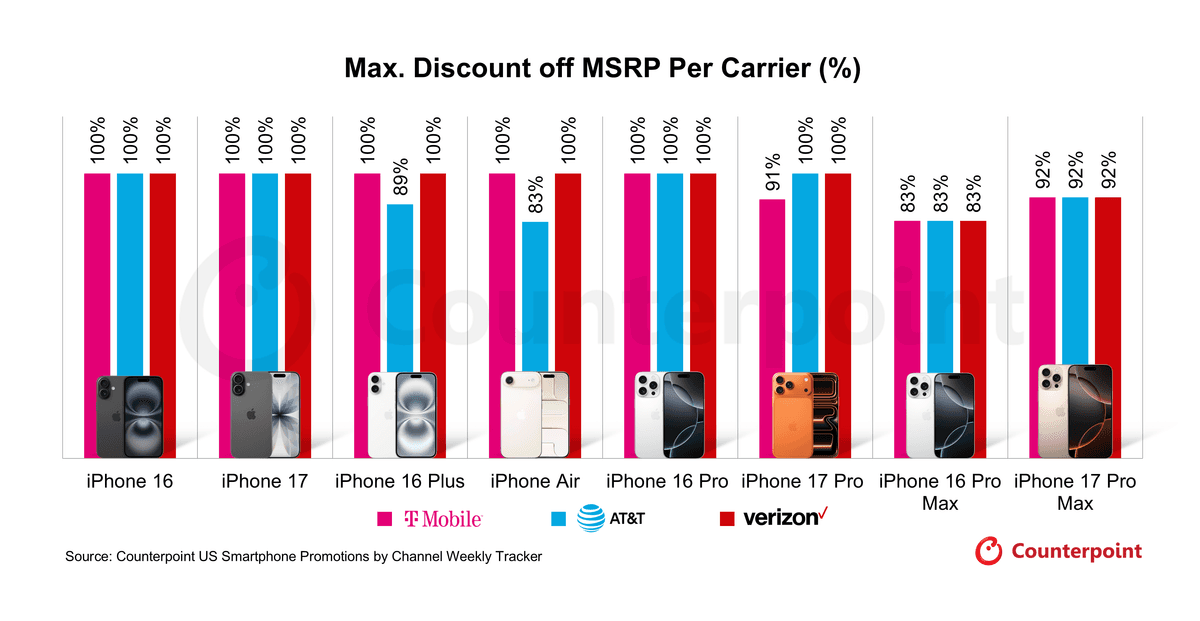
Carriers boosted iPhone 17 Pro Max maximum subsidies by 10% or $100 YoY across the big three, signaling unified intent to make premium models more accessible. The consistent 92% discount off MSRP for the iPhone 17 Pro Max across carriers reflects a strategic shift toward ultra-premium customer segments and a broader push for device premiumization in the US market.
IMAGE
Most carriers already offered a 100% maximum discount on non-Pro Max variants last year. Apple replaced last year's iPhone 16 Plus with the new iPhone Air, and while prices are $100 higher for the new Air & Pro variants compared to their predecessors, some carriers matched the price hike while others did not. For example, last year AT&T offered $830 off the iPhone 16 Plus and is offering the same discount off the iPhone Air despite the iPhone Air being $100 more than the iPhone Plus. In addition, T-Mobile decreased subsidy values by 7% YoY for the Pro model, as it retained the same $1,000 promotion despite the price increase.
Key Promotional Differences
T-Mobile is taking an aggressive approach to win switchers. The carrier is offering four iPhone 17s with four new lines for $100/month ($25 per line), no trade-in required. This combination of upfront affordability and plan simplicity stands out against competitors' trade-in-heavy offers.
For customers with trade-ins, T-Mobile boosted its top promotional credit from $1,000, last year, to $1,100, this year, on premium plans (Experience Beyond – $105/mo. before fees, one line). The carrier also added new no-trade-in options worth up to $1,000, maintaining a 24-month payment term. This simplified model treats base, Air, Pro, and Pro Max identically, ensuring clarity for consumers while sustaining value across new and existing customers alike.
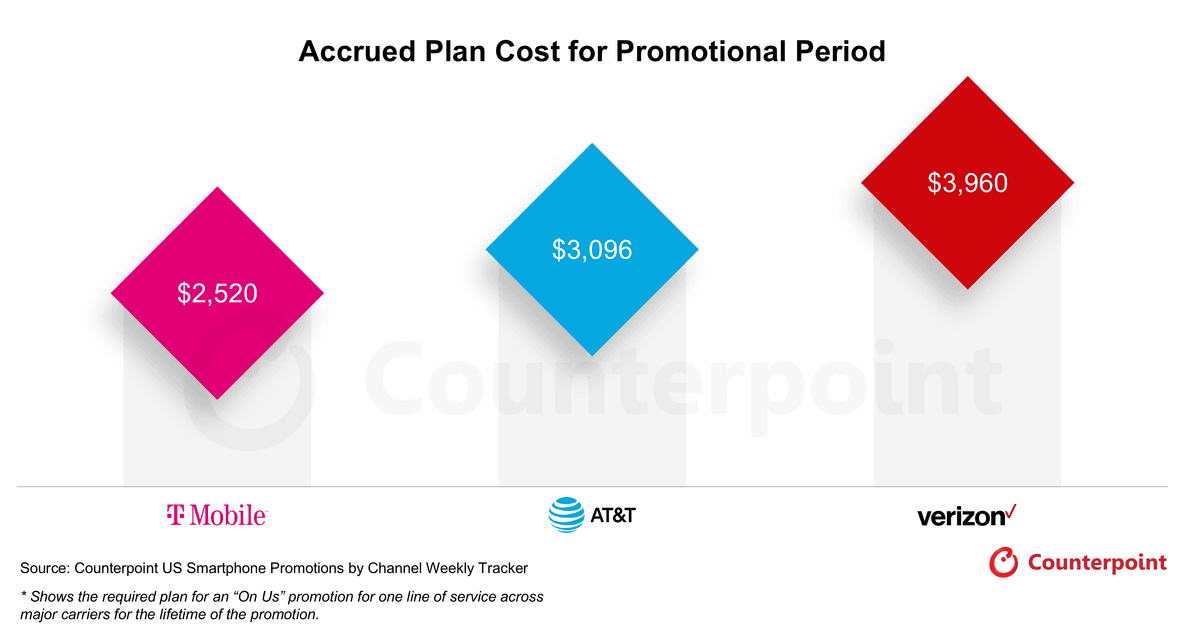
All “On-Us” promotions, whether a new line and/or trade-in is involved, require a premium plan. All major carriers are now requiring their top plan this year, whereas only Verizon did last year. The terms agreed upon to unlock the promotional value matter in the long run, as subscribers are tied to a premium plan’s price until the end of the promotional period. T-Mobile's shorter 24-month commitment delivers lower cost accrued for the plan during the promotional term and earlier plan flexibility. T-Mobile customers can switch to lower-cost plans or upgrade 12 months sooner than competitors' 36-month structures allow. However long the term, tying iPhone 17 promotions to more expensive plans mean carriers are gaining more customer lifetime value with each trade-in or new line.
IMAGE
AT&T has simplified its promotions structure, reducing trade-in tiers from four to three. The carrier now offers $830 off devices with residual value between $130-$170 across all new iPhone 17 models, a change from last year's more segmented approach. Pro models maintained up to $1,000 off with trade-ins valued above $180. Both new and existing customers access identical offers on Postpaid Unlimited Starter SL ($85.99/mo. before fees, one line) or higher, spread over a 36-month payment term. The strategy focuses on driving upgrades from trade-in customers with older devices.
Verizon raised its Pro model trade-in credits from $1,000 to $1,100, but tightened qualification requirements. All but 1 iPhone 17 model now requires trade-in; the base variant offers $830 off without trade-in. The discounts on the iPhone Air increased to up to $1,000 (up from $930 on the 16 Plus), consistent with the model's higher price.
In a continued push toward premium bundling, Verizon is pairing Unlimited Ultimate plans ($110/mo. before fees, one line) with free Apple Watch Series 11 or iPad (A16) devices with any iPhone 17 model. Verizon also now mandates existing phones to be active for 60 days prior to trade-in. All offers require Unlimited Plus or Ultimate plans over a 36-month payment term. Verizon is using hardware bundles to justify higher plan costs while raising the ceiling on Pro Max device credits to stay competitive.
Among cable players, Xfinity Mobile aligned with national trends by raising its Pro Max subsidy by 10% YoY to $1,100, matching top-tier carrier offers. Xfinity continues to offer all other models for free. The cable operator also introduced upgrade promotions up to $1,100 with trade-in for current customers, where none existed last year - a notable shift toward customer retention.
By contrast, this year, Spectrum’s promotions decreased in terms of discount value for the iPhone 17 series except for the Pro Max. The company offers no upgrade promotions for its subscribers. Spectrum remains the least aggressive player in terms of promotional value.
Boost reduced its discount from $1,000 to $830 across all iPhone 17 models but continues to differentiate through service value. The company bundles a free year of service with Infinite Access plans, no trade-in required. Boost prioritizes long-term service savings over maximum hardware credits on its 36-month payment cycles.
Strategic Implications
Aggressive promotions, post launch, signal a continued competitive carrier landscape. Higher iPhone 17 Pro Max trade-in credits, enhanced discounts, and bundling incentives reflect strategic efforts by nation-wide carriers to retain existing customers and capture high-value switchers. Carriers are pushing subscribers into top-tier plans, locking them into premium pricing long-term. T-Mobile's differentiation through shorter 24-month payment terms and no-trade-in options stands in contrast to AT&T and Verizon's 36-month commitments, offering customers earlier plan flexibility and upgrade optionality. Regardless of contract length, these premium plan requirements maximize customer lifetime value by converting upfront device subsidies into years of higher monthly revenue. The emphasis on Pro Max offers makes the ultra-premium Apple device more accessible to customers, driving further premiumization in the US market and strengthening high value customer ties to the Apple ecosystem.
The US Smartphone Promotions by Channel Weekly Tracker examines trends in smartphone promotions across major carriers, highlighting changes in strategies, key device launches, and the most impactful discounts. It explores how carriers like AT&T, Verizon, and T-Mobile adapted their offers to drive sales of flagship devices, while employing varied tactics such as bundled offers, trade-in programs, and promotions tied to new device launches. Email [email protected] to learn more.