

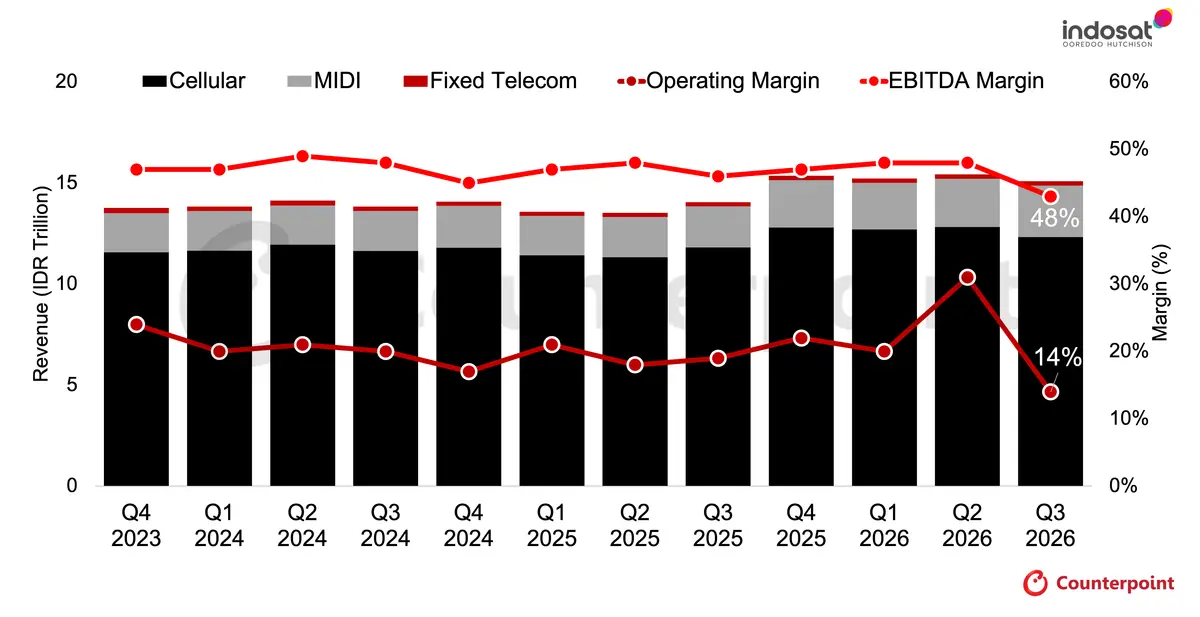
- Revenue rose 11.1% YoY to IDR 45.75 trillion ($2.52 billion) on a 9.5% increase in cellular revenue, showing monetization, not subscriber volume, doing the heavy lifting.
- The mobile base fell from 93.4 million in Q2 to 91.5 million in Q3 amid biometric SIM registration. But quarterly ARPU held at IDR 46,000 ($2.54).
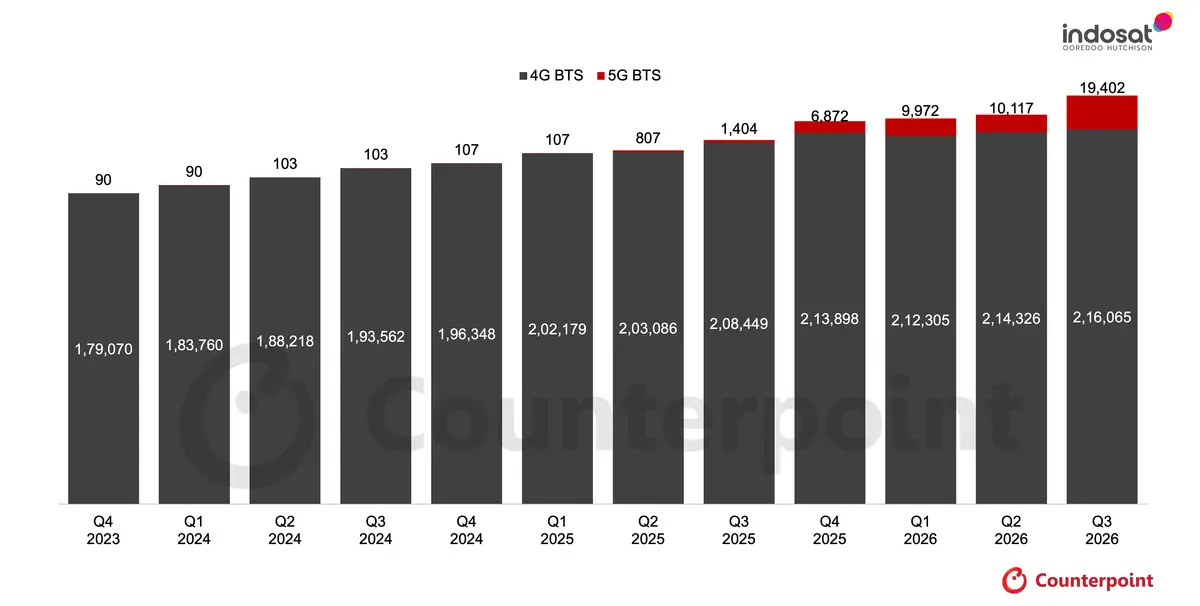
- 5G rollout accelerated nearly 14x in a year, now covering 75 cities and ~22% of the population.
- AI cloud crossed a new milestone. Revenue reached $50 million in the first nine months, already exceeding the $28 million recorded for all of 2025.
Indosat Ooredoo Hutchison (ISAT) delivered strong revenue growth in the first nine months of 2026. Revenue increased 11.1% YoY to IDR 45.75 trillion ($2.52 billion), supported by a 9.5% increase in cellular revenue. However, its mobile subscriber base declined from 93.4 million in Q2 to 91.5 million in Q3, partly due to the implementation of biometric SIM registration. Despite losing nearly 2 million subscribers during the quarter, blended ARPU remained stable at IDR 46,000 ($2.54) QoQ, while the nine-month average increased 16.5% YoY. This suggests that Indosat is increasingly prioritizing customer value and monetization over subscriber volume.
Indosat Revenue by Business Segment, Q4 2023 – Q3 2026
Source: Counterpoint Indosat Earning Reports, Q3 2023-Q3 2026
Meanwhile, Indosat is significantly accelerating its 5G expansion. The company increased its 5G BTS count from around 1,400 in September 2025 to more than 19,400 in September 2026, representing nearly 14-fold growth within a year. Its 5G network now covers 75 cities and approximately 22% of Indonesia’s population. This expansion is supported by substantial investment, with capital expenditure reaching IDR 28.99 trillion ($1.6 billion) during the first nine months of 2026. However, these investments are also putting pressure on near-term profitability, with the Q3 EBITDA margin declining to 42.7% from 47.7% in Q2.
Indosat BTS by Network Generation, Q4 2023 – Q3 2026
Source: Counterpoint Indosat Earning Reports, Q3 2023-Q3 2026
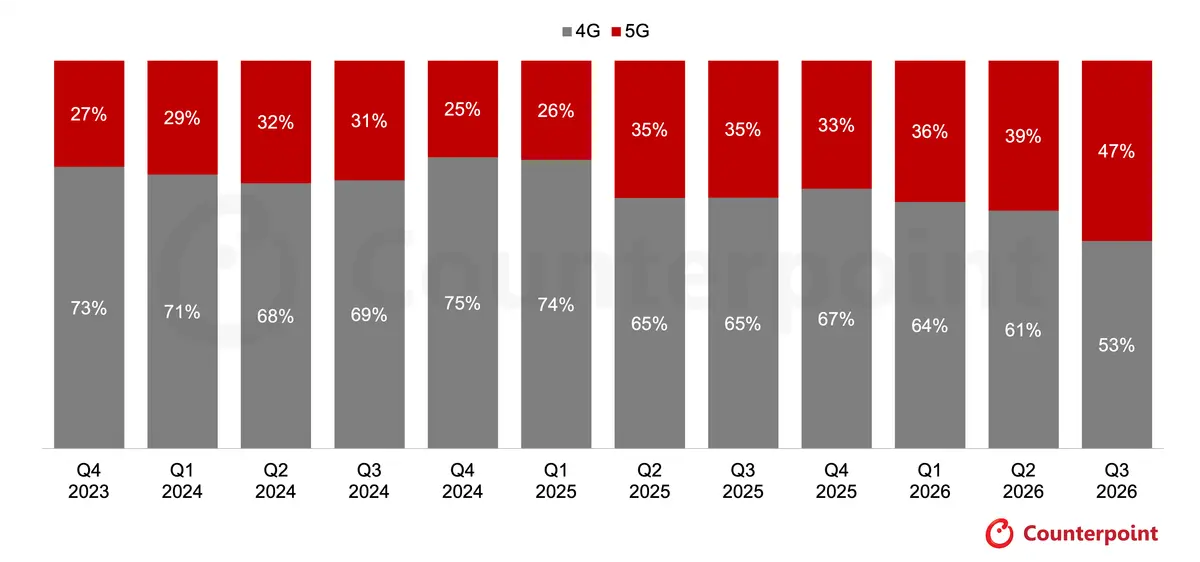
This expansion aligns with Indonesia’s smartphone market trends and the government’s digital ambitions. According to Counterpoint Research, the share of 5G-capable smartphones in Indonesia’s shipments has risen to 47%, up from 35% last year, as the entry-level segment slows amid memory supply pressures. A growing base of 5G-capable devices could support demand for Indosat’s expanding network, although device availability alone does not guarantee adoption.
Share of 5G and 4G Devices in Indonesia Smartphone Shipments
Source: Counterpoint Indosat Earning Reports, Q3 2023-Q3 2026
Government policy is also encouraging faster rollout. Komdigi (Indonesia’s Ministry of Communication and Digital Affairs) has said it aims to cover the whole country with 5G by 2029. Separately, the winners of its 2026 spectrum allotment, including Indosat, are required to provide 5G coverage to at least 51% of the country’s population by the fifth year. The ministry also targets an average mobile broadband speed of 100 Mbps by 2029.
Beyond connectivity, Indosat is building its AI business as a new growth engine. The company reported that Indosat AI Cloud generated $50 million in revenue in the first nine months of 2026, surpassing the $28 million recorded for all of 2025. Indosat expects AI Cloud revenue to reach $100 million by the end of 2026. Its broader strategy connects cloud computing, AI infrastructure and enterprise applications, but the key test will be whether rising revenue can translate into sustainable margins and returns on investment.
Wider 5G coverage creates opportunities to attract higher-value customers, increase data monetization, and expand services such as 5G-powered home broadband. However, with subscriber growth under pressure and infrastructure costs rising, maintaining ARPU growth while improving profitability will be critical. Indosat's performance in the coming quarters will provide an important indication of whether its strategy of focusing on customer quality, network experience, and higher-value services can deliver long-term returns.
