
How interference cancellation, channel estimation and multi-cell scheduling are being rebuilt on purpose-built heterogeneous-accelerated hardware to handle the changing nature of cell traffic efficiently.
Summary
Huawei has introduced OSCAR (Optimal Solution with Cross-Domain Autoregression for Radio), a new-generation intelligent wireless solution that runs targeted, higher-order autoregressive models inside the radio’s physical layer, on purpose-built hardware: heterogeneous compute accelerators on the Universal Baseband Processing (UBBP) board, linked by Huawei’s SpiritPath high-speed interconnect architecture. It targets three long-standing sources of lost capacity in mobile networks: multi-variable cell interference, imprecise channel estimates, and traditional schedulers that optimise one cell at a time. With OSCAR, Huawei aims to unlock cell capacity by reducing interference and congestion and extending coverage, while building a 6G-ready, scalable architecture that protects long-term investment. The combination delivers about 30% higher spectral efficiency, 40% better energy efficiency in its field trials.
It remains to be seen how quickly operators adopt the technology, invest in the additional heterogeneous accelerator boards and upgrade their RAN to drive higher cell utilisation and performance.
Why operators need more from the same spectrum
Operators have traditionally added capacity by buying spectrum or adding sites and antennas. Both are CAPEX-heavy approaches and neither is optimal. Mid-band spectrum is limited and expensive, new sites take time to permit, and every added radio increases the energy bill.
The nature of traffic is also changing. AI assistants, agents, connected vehicles and industrial devices send more data upstream and need steadier latency than video streaming. Huawei’s planning targets are roughly 10x uplink growth, uplink speeds above 20 Mbps, and latency of 30–200ms held at 99.9% reliability. Networks tuned for downlink-heavy smartphone use were not designed around those numbers.
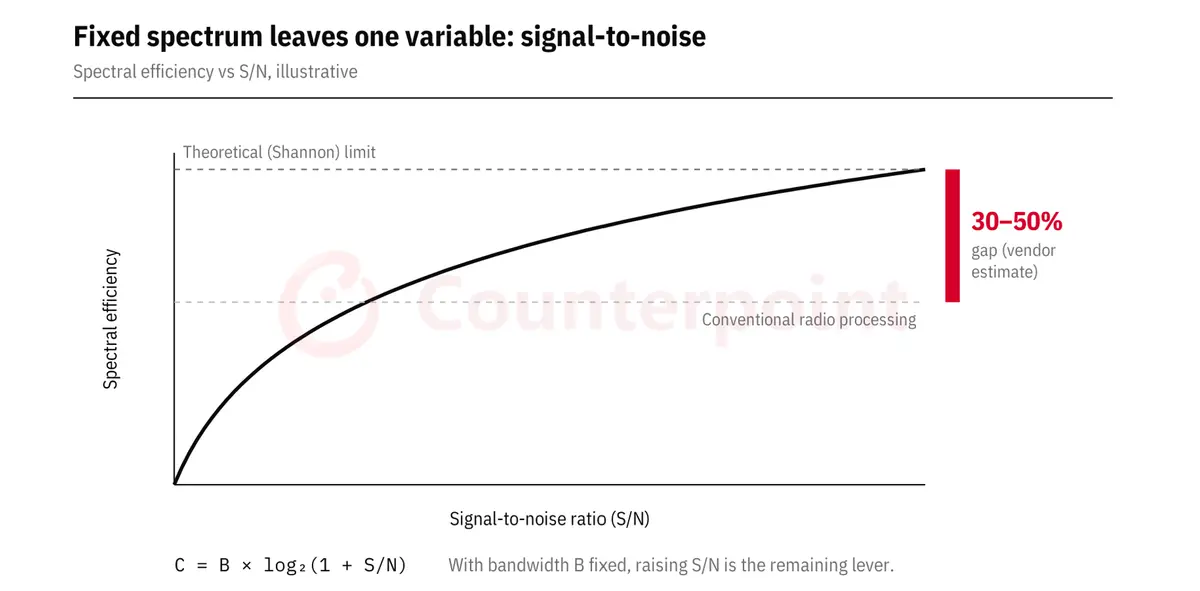
With bandwidth fixed, Shannon’s capacity formula leaves one variable to improve: signal-to-noise ratio (SNR). Huawei estimates that conventional radio processing runs 30–50% below the theoretical limit, which leaves a large share of spectrum capacity unused. To raise SNR, Huawei targets three areas: interference cancellation, channel estimation accuracy, and the computational scale of dynamic resource scheduling.
Source: Huawei, Counterpoint Analysis
How OSCAR handles interference
In dense cities, a user’s signal arrives mixed with reflections off buildings (multipath) and pilot signals from neighbouring cells. Conventional receivers apply fairly generic filtering and leave a significant share of that interference in place.
OSCAR first classifies the interference, then removes it. OSCAR uses the autoregressive model to identify extensive interference features with over 99% accuracy, and matches customized filtering models for the detected interference features. With this approach, the target is to boost interference suppression ratio above 90%. This solution delivers obvious value in busy areas, cell overlapping regions and other scenarios.
How OSCAR improves channel estimation
To point beams and choose a modulation level, the base station needs to know the radio path to each user. Measuring every combination of antenna, beam, user and neighbouring cell would use too much airtime, so networks sample a fraction and estimate the rest. Conventional systems measure between one-twentieth and one-tenth of the channel.
OSCAR uses autoregressive models to rebuild the full channel from about one-tenth of the samples. Huawei reports normalised mean square error (NMSE) falling from about 0.1 to 0.01, which it describes as 10x accuracy, and says historical data lets the model converge up to 100x faster. Better channel estimates allow tighter beams and higher-order modulation, and reduce wasted transmit power. Huawei attributes this to an optimised multivariate autoregressive model and what it calls “prompt engineering optimisation”, which uses historical priors to speed up convergence.
How OSCAR schedules across cells
The complexity of network-wide optimisation grows exponentially with traffic load. Yet today each cell mostly schedules its own users, which does not keep up with the growing number of variables that shape traffic. Joint optimisation across many cells has been impractical because the calculation cannot finish within a 0.5ms transmission time interval (TTI). Exact methods are too slow, and heuristic shortcuts settle for a local answer. OSCAR schedules time, frequency, space and power jointly across many cells and bands. This greatly expands the scale of the optimization problem, with coordination across a large number of cells. It solves this with a higher-order parallel algorithm running on heterogeneous accelerators, with data exchanged over the SpiritPath high-speed architecture, and delivers 10x gain in solving efficiency.
Why the hardware is the key
Heterogeneous models in the physical layer only help if they run in microseconds within a cell-site power budget. General-purpose processors struggle to do that, which is why the hardware is the main enabler here.
Huawei’s UBBPi (Universal Baseband Processing) board pairs telco-customized accelerators with heterogeneous compute cores. Fixed tasks such as encoding, decoding and fast Fourier transforms run on dedicated silicon; flexible tasks such as scheduling and beamforming run on the heterogeneous compute cores. Huawei says this gives about 10x compute efficiency and around 40% lower energy use at equal performance. Joint scheduling also needs data to move fast, so shortening latency is the other focus. Peak workloads require massive data exchanges within one TTI. Its SpiritPath interconnect replaces Ethernet switching between chips with direct memory access between dies on the board, cutting on-board latency down to hundreds of nanoseconds, and delivers 2x board-to-board bandwidth via new connectors.
This design pattern is co-built by models, accelerators and interconnect technologies.
That co-design is what separates OSCAR from software-only RAN intelligence features, and it raises the bar for competing baseband designs.
What the Shanghai field test shows
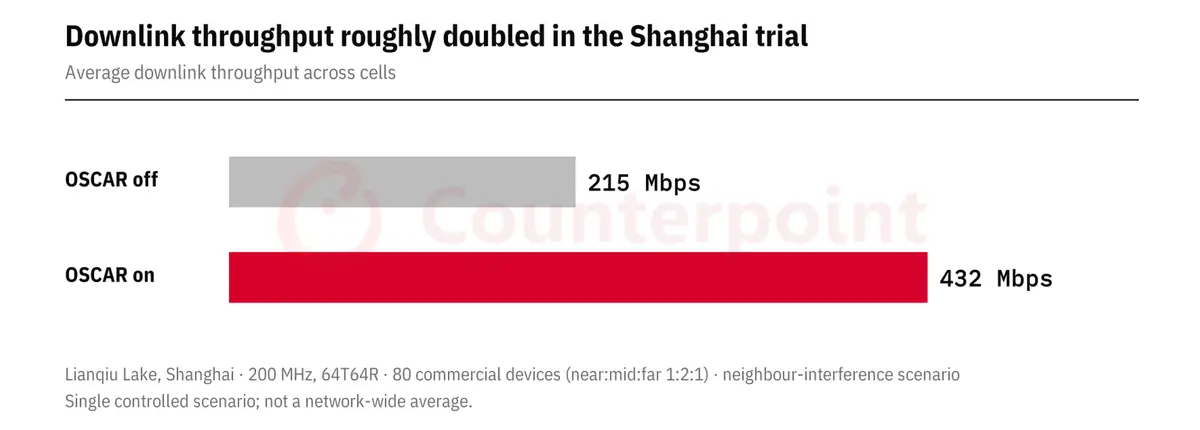
Huawei’s published trial ran at Lianqiu Lake, Shanghai, with 200 MHz cells using 64T64R massive MIMO, 80 commercial devices spread across near, mid and far positions in a 1:2:1 ratio, and a mix of short video, streaming, file downloads and ping traffic. In a neighbour-interference scenario, average downlink throughput across cells doubled with OSCAR enabled.
Source: Huawei, Counterpoint Analysis
This is a controlled test chosen to show the interference feature at its best. It shows the mechanism works; it does not establish the network-wide average gain.
What operators will look for
• How the gains hold up across different spectrum mixes and traffic loads, rather than in interference-heavy test zones.
• How much of the gain survives alongside existing 2G/3G/4G layers and mixed-vendor neighbouring cells.
• Whether the 40% energy figure holds under real load profiles, not peak-equivalent comparisons.
• What the UBBPi upgrade costs per site against the capacity it frees up.
Scenarios
|
Broad adoption |
Selective deployment |
Limited Uptake |
|
Gains near Huawei's figures hold in live networks. Operators use OSCAR to defer spectrum and site spend, and rivals accelerate their own AI-plus-silicon baseband work. |
Gains are real but concentrated in dense urban and cell-edge areas. Operators deploy it in hotspots where the board upgrade pays back. |
Network-wide gains come below test results, or board costs outweigh savings. Uptake stays confined to Huawei’s biggest customers. |
On the evidence so far, we see the second scenario as the most likely near-term outcome, with the first possible if independent operator results line up with Huawei’s.
Closing view
• Where it stands: OSCAR is in commercial release on Huawei’s UBBPi board, with published field results from Shanghai and other operator pilots cited by Huawei.
• What works: The technical case is sound. Raising SNR is the only route to more capacity from fixed spectrum, and pairing high-speed heterogeneous cores with dedicated accelerators and a fast interconnect is a credible way to do it in real time.
• What is the cost: The estimated price of a single baseband board will increase, but with doubled cell capacity, improved user experience and reduced power consumption, it delivers better cost-effectiveness per cell. Combined with overall benefits and a 6G-ready software upgrade path, this makes a strong business case for operators.
• Outlook: We expect heterogeneous computing and intelligent algorithms running inside the baseband, on purpose-built silicon, to become a standard part of 5G-Advanced and 6G radio design. OSCAR is an early commercial example. Independent operator data over the next 12 months will help validate the gains.
Related Reading
· Huawei’s AI-Native 5G-Advanced Vision
Counterpoint Conversations: Huawei's 5G-Advanced Powering the Mobile AI Revolution

