Harman and Bose Dominate, but Chinese Players and EV Trends Reshape the Global Car Audio Market
Harman and Bose lead the audio system market with nearly 60% share of vehicles sold globally, while Chinese suppliers are growing with the globalisation of their EV brands.
Chinese OEMs like Xpeng, Geely and Leapmotor developed in-house audio systems to differentiate product offerings and enhance supply chain control.
Average premium audio system speaker counts per vehicle remained flat at 12 due to the launch of more affordable EVs.
Spatial audio, OTA updates, personalised zones and AI-assistant are redefining in-car sound experience with software-defined systems.
EVs’ quiet cabins boost demand for immersive audio, making premium sound a key buying factor in China.
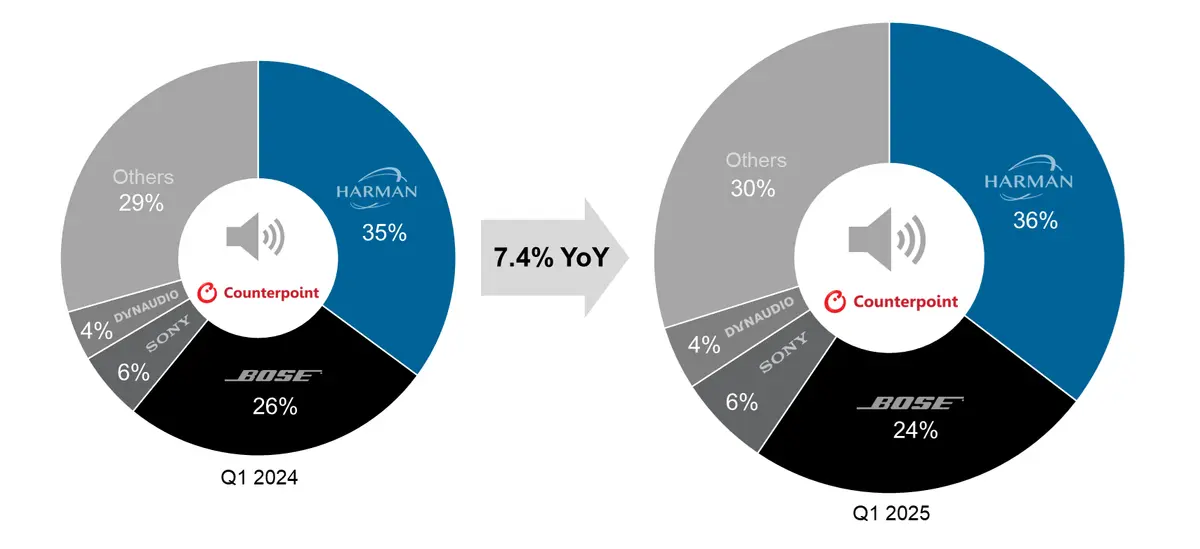
The global passenger vehicle audio system market is currently dominated by Harman and Bose, which together account for nearly 60% of total sales, according to Counterpoint’s new Global Passenger Vehicle Audio System Tracker report. Among the top ten suppliers, AAC Technologies is the only Chinese company represented. While the market has traditionally been led by American, Japanese, and European firms like Harman, Bose, Sony and Dynaudio, Chinese suppliers like Sonavox, WANOS, Nobo Automotive, and ADS Audio are growing quickly, driven by the increasing global presence of Chinese electric vehicle (EV) makers. In a bid to gain more control over their supply chains and offer differentiated features, Chinese automakers such as Xpeng, Leapmotor, and Geely have developed their own in-house audio systems, working closely with industry partners.
Global Passenger Vehicle Audio System Sales Share by Supplier, Q1 2025 vs Q1 2024
Source: Counterpoint Research Global Passenger Vehicle Audio System Tracker, Q1 2025
A notable trend among Chinese automakers has been increasing speaker counts in the premium segment of the market. Several Chinese OEMs, such as NIO, Zeekr, and BYD have offered models with more than 20 speakers, for example, NIO’s ET7, Zeekr’s 01, and BYD’s Denza brand’s D9. Despite these high speaker counts at the premium end of the market, automakers in China have been focusing on launching affordable EVs with fewer speakers, which has reduced the average maximum speaker count for the market.
Although speaker counts are one major area where automakers compete, the audio system market is also changing as OEMs add more software-defined audio features. This evolution enables automakers to deliver personalised audio experiences through over-the-air (OTA) updates. Tesla’s Model 3, NIO’s ET7, Cadillac’s Optiq, and the Lucid Air are among several models that deliver OTA updates, continuously enhancing the user experience and adding new features over time. Premium vehicles are increasingly adopting spatial and immersive audio technologies to provide 360-degree soundscapes. An example would be in the US market, where General Motors will offer Dolby Atmos across its Cadillac brand’s entire 2026 EV lineup.
Overall, advanced car audio systems are becoming a key differentiator in consumer buying decisions, especially in technology-forward markets like China, where buyers are increasingly willing to pay a premium for top-tier sound experiences.
Soumen is a Senior Analyst tracking IoT, Automotive and Telecommunication ecosystem at Counterpoint Research. He is interested in IoT applications, connections, components, electric vehicles, connected cars, autonomous vehicles, semiconductors, shared mobility, services and emerging technologies. He started his career as an Energy Analyst with Manikaran Power Ltd. He has experience working with DISCOMs and SLDCs in the Indian power and energy industry. He is currently based in Gurgaon. He holds an Electrical Engineering degree and an MBA in Marketing & Finance.