

- Global smartphone shipments are forecast to fall 14.3% YoY in 2026, with the downturn extending into 2027 as component costs and affordability pressures intensify.
- Samsung is set to retake the global No. 1 position, helped by its supply chain strength, broad portfolio and willingness to defend volume.
- Apple will outperform the market, but higher pricing and a staggered launch cadence will constrain its shipment outlook.
- Leading Chinese OEMs face shipment declines between 15% to 34% in 2026, reflecting their greater exposure to lower priced devices and emerging markets.
- The market is forecast to rebound in 2028 and move back to 2024-2025 levels by the end of the decade as anticipated 6G commercialization broadens.
Beijing, Berlin, Buenos Aires, Fort Collins, Hong Kong, London, New Delhi, Seoul, Taipei, Tokyo - August 22, 2026
The global smartphone market is forecast to decline 14.3% year on year in 2026, according to Counterpoint Research's latest Smartphone Market Outlook Tracker, as higher component costs, reduced availability of lower priced devices and weaker consumer affordability weigh on demand. Market conditions are expected to remain challenging in 2027, with shipments forecast to decline by a further 1.4% before a stronger recovery begins in 2028.
Global Smartphone Forecast, August 2026 Edition
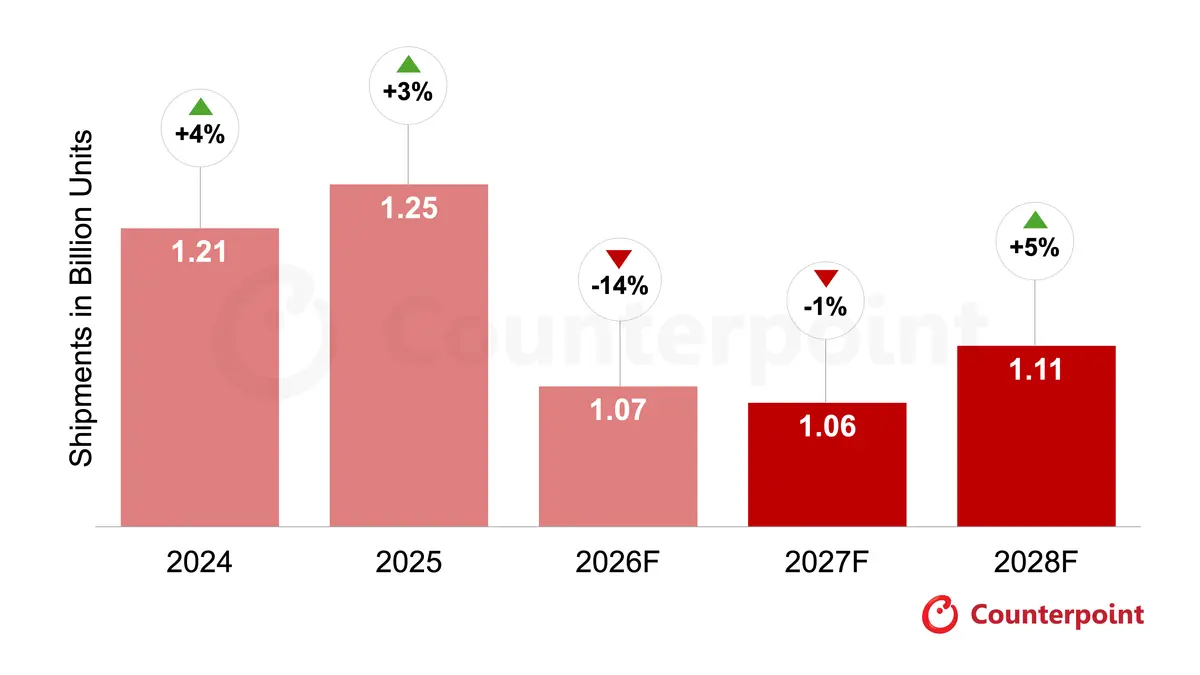
The downturn is being driven primarily by supply chain and cost pressures. The demand side shows a bifurcated picture with the premium segment still showing resilient performance, while the mass market segments bear the brunt of the market retreat. Mobile memory remains the most significant constraint, while higher chipset prices are adding pressure across premium, mid-range and legacy product platforms.
The impact on shipments will be greatest at lower price points, where component costs account for a larger share of the bill of materials and manufacturers have less room to absorb increases. Vendors are responding by raising prices, reducing lower margin configurations and concentrating resources behind fewer products and priority markets.
Channel inventory increased during the first half of 2026, although the build was uneven across brands and markets. As pre-shock inventory is exhausted, higher costs, ageing stock and weaker sell through are expected to result in a significant reduction in shipments, and production orders, during the second half of the year.
Principal Analyst Yang Wang commented, “The 2026 decline reflects more than temporarily weak demand. Higher component costs are pushing manufacturers to remove products and configurations that are no longer economically viable, particularly at lower price points. Although supply visibility should improve during 2027, affordability will recover more slowly because higher cost inventory must first move through the channel. As such, we expect the market to remain under pressure in 2027 before rebounding more strongly in 2028.”
Global Smartphone Forecast by Brand Market Share (2024 - 2027F)
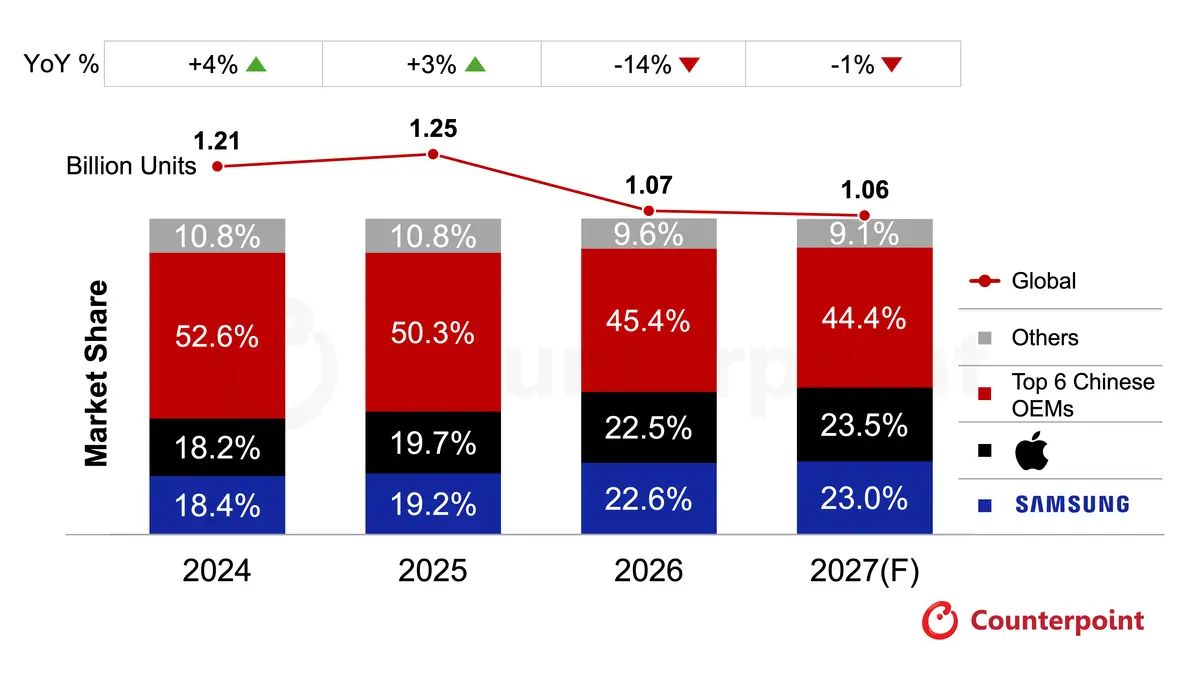
*Top 6 Chinese OEMs include: HONOR, Huawei, OPPO Group (Including OPPO, OnePlus, realme), Transsion Group (Including TECNO, Infinix, itel), vivo, Xiaomi
Samsung expected to regain the global lead
The downturn is expected to reshape the competitive landscape, with Samsung forecast to regain the leading global smartphone position in 2026.
Samsung smartphone shipments are forecast to grow by approximately 0.8% in 2026, significantly outperforming the wider market’s decline. This resilience reflects Samsung’s broad geographic presence, supply chain depth and more reliable access to memory and semiconductor supply.
On Samsung’s strength through the downturn, Wang commented, “Samsung’s return to the top position comes down to its internal component capabilities, broad portfolio and established operator and retail relationships, giving it more flexibility to secure supply, redirect products between markets and maintain availability. Samsung may accept some pressure on profitability to capture volume share, but that trade off should still leave it better positioned than most competitors during the downturn.”
More cautious outlook for Apple
Apple is expected to remain comparatively resilient, but the outlook for the brand is more cautious than for Samsung. Apple shipments are forecast to decline by approximately 2.1% in 2026, before returning to growth of around 2.8% in 2027.
Apple continues to benefit from its premium positioning, customer loyalty, financing options and preferential access to critical components. These advantages were on display through the strong demand for the iPhone 17 series. However, possible higher launch pricing of the iPhone 18 series, and changes to the timing of Pro and base-model introductions across the 2026 and 2027 product cycles could affect quarterly demand and channel inventory.
Apple is expected to launch its first foldable smartphone in Q3 2026. We forecast high-single-digit million unit shipments for the device, and therefore unlikely to change Apple’s overall shipment trajectory. Nevertheless, it establishes an important foundation for future Apple device portfolio expansion in the coming years.
Leading Chinese OEMs face greater pressure
Leading Chinese smartphone manufacturers are expected to experience substantially greater shipment pressure because of their exposure to price sensitive consumers, mid-range-focused devices portfolios and emerging markets.
Across several major Chinese OEMs, shipments are forecast to decline by approximately 15% to 34% in 2026. The scale of the decline varies significantly by company, depending on portfolio mix and exposure to lower income markets. Common pressures are higher memory and chipset costs, a challenged affordability picture and reduced profitability at lower price points.
Manufacturers are expected to respond to these challenges by reducing memory configurations, using older platforms, raising prices or discontinuing products that can no longer meet profitability targets. Through our industry checks, we assume that leading Chinese OEMs will generally prioritize financial discipline, strategically important products and core markets, rather than defend market share.
Pressure on shipments is expected to continue into 2027. Some leading Chinese OEMs are expected to return to modest growth, while others remain in decline as inventory, portfolio restructuring and weak demand continue to affect shipments. Accelerating industry consolidation continues to be Counterpoint’s baseline scenario through the down cycle.
Huawei remains an important exception. Huawei shipments are forecast to grow by approximately 8% in 2026 and a further 4.3% in 2027, supported by strong demand in China, improving domestic component capabilities and continued progress with HiSilicon processors. Over the long term, Huawei’s performance is expected to be constrained more by component and production availability than by consumer demand. Recovery outside China remains selective.
Recovery expected from 2028
A stronger market recovery is forecast for 2028, with global smartphone shipments expected to grow by approximately 4.8% as component availability improves, retail pricing begins to stabilize and purchases, postponed during 2026 and 2027, are realized. The recovery is likely to favor the largest manufacturers, which are better positioned to secure components, manage financing and maintain distribution through the downturn.
Foldables and on-device AI should support product differentiation and premiumization but are not expected to create a broad shipment supercycle. Toward the end of the decade, wider commercialization of 6G-capable devices should support an incremental upgrade cycle and help the market move back toward the shipment levels typically recorded during 2024 and 2025.
About Counterpoint Research
Counterpoint Research is a global market research firm specializing in products across the technology ecosystem. We advise a diverse range of clients – from smartphone OEMs to chipmakers and channel players to Big Tech – through our offices located in the world's major innovation hubs, manufacturing clusters and commercial centers. Our analyst team, led by seasoned experts, engages with stakeholders across the enterprise – from the C-suite to professionals in strategy, analyst relations (AR), market intelligence (MI), business intelligence (BI), product and marketing – to deliver services spanning market data, industry thought leadership and consulting. Our core areas of coverage include AI, Automotive, Consumer Electronics, Displays, eSIM, IoT, Location Platforms, Macroeconomics, Manufacturing, Networks and Infrastructure, Semiconductors, Smartphones and Wearables. Visit our Insights page to explore our publicly available market data, insights and thought leadership, and to understand our focus, meet our analysts and start a conversation.

