

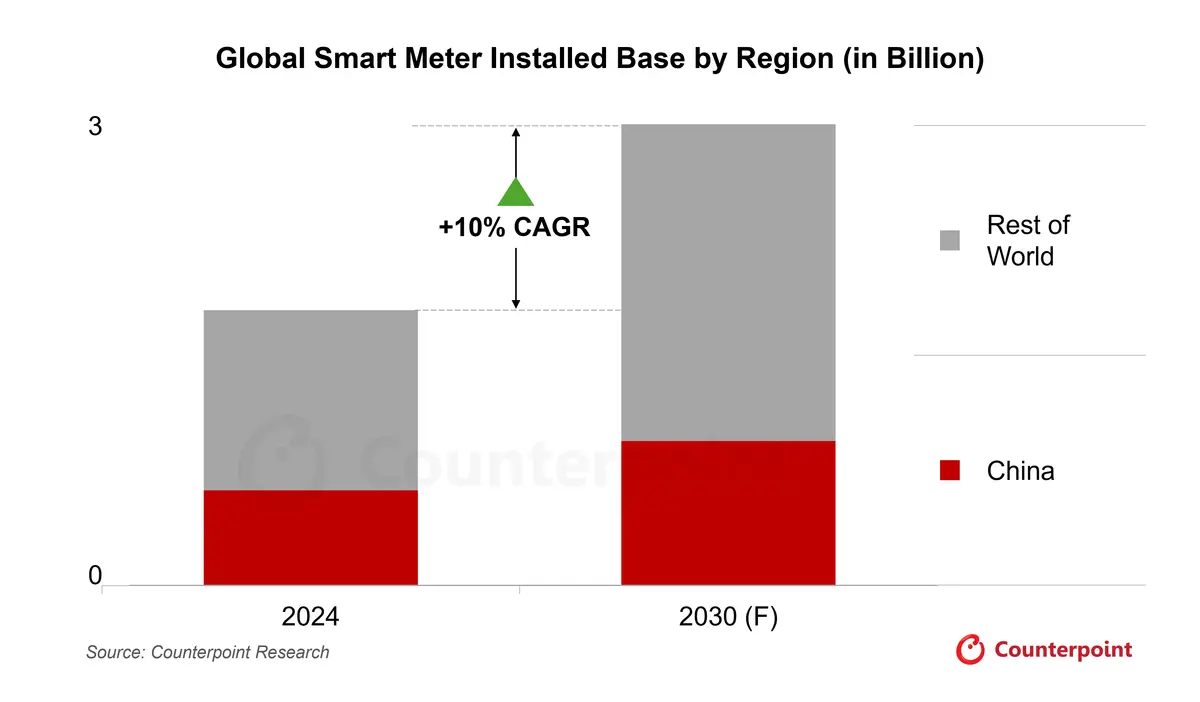
- Global smart meter installations exceeded 1.8 billion units by end-2024, with robust shipment growth expected through 2025 and beyond, supported by grid modernization and regulatory mandates.
- Smart meter adoption is uneven across regions. North America had the highest penetration (~81%) in the smart electricity metering market at the end of 2024, while growth opportunities remain strongest in under-penetrated regions such as Latin America, Africa and South Asia.
- By 2030, the global smart meter installed base is projected to cross 3 billion units, driven primarily by electricity metering but with accelerating growth in water and gas.
- Legacy PLC and RF mesh technologies will continue to coexist with growing cellular adoption (4G Cat 1 bis, NB-IoT, LTE-M). By 2030, two-thirds of new smart meters will use cellular, led by remote and new deployments.
Seoul, Beijing, Berlin, Buenos Aires, Fort Collins, Hong Kong, London, New Delhi, Taipei, Tokyo – November 11, 2025
Global smart meter installed base exceeded 1.8 billion units by the end of 2024 and is projected to grow at a CAGR of 10%, crossing 3 billion by the end of 2030, according to Counterpoint Research’s Global Smart Meter Report. Robust smart meter shipment growth is expected in 2025 and beyond, supported by grid modernization and regulatory mandates.
Commenting on the smart meter market’s regional dynamics, Principal Analyst Tina Lu said, “North America had the highest penetration of around 81% in the smart electricity metering market at the end of 2024. China and Europe are among the other regions having high penetration in terms of smart meter deployment. However, opportunities remain strongest in under-penetrated regions such as Latin America, Africa and South Asia.”
While smart electricity meters currently dominate the market and will lead the growth due to continued expansion in electricity metering, particularly in under-penetrated regions, developed markets supported by mature utility infrastructure will lead growth in smart water and gas metering. Beyond 2027, this growth in smart water and gas metering will be complemented by increasing adoption in emerging economies.
Commenting on the technology landscape, Research Analyst Hanumant Pawar said, “Connectivity preferences in the smart metering market are evolving rapidly, driven by the need for greater scalability, reliability and cost efficiency. Today, smart meters rely on a mix of powerline communication (PLC) and RF mesh networks, but the market is steadily migrating toward Low Power Wide Area (LPWA) technologies. These include cellular massive machine-type communication (mMTC) standards such as NB-IoT and LTE-M, alongside unlicensed options like LoRaWAN and Sigfox. While legacy connectivity options such as PLC and RF mesh technologies will continue to coexist with growing cellular adoption. In particular, 4G Cat 1 bis, NB-IoT and LTE-M are expected to dominate future rollouts.”
Within the cellular segment, beyond NB-IoT and LTE-M, 4G Cat 1 bis remains a key connectivity technology and is expected to retain its leadership in shipment volumes, growing at a CAGR of around 8% between 2024 and 2030. Its strong position is driven by an optimal balance between performance, cost, and deployment simplicity. The technology’s affordability, widespread network compatibility, and ease of integration make it particularly suited for high-volume, low-complexity use cases such as smart metering. By 2030, cellular technologies are projected to power nearly two-thirds of new smart meter installations, especially in remote or large-scale deployments.
Chinese smart meter manufacturers have been early adopters of 4G Cat 1 bis, leveraging its cost efficiency, performance balance and broad network compatibility. Leading vendors such as Sanxing Electric, Holley Technology, Jiangsu Linyang Energy, Suntron Technology, and GoldCard Smart Group are among the top players by cellular shipment volume. 4G Cat 1 bis is expected to remain a key connectivity technology, led by Sanxing Electric and Holley Technology, while NB-IoT will continue as a parallel growth technology with strong leadership from Sanxing Electric, Wasion Group and GoldCard Smart Group.
For detailed research, refer to the following reports available for subscribers:
Counterpoint’s Global Smart Meter Tracker and Forecast report provides key market trends, growth drivers, and competitive dynamics shaping the industry from 2022 to 2030F. It offers detailed shipment analysis across 5+ regions and 15+ leading brands, covering both cellular technologies (2G, 3G, 4G, 4G Cat-1 bis, NB-IoT, LTE-M and 5G eRedCap) and non-cellular solutions (Power Line Communication [PLC], RF Mesh, and other LPWA options). Key regions analysed include North America, Europe, Latin America, Middle East and Africa (MEA), China, India and the Rest of Asia-Pacific, each exhibiting distinct rollout trajectories and opportunities aligned with evolving energy infrastructure and smart grid digitization.
About Counterpoint Research
Counterpoint Research is a global market research firm specializing in products across the technology ecosystem. We advise a diverse range of clients – from smartphone OEMs to chipmakers and channel players to Big Tech – through our offices located in the world's major innovation hubs, manufacturing clusters and commercial centers. Our analyst team, led by seasoned experts, engages with stakeholders across the enterprise – from the C-suite to professionals in strategy, analyst relations (AR), market intelligence (MI), business intelligence (BI), product and marketing – to deliver services spanning market data, industry thought leadership and consulting. Our core areas of coverage include AI, Automotive, Consumer Electronics, Displays, eSIM, IoT, Location Platforms, Macroeconomics, Manufacturing, Networks and Infrastructure, Semiconductors, Smartphones and Wearables. Visit our Insights page to explore our publicly available market data, insights and thought leadership, and to understand our focus, meet our analysts and start a conversation.

