- Global refurbished smartphone sales grew only 3% YoY in H1 2025, a slowdown from the year-ago period, weighed by increased market challenges in Q1 and uncharacteristic volatility in Q2.
- The US tariffs led to most trade and price fluctuations in the domestic secondary smartphone market, although global secondary markets absorbed most uncertainties quite well.
- Japan continues to grow, rising 5% YoY while other mature markets like the US and Europe were flattish. Africa, India and SEA led as emerging markets saw growth.
- Apple led with 7% YoY growth in H1 2025. Samsung’s share increased in mature markets by 4%, but it was dwarfed by Apple’s 12% growth in emerging markets.
- ‘As Is’ smartphones outpaced refurbished smartphone growth, rising 10% YoY in H1 2025.
Seoul, Beijing, Berlin, Buenos Aires, Fort Collins, Hong Kong, London, New Delhi, Taipei, Tokyo – September 4, 2025
Global refurbished smartphone sales increased only 3% YoY in H1 2025, a slowdown from the year-ago period, as further growth was limited by difficult conditions in many mature markets stemming from supply constraints, price uncertainties, and increased regulation, according to Counterpoint’s Global Secondary Smartphone Market report. The slowdown was despite stable demand for recent refurbished models and robust performance of emerging markets during the period.
The US market was the worst hit by Trump’s tariffs. Most businesses stocked up on devices and components to avoid uncertainty in trade and to keep prices as unaffected as possible. However, global secondary markets absorbed most uncertainties quite well. Trade routes seemed to be working cohesively throughout the last two months of H1 2025 to make sure bulk-selling models and their components were available before prices increased or devices became unavailable.
Global Refurbished Smartphone Sales by Region, H1 2024 vs H1 2025
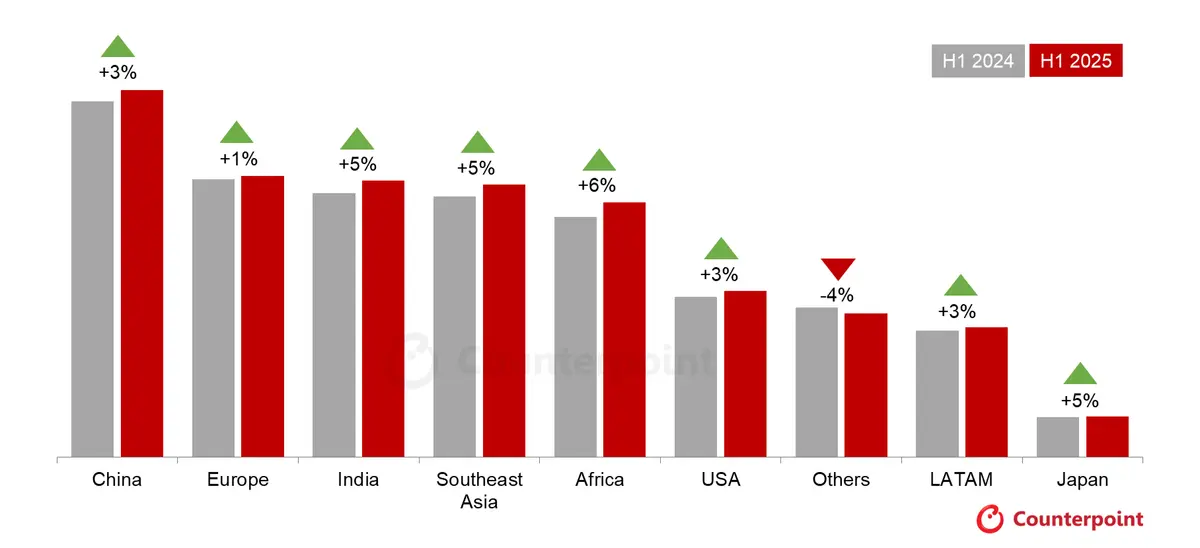
Most mature markets saw a decline in refurbished sales as consumers held on to their smartphones and supply issues became more pronounced. In contrast, Japan continued to grow consistently since last year, although at a slightly slower rate. The US and major European countries showed either muted growth or a decline. Meanwhile, most emerging markets performed well. On an average, mature markets saw a flat 1% rise, and emerging markets registered 4% growth. The growth was due to the popularity of Apple iPhones with global refurbished sale increasing 7% YoY during the period. Samsung’s share increased by 4% in mature markets, but was dwarfed by Apple’s 12% growth in emerging markets.
The keen focus on trade-ins has resulted in increased inflow but big players are amassing the larger, more premium share. Most iPhone users now are repeat Apple owners and according to Counterpoint’s Apple User Survey 2024-2025, one in every three iPhone users in the US traded-in or sold their previous iPhones before buying a new one. This metric is lower for other big markets like the UK, China, and India.
5G smartphones accounted for 57% of the global refurbished sector in H1 2025, a 65% YoY rise from the year-ago period. This share will likely grow significantly by the end of 2025.
Commenting on the secondary market dynamics, Associate Director Jan Stryjak said, “Established businesses across markets are now competing with many companies and margins are running thin. Trade-in volumes are tougher to achieve. Many exporting markets have reduced volumes going out, so importing countries do not get much choice of devices being imported. In these situations, companies lower the cost of doing business, and as a result, ‘As Is’ volumes have been steadily growing. Even in H1 2025, ‘As Is’ devices rose 10% YoY, outpacing refurbished smartphone growth. We expect this trend to continue over the next few years.”
The global refurbished market will likely be more resilient to macroeconomic uncertainties in H2 2025 if trade routes are not significantly affected. Additionally, trade-in initiatives will likely ease supply issues. Demand for newer models like the iPhone 13, iPhone 14 series, and Samsung S series is expected to grow at least in mature markets.
About Counterpoint Research
Counterpoint Research is a global market research firm specializing in products across the technology ecosystem. We advise a diverse range of clients – from smartphone OEMs to chipmakers and channel players to Big Tech – through our offices located in the world's major innovation hubs, manufacturing clusters and commercial centers. Our analyst team, led by seasoned experts, engages with stakeholders across the enterprise – from the C-suite to professionals in strategy, analyst relations (AR), market intelligence (MI), business intelligence (BI), product and marketing – to deliver services spanning market data, industry thought leadership and consulting. Our core areas of coverage include AI, Automotive, Consumer Electronics, Displays, eSIM, IoT, Location Platforms, Macroeconomics, Manufacturing, Networks and Infrastructure, Semiconductors, Smartphones and Wearables. Visit our Insights page to explore our publicly available market data, insights and thought leadership, and to understand our focus, meet our analysts and start a conversation.


