

- The growth of the cellular IoT module market in 2025 was supported by strong demand across applications like smart metering, asset tracking, POS and router/CPE applications.
- Cat-1 bis emerged as the dominant technology for mass market with one out of every two modules shipped based on Cat-1 bis. Meanwhile, 5G module shipments continued to expand rapidly, led by routers, PCs and automotive applications.
- The year also marked the commercialization of 5G RedCap primarily in China, alongside growing momentum for AI-enabled IoT modules as vendors shifted toward higher-value offerings.
- Cellular IoT module ASPs remained under pressure in 2025 due to intense competition, particularly from China-based vendors, while rising RAM prices in Q4 2025 increased BOM costs for 5G and smart modules.
Seoul, Beijing, Berlin, Buenos Aires, Fort Collins, Hong Kong, London, New Delhi, Taipei, Tokyo – March 11, 2026
Global cellular IoT module shipments rose 15% YoY in 2025, maintaining steady growth throughout the year, supported by strong demand for applications like smart meters, POS and automotive sectors. According to Counterpoint Research’s Global Cellular IoT Module and Chipset Tracker, Q4 2025, China continued to dominate global shipments during the year due to strong domestic demand across POS, asset-tracking and surveillance applications, growing 15% YoY. The market growth was further supported by accelerating deployments in emerging markets, with India growing 33% YoY. The Middle East and Latin America also witness higher than market average growth.
Commenting on the technology dynamics, Principal Analyst Tina Lu said, “One of the most significant developments during the year was the rise of 4G Cat-1 bis, which has now become the global standard for large-scale IoT deployments. Its balance of affordability, performance and simplified design has made it the preferred connectivity solution for high-volume applications such as smart meters, tracking and POS devices. 5G adoption accelerated simultaneously, with volumes growing almost three times the industry average, particularly in higher-bandwidth IoT segments such as automotive, routers/CPE and PCs. 5G shipments recorded strong double-digit percentage growth throughout the year as enterprises and device manufacturers began integrating higher-performance connectivity into new deployments.”
Lu added, “Another key milestone in 2025 was the early commercialization of 5G RedCap. Although shipments remain relatively small compared to traditional 4G technologies, RedCap is expected to play a major role in bridging the gap between low-power IoT technologies and high-performance 5G connectivity in the coming years. In parallel, the industry began shifting toward AI-enabled IoT modules, with vendors integrating edge AI accelerators, enhanced processing capabilities and secure software platforms. This reflects a broader transition in the IoT ecosystem from basic connectivity hardware toward intelligent edge devices capable of real-time analytics and automation.”
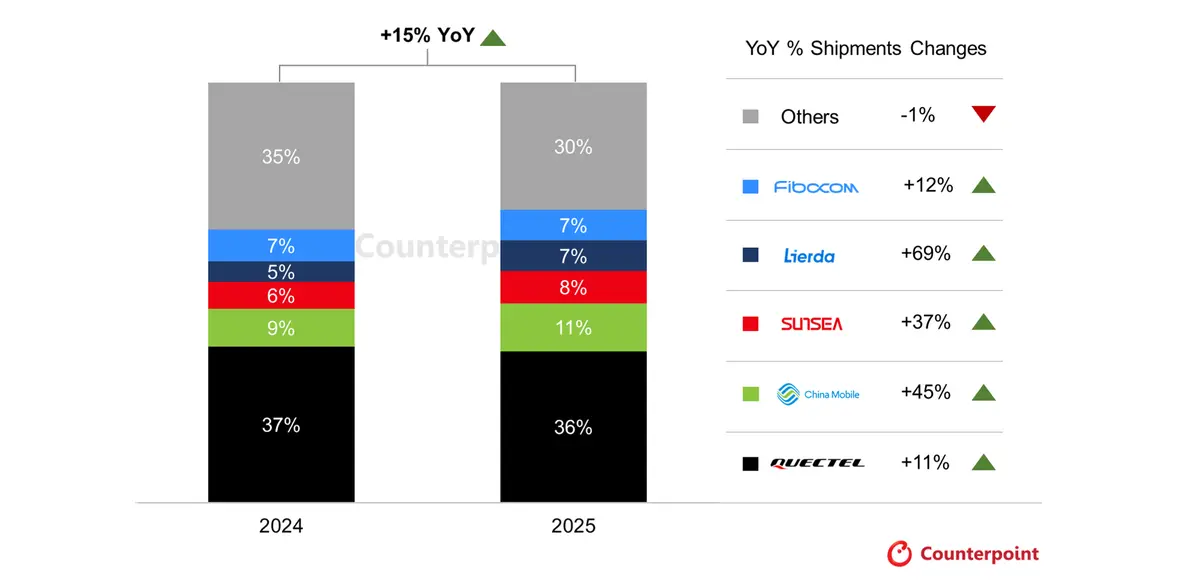
Global Cellular IoT Module Shipments Share by Vendor 2025 vs 2024
Vendor Performance
- Quectel retained its global leadership across China and international markets, while China Mobile strengthened its position through operator-driven deployments in connected two-wheelers, asset trackers and AI toys. Sunsea secured the third position, supported by steady shipments in POS, utility metering and IP cameras.
- Lierda rose 69% YoY to emerge as one of the fastest-growing vendors in 2025 driven by strong Cat-1 bis demand and expanding footprint in South Korea, Southeast Asia and Europe.
- Outside China, Telit Cinterion remained the leading international vendor, growing 13% YoY, as it benefitted from its strong presence in high-value verticals such as telematics, healthcare and energy across Europe and North America.
- ZXinfoTek has emerged as a significant player in the Cat-1 bis module sector. Backed by its years of extensive expertise in POS terminals, the company’s module products are widely recognized in the POS and IP camera market. In 2025, ZXinfoTek reported strong shipment numbers.
Commenting on the market dynamics, Director of IoT Practice Mohit Agrawal said, “ASPs in the cellular IoT module market remained under pressure in 2025, despite strong shipment growth. Intense competition among vendors, particularly from China-based players, continued to push pricing lower and tighten margins. Towards the end of the year, the market experienced memory supply constraints as rising demand for DRAM and NAND from AI servers, smartphones and PCs tightened overall supply. This led to higher memory pricing in Q4 2025, which affected the bill of materials for 5G and smart module categories, particularly those used in routers, PCs and higher-performance IoT devices. In response, some vendors adjusted their production planning and pricing strategies to manage rising component costs. This included selective production prioritization for higher-margin modules, cautious inventory management and limited price adjustments in certain segments. In some cases, customers also accelerated orders ahead of potential module price increases.”
The memory shortage is expected to extend into 2026, with pricing likely to remain volatile. Vendors will likely continue balancing cost pressures with competitive pricing, which could moderate shipment growth in high-end module categories while sustaining demand in cost-sensitive segments such as Cat-1 bis.
Agrawal added, “Looking ahead, the cellular IoT module market is expected to maintain steady growth in 2026 as connected device deployments continue to expand across industries. Emerging markets, particularly India and parts of Latin America and the Middle East, are expected to remain key growth drivers due to ongoing infrastructure digitization and smart meter deployments. Meanwhile, the commercialization of 5G RedCap is expected to accelerate as operators expand standalone 5G coverage and module pricing becomes more competitive, particularly in China, North America and Europe markets.”
For detailed research, refer to the following reports available for subscribers:
- Global Cellular IoT Module and Chipset Tracker by Application, Q4 2025
- Global Cellular IoT Module Tracker, Q4 2025
Counterpoint’s ‘Global Cellular IoT Module and Chipset Tracker by Application’ tracks over 2,000 IoT module SKUs on a quarterly basis and provides forecasts on shipments, revenues and ASP performances for over 80 IoT module vendors, over 12 chipset players and over 18 IoT applications across 10 major geographies.
About Counterpoint Research
Counterpoint Research is a global market research firm specializing in products across the technology ecosystem. We advise a diverse range of clients – from smartphone OEMs to chipmakers and channel players to Big Tech – through our offices located in the world’s major innovation hubs, manufacturing clusters and commercial centers. Our analyst team, led by seasoned experts, engages with stakeholders across the enterprise – from the C-suite to professionals in strategy, analyst relations (AR), market intelligence (MI), business intelligence (BI), product and marketing – to deliver services spanning market data, industry thought leadership and consulting. Our core areas of coverage include AI, Automotive, Consumer Electronics, Displays, eSIM, IoT, Location Platforms, Macroeconomics, Manufacturing, Networks and Infrastructure, Semiconductors, Smartphones and Wearables. Visit our Insights page to explore our publicly available market data, insights and thought leadership, and to understand our focus, meet our analysts and start a conversation.

