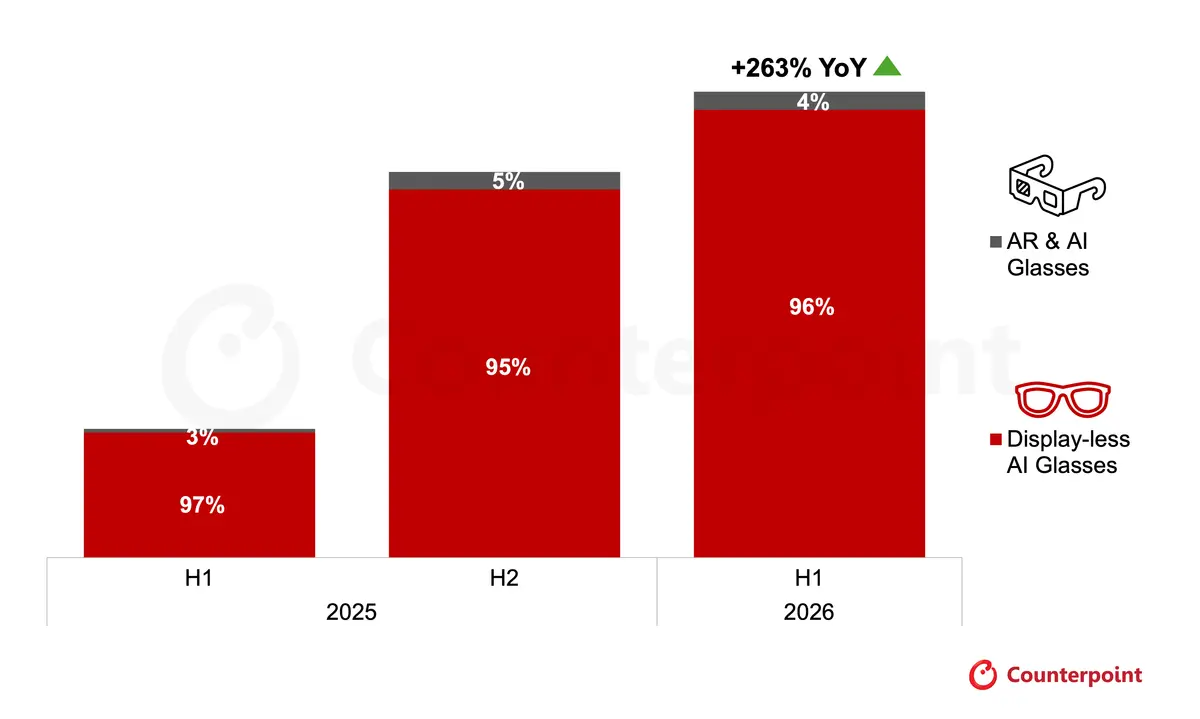
- Global AI glasses shipments – including display-less and AR & AI glasses – surged 263% YoY in H1 2026, with the more mature display-less segment accounting for 96% of total shipments.
- Display-less AI glasses shipments increased 258% YoY and 22% sequentially, driven by Meta and EssilorLuxottica’s expanded product lineup, entry into new APAC markets, and broader promotional activities across global retail channels.
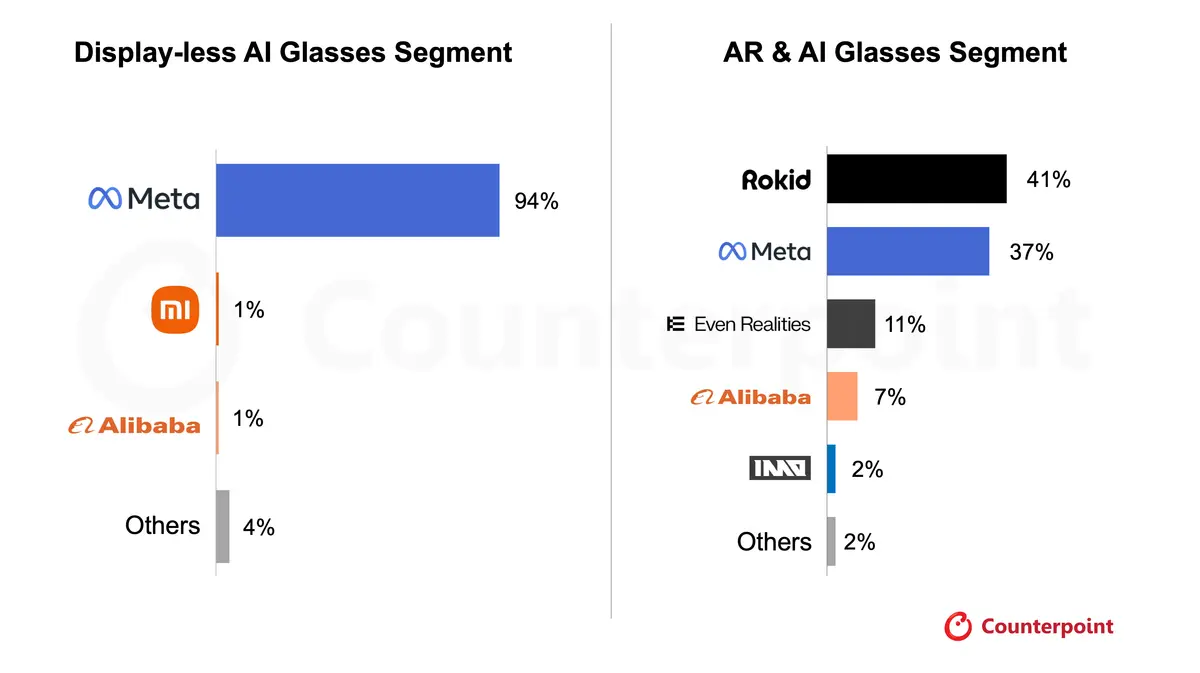
- Meta accounted for 94% of global display-less AI glasses shipments, with volumes up 260% YoY and 22% sequentially in H1 2026. Outside Meta, the market remains highly fragmented.
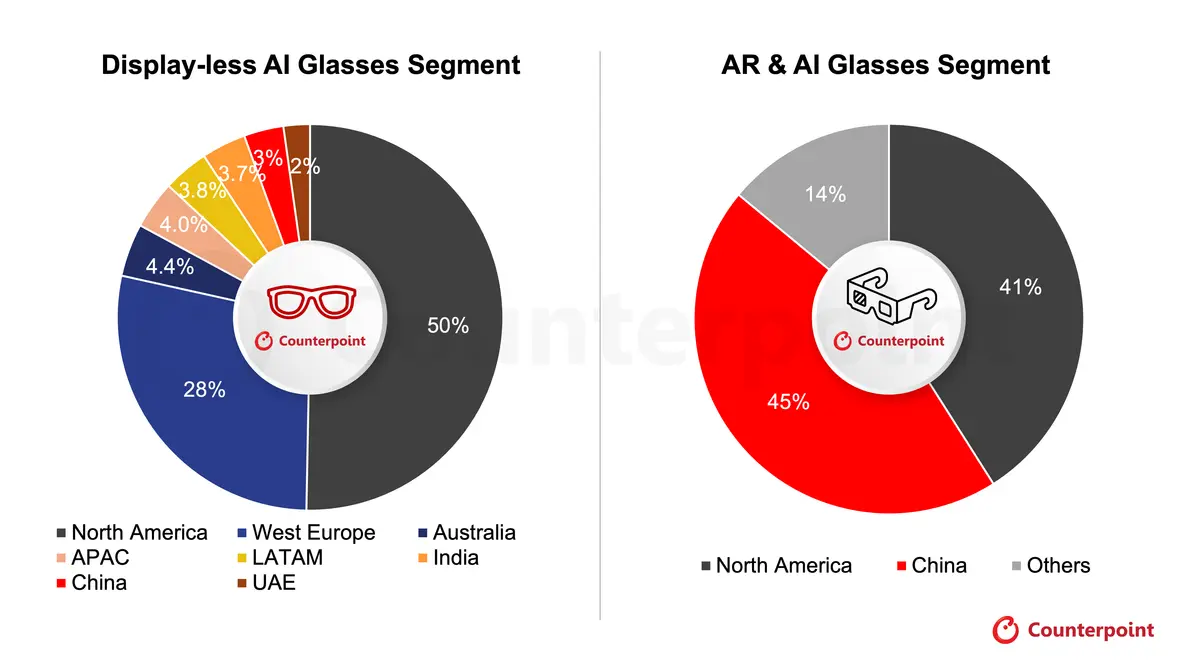
- AR & AI glasses shipments grew 449% YoY from a small base, with Chinese OEMs – including Rokid, Even Realities and Alibaba – leading commercialization fueled by a relatively mature domestic supply chain. China accounted for 45% of segment shipments, ahead of North America at roughly 41%.
- Rising memory and other component prices, along with growing public concerns over the privacy implications of cameras in AI glasses, are emerging as key challenges to the industry’s near-term development. However, we do not expect these challenges to alter the industry’s broader trajectory of growth and innovation.
Beijing, Berlin, Buenos Aires, Fort Collins, Hong Kong, London, New Delhi, Seoul, Taipei, Tokyo – September 21 , 2026
Global broader AI glasses shipments, including display‑less AI glasses and AR & AI glasses, surged 263% YoY in H1 2026, according to Counterpoint Research’s Global Intelligent Eyewear Market Tracker. Lower‑priced, lightweight display‑less AI glasses continued to dominate, accounting for 96% of total shipments, while AR & AI glasses, most of which rely on waveguide lenses for optical see‑through experiences, remained relatively small and niche due to higher costs, lower technology maturity and bulkier form factors.
Global AI Glasses Shipments by Device Type, H1 2025-H1 2026
Source: Counterpoint Research's Intelligent Eyewear Market Tracker, H1 2026 Update
In H1 2026, the display‑less AI glasses segment grew 258% YoY and 22% compared with H2 2025, driven primarily by the continued expansion of Meta and EssilorLuxottica.
Commenting on the market’s competitive landscape, Research VP Peter Richardson said, “Three years after the launch of the Ray‑Ban Meta AI Glasses in 2023, the competitive landscape of the global AI glasses market remains largely unchanged. Meta further strengthened its dominance in H1 2026, accounting for about 94% of global shipments.”
Meta’s shipments grew 260% YoY and 22% sequentially in H1 2026, driven by new Ray-Ban Meta AI Glasses variants, the introduction of lower-priced Meta Glasses, expansion into new markets and broader retail promotions. Beyond Meta, the AI glasses market remains fragmented despite launches from Chinese players such as Alibaba and Huawei.
The AR & AI glasses segment remains relatively small but is growing rapidly, with shipments up 449% YoY and 18% sequentially in H1 2026. Unlike display-less AI glasses, Chinese OEMs such as Rokid, Even Realities, Alibaba and INMO are leading commercialization, making China the clear frontrunner in this category.
Explaining this divergence, Principal Analyst Flora Tang noted, “At this early stage, the competitive landscape is shaped more by product supply than consumer demand. China has established a relatively mature AR glasses ecosystem, spanning micro-display makers, waveguide suppliers – one of the most critical components – to manufacturing partners, audio component suppliers and other key component providers. Chinese companies also tend to launch products earlier, iterate faster and refine their offerings based on user feedback. In comparison, companies like Meta and Apple generally take a more cautious approach, waiting for technologies to become more mature before scaling up.”
Global AI Glasses OEM Shipments Share, H1 2026
Source: Counterpoint Research's Intelligent Eyewear Market Tracker, H1 2026 Update
Global AI Glasses Shipments Share by Region, H1 2026
Source: Counterpoint Research's Intelligent Eyewear Market Tracker, H1 2026 Update
In the display-less AI glasses segment, Meta and EssilorLuxottica have adopted a more aggressive expansion strategy, driving growth across North America, Western Europe, LATAM, India and newer APAC markets. Meanwhile, China remained the leading market for AR & AI glasses, followed by North America.
As the global AI glasses market evolves, new challenges are emerging, particularly rising semiconductor component prices, especially memory, and growing public concerns over privacy and cameras in AI glasses. These headwinds could introduce greater uncertainty and weigh on market growth in the near term.
Despite near-term challenges, we expect the AI glasses market to maintain its strong growth trajectory as Meta, Google, Samsung and Apple intensify their investments and competition. The next phase of growth will be driven by agentic AI glasses offering more proactive, context-aware experiences, enabled by advancements in agent-integrated software, operating systems, voice interaction, and ultra-low-power sensing and computing technologies. These developments are expected to create new growth opportunities for component vendors in the AI glasses ecosystem. We also expect a wider range of AI glasses form factors to emerge to address privacy concerns associated with cameras, including camera-free AI audio glasses and AI glasses equipped with cameras primarily for contextual understanding rather than photo or video capture.
For a detailed overview of the global AI glasses market landscape in H1 2026, please refer to Counterpoint Research’s Intelligent Eyewear Market Research Service.
** Definitions of Terms in this report:
- In this report, AI glasses refer to smart glasses equipped with AI-enabled processor(s) to support on-device AI capabilities. To enable relatively natural user interaction, these glasses must incorporate at least two of the following components: speaker(s), microphone(s), camera(s) and AR display(s).
- Display-less AI glasses refer to AI glasses without a see-through display, such as Ray-Ban Meta AI Glasses, Xiaomi AI Glasses and Alibaba Qwen AI Glasses G1.
- AR & AI glasses refer to AI glasses equipped with the necessary display(s) and optical components to enable an optical see-through experience. Most AR & AI glasses currently use waveguide lenses. Typical products include Rokid Glasses, Meta Ray-Ban Display and Alibaba Qwen Glasses S1.
About Counterpoint Research
Counterpoint Research is a global market research firm specializing in products across the technology ecosystem. We advise a diverse range of clients – from smartphone OEMs to chipmakers and channel players to Big Tech – through our offices located in the world's major innovation hubs, manufacturing clusters and commercial centers. Our analyst team, led by seasoned experts, engages with stakeholders across the enterprise – from the C-suite to professionals in strategy, analyst relations (AR), market intelligence (MI), business intelligence (BI), product and marketing – to deliver services spanning market data, industry thought leadership and consulting. Our core areas of coverage include AI, Automotive, Consumer Electronics, Displays, eSIM, IoT, Location Platforms, Macroeconomics, Manufacturing, Networks and Infrastructure, Semiconductors, Smartphones and Wearables. Visit our Insights page to explore our publicly available market data, insights and thought leadership, and to understand our focus, meet our analysts and start a conversation.
Follow Counterpoint Research


