- CES’ automotive-centric focus is being diluted by broader industry trends – nevertheless, we expect software-defined vehicles and autonomy to be central themes discussed, along with how Western automakers can combat China’s rise.
- The hottest keynote ticket at the event will be for NVIDIA CEO Jensen Huang as he lays out a vision for a more pragmatic use of AI in what is likely to be a wide-ranging tour de force that will take in everything from data centers to robotics.
- AI-based client compute will be a recurrent key theme as Windows on Arm, powered by Qualcomm’s second-generation Snapdragon X chips, increase the threat level to Intel and AMD’s x86 architecture – though both are fighting back across multiple fronts.
- Health tech and other low-power edge AI solutions are likely to be a major theme with multiple players delivering a growing ecosystem of low-power AI-capable chip solutions, a wide range of sensors and a rich array of increasingly sophisticated software solutions.
CES 2026 will kick off in January with a round of exciting announcements that underscore the continued rise of high-performance compute, shifts in automotive to a software-first development structure, the continued emergence of embedded AI in everything from PCs to smart glasses and myriad health and wellness devices.
Counterpoint’s analysts will be on the ground in Las Vegas during the event. If you are there, reach out to meet with us. Alternatively, you can follow us to gain insights on the announcements during the event. We will produce sector-focused wrap-up reports after the show closes to help you make sense of the stream of information that will pour out of Las Vegas.
NIVIDA, AMD and Qualcomm – Making AI More Concrete
The big silicon players will be the backbone of CES 2026 with NVIDIA, AMD and Qualcomm leaning hard into AI-first computing. Expect fewer new architectures and more focus on refreshed silicon, system design, and real-world demos across PCs, phones, automotive, and data centers. The common thread will be on-device AI performance, battery efficiency, and software stacks that make the compute power visible in daily workflows.
NVIDIA
NVIDIA is treating CES 2026 as an AI showcase, with NVIDIA CEO Jensen Huang’s keynote themed around the power of AI. Expect the story to span from data center and enterprise accelerators through to AI PCs, Arm-based client chips (like the rumored N1x SoC), and automotive platforms such as DRIVE for in-vehicle and autonomous systems including robotics.
On the GeForce side, CES looks set to address questions around the RTX 50 “Super” refresh rather than introduce an entirely new architecture, so we expect spec tweaks, partner designs, and creator/RTX demos rather than a generational reset. Show-floor demos should lead with generative AI for creators, thin-and-light RTX laptops, and edge/robotics use cases that make Blackwell-class tech feel less like a cloud-only story.
AMD
AMD is opening CES with a Lisa Su keynote that positions the company as pushing future AI solutions – from cloud to edge to PC, rather than a single headline-grabbing product.
In gaming, AMD is focusing on refinements to current Radeon lines and a big push for its FSR/Redstone frame generation tech, now pitched as a more AI-driven answer to DLSS and supported in a large and growing list of titles. The overall stance of AMD is likely to be incremental but confident: steady AI and gaming improvements, more OEM systems on the show floor, and a lot of emphasis on power efficiency and mature process nodes.
Qualcomm
Qualcomm’s CES presence is all about cementing its role in AI-heavy mobile and Arm PC platforms and its growing presence in the automotive industry.
On the mobile side, the company is highlighting its latest Snapdragon 8 Elite Gen 5 with an upgraded AI Engine and Hexagon NPU, designed to keep large models running on-device with lower latency and better power efficiency.
In PCs, expect a strong push around Snapdragon X2 Elite and X2 Elite Extreme laptops, with OEM designs that showcase all-day battery life, Windows on Arm maturing, and NPUs driving features like live translation, creative tools, and local copilots.
Qualcomm is also likely to talk about its consolidation as a leading silicon platform provider in the automotive sector – a position where it continues to gain momentum through high-profile design wins and a growing revenue pipeline.
Automotive Technologies at CES 2026: The Three Defining Battles for the Future of Mobility
CES has become the proving ground for the automotive industry. In the 2026 edition, the focus on digital transformation is expected to sharpen in three inescapable, intertwined realities: the fundamental shift of value creation from hardware to software, the massive external pressure from fast-moving Chinese competitors who are mastering that very shift and the acceleration to fully autonomous vehicles that is now at its inflection point.
1. ‘Software Eats the Auto Industry’: The SDV as the Cost-critical Platform
The mantra that "software is eating the world" has found a complex and expensive battleground in the automotive sector. CES 2026 will be about how legacy automotive giants and suppliers can execute this transition at scale, speed, and profitably.
- After years of pushing complex, high-cost architectures, the focus has shifted to making the Software-Defined Vehicle (SDV) affordable and scalable across all market segments. This is a direct response to global market demands and rising development costs. Tier-1 suppliers like Elektrobit, among others, are expected to showcase modular E/E architectures designed to accelerate development cycles and reduce manufacturing complexity. The goal is to deliver continuous innovation without breaking the budget or existing architectures.
- The ability to test, validate, and integrate new features virtually (called "shift left") will be showcased through advanced digital twin environments that link software from the cloud directly into the car. Software platforms from companies like QNX will demonstrate integration through AI-assisted automation that streamlines configuration, testing, and deployment will demonstrate the agility practiced by technology-first new-age competitors.
- The challenge faced by SDVs is generating sustainable, post-sale revenue. Companies will try to demonstrate the mass-market appeal of subscription services and features-on-demand. From companies like Sonatus and NXP, we expect AI-powered personalization and safety features such as predictive maintenance, smart diagnostics, and optimized battery management that can be bundled into appealing services, moving the revenue stream from a one-time sale to a continuous relationship.
2. Battling the Chinese Wave: Speed, Software, and Strategy
The rise of Chinese manufacturers like BYD, Geely and emerging players like Xiaomi, Xpeng and NIO presents a stark competitive reality. These companies, driven by national support and vertical integration, are dominating their home market and expanding aggressively into Europe and other global regions.
- Chinese domestic brands have succeeded not just on price, but on delivering a superior, fast-moving digital, and overall, user experience (UX) that Chinese consumers, especially younger buyers, now expect. Western OEMs must prove they can close this “software gap.” Expect a showcase of highly integrated, AI-powered cockpits to rival Chinese counterparts from the likes of Mobis, Qualcomm, and more.
- Chinese EV players often control the entire value chain from battery material and cell production to the software stack. This allows for unparalleled cost advantages and rapid iteration. Western players cannot do it all but are expected to highlight their strategic partnerships at the event. CES 2026 may see a plethora of announcements of alliances with tech firms (Big Tech/AI providers) such as NVIDIA, Qualcomm and Tier-1s such as Bosch, Aumovio, Denso, and automotive OEMs to build modular, non-proprietary platforms that aim to match the efficiency of China's vertical model without the risk of single-source lock-in.
- The battleground for future vehicle sales is shifting. While tariffs loom in North America and Europe, Chinese companies are moving fast, establishing Western R&D hubs to ensure their software is compliant and appealing to Western consumers. CES announcements, showcase and demonstration are expected to focus on speed and innovation as a differentiator than mere new technology and flashy concept cars.
3. The AI-driven Leap: Advanced and Autonomous Driving Systems
The evolution of safety and convenience features and full autonomy is now entirely dependent on computing power and software sophistication. CES 2026 will showcase three critical advancements in ADAS and Autonomy:
- Autonomous vehicles will require high compute processing power with semiconductor and software integration as the central battleground to process data from dozens of sensors and to execute driving behaviors replicating humans. We will see SoC players like NVIDIA, Qualcomm, Mobileye, Horizon Robotics demonstrating their latest SoC and Momentum, Deeproute.ai, Helm.ai, Qcraft demonstrating their software solutions that deliver Level-4 autonomous vehicles. This will be as much about how scale can be achieved across vehicle segments as it will be about performance and efficiency.
- Sophisticated sensor fusion and machine learning models trained on massive real-world datasets will be at the forefront in demonstrating how next-generation autonomous vehicles can advance. Demonstrations featuring 4D imaging radar and adaptive LiDAR, which add additional high-fidelity in understanding the environment, are expected by key players – NXP, Arbe, Mobileye, Hesai, Robosense, and Seyond. These emerging sensor technologies are expected to help interpret complex, nuanced environments and challenging weather conditions, dramatically enhancing safety of Level 2+ and above systems.
Robotics Slowly Developing a Full Supporting Ecosystem
Robotics is a fast-growing vertical for many silicon players, AI orchestrators and sensor players in both the consumer electronics and industrial sectors. Development, deployment, simulation, and IoT sensor solutions/ecosystems will accompany visual intelligence integration to improve HMI and task performance.
For the consumer segment, expect improved appearances and intractability from humanoid robots enabled by visual context models. For industrial robotics, we expect improved environment context enabled by sensor fusion including visual intelligence, private 5G networks, IoT sensor integrations and LiDAR for precise movements in tight spaces. For both, we expect a host of software solutions similar to automotive to offer SDKs that include software simulation, testing and deployment for a variety of robotics applications.
Edge AI solutions continue to grow in dominance, with small language models servicing specific purposes to keep compute lighter. Lightweight edge AI solutions will continue to be touted especially given the current memory demand situation in addition to security considerations and cloud cost savings.
Client Compute: AI PCs Enter the Scaling Phase
CES 2026 will mark the transition of AI PCs from early adoption to scale. We expect broader, more mature portfolios across commercial, consumer, and creator segments, with OEMs emphasizing real productivity and workflow gains rather than novelty AI demos. NPUs will be positioned as standard platform components, and messaging will shift toward sustained AI performance, local inference reliability, and software ecosystem readiness (ISVs, security, and enterprise manageability).
Key themes will include:
- Second-generation AI PC platforms with higher NPU TOPS and better CPU-GPU-NPU workload orchestration.
- Stronger focus on commercial AI PCs, security use cases, and fleet deployment.
- Continued pressure on memory configurations, influencing pricing and system segmentation.
CES 2026 will further intensify x86 vs Arm competition, but the narrative will evolve beyond ‘can it compete?’ to ‘where does it win?’ Arm-based PCs will lean into battery life, thermals, always-on AI, and thin-and-light designs, while x86 platforms will highlight performance scaling, compatibility, and enterprise breadth.
Expect OEM demos to increasingly focus on:
- Performance per watt and real-world endurance.
- Fanless and near-silent designs.
- Seamless AI experiences across OS, silicon, and applications.
Consumer Tech
Smart glasses and eXtended Reality (XR):
Smart glasses without see-through displays have outshone XR devices in 2025, although Meta’s Ray Ban Displays gave a glimpse of what is likely to be a growing wave of new devices. CES is unlikely to see a huge number of new product launches but will be a showcase for display technologies used in XR devices. Swave Photonics, a previous recipient of CES technology awards, is expected to showcase its dynamic color holographic XR displays built on a standard low-cost CMOS process. This will be combined with its real-time holographic processing unit (HPU) to enable dynamic depth focus that is compatible with prescription lenses.
Smart glasses present unique challenges among other form factors in managing heat, weight and UI in a compact form factor. UltraSense is a solution provider hoping to show off its unique value proposition that solves weight and UI problems. It is bringing its experience in automotive HMI to smart glasses offering improved materials flexibility, resiliency to varying conditions and usability. Its approach is through sensor fusion that combines capacitive sensing, enhanced with force and ultrasound.
Additionally, providers such as xMEMs offer compact solutions to address space constraints and thermal management, including a 1mm micro-blower called µCooling. The other is its new silicon MEMS loudspeaker: an ultra-light, full-range solid-state driver enabling richer sound and slimmer, more comfortable designs for AI glasses, wearables, and open-fit earbuds. We expect similar solutions throughout the show to address the challenges of designing for the specific constraints of wearables.
Health Tech
Smart wearables have long been a staple of CES. However, for 2026, we are expecting to see the incorporation of new types of sensors that can enable new use cases – In-ear EEG sensors that can be built into, for example, ear buds to offer real-time brainwave monitoring, with applications spanning neurology, mental health, sleep disorders and even brain-machine interfaces.
Hormone detectors that can be paired with a smartphone to monitor a range of different indicators such as stress responses, menstrual cycles, and other sex hormones.
And NuraLogix will unveil the Longevity Mirror that uses a 30-second selfie to reveal current health and project long-term health risks. It will be paired with AI guidance to help the user understand and address risks to long-term health.
As humanoid robots become more capable, we are also expecting to see more examples of exoskeletons to enhance human movement and performance. Examples include Ascentiz, which will be showing improved versions of its module exoskeleton that can help users by delivering targeted power or joint assistance.
Display Technology: OLED Everywhere, MiniLED Evolves
Displays at CES will reinforce that OLED is no longer niche. We expect broader OLED adoption across notebooks, monitors, and premium tablets, with a strong push in gaming and creator segments. High-refresh-rate OLED monitors (240Hz–500Hz+) will dominate attention, alongside improvements in brightness, power efficiency, and burn-in mitigation using tandem OLED and new compensation algorithms.
MiniLED will remain relevant but increasingly positioned as a cost-optimized premium rather than cutting-edge tech. We expect thinner MiniLED backlights, higher zone counts, and improved local dimming algorithms, particularly in larger notebooks and gaming laptops where OLED ASPs remain difficult.
Key Display Trends to Watch on the Show Floor:
- Ultra-high refresh OLED monitors (360Hz–500Hz+) targeting esports and high-end gaming.
- Tandem OLED and improved WOLED/QD-OLED panels with higher brightness and longer lifespan.
- Power efficiency as a headline feature, especially for AI notebooks and handheld gaming PCs.
- Foldable, rollable, and dual-screen concepts, mostly as proof-of-concept rather than near-term mass products.
- More touch, pen, and hybrid use-case demos, blurring the lines between tablets and notebooks.
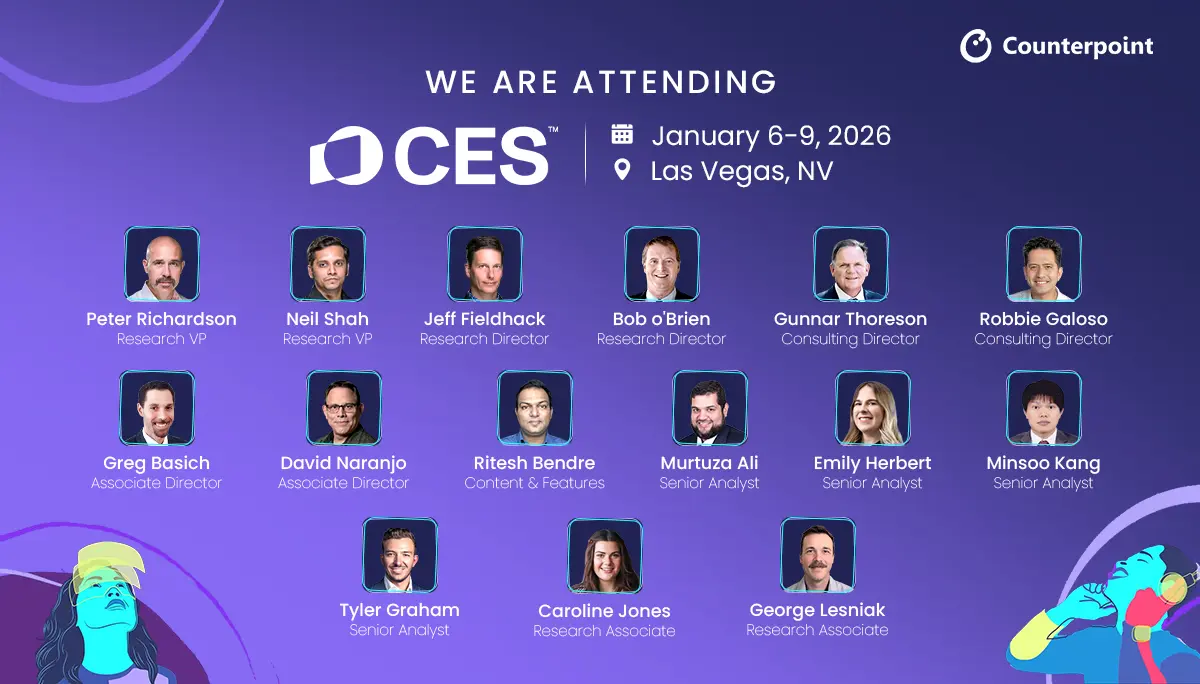
Our analysts are attending CES 2026 from 6th to 9th January, 2026. You can schedule a meeting with them to discuss the latest trends in the technology and telecommunications sector and understand how our leading research and services can help your business.
