"AI glasses offer a more natural interface for personal AI agents, enabling continuous, hands-free, and contextual computing -- seeing what users see and hearing what they hear," said Flora Tang, senior analyst at Counterpoint Research.
"This supports real-time translation, object recognition and proactive assistance in ways that smartphones, still reliant on touch or voice activation, struggle to match."
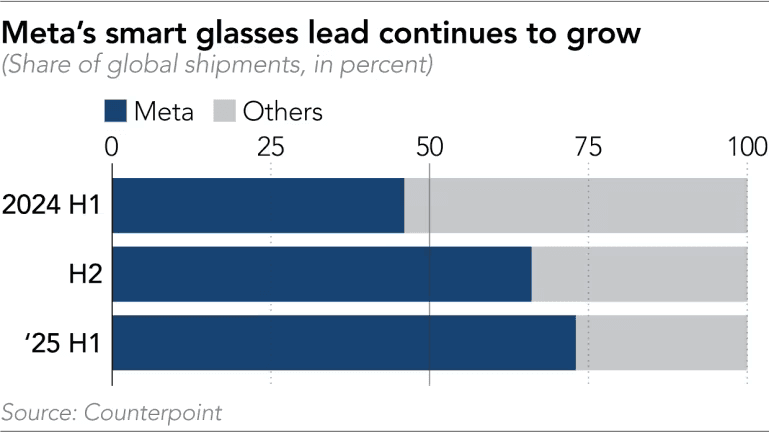
According to Counterpoint, Meta accounted for 70% of all smart glasses shipped in the first half of this year and has sold over 3 million pairs of its Ray-Ban AI glasses since their launch in September 2023, but still only a small fraction of the iPhones Apple ships every quarter.
One reason for the interest in these wearable devices is their potential to be the next frontier of the "software and hardware" ecosystems that are seen as critical for winning the AI race.
IMAGE
Chinese players have a number of advantages on their side. The tech supply chain in their country may help domestic smart-glasses makers to beat their competitors in cost and efficiency, similar to how smartphone makers like Huawei, Xiaomi and Oppo are quickly catching up to Apple in terms of global market share.
"Chinese players benefit from a massive domestic user base and super-app ecosystems, such as WeChat and Douyin, that drive everyday use cases, along with a strong hardware supply chain and cost efficiency, giving them an edge in rapid iteration and competitive pricing," said Tang.
Meanwhile, U.S. tech giants "have greater financial resources to invest in AI and software R&D, excel in hardware-software integration, and enjoy globally recognized consumer brands," Tang added.


