

- Amazon’s glasses use AI and computer vision to help delivery drivers stay safe while speeding up the last-mile delivery process.
- The glasses are based on a monochrome green display. With potentially over 100,000 units shipping next year, this could be the largest volume order for MicroLED displays to date.
- Amazon has not confirmed a consumer version of the glasses. In China, e-commerce giant Alibaba is set to start shipping its first AI + AR glasses next month.
Amazon has unveiled AR smart glasses that are designed to assist its delivery drivers. While the glasses do not have an official name yet, they are reportedly known internally as the Amelia glasses. Amelia is also the name of Amazon’s AI assistant for independent sellers, so the glasses appear to be part of the company’s vision to leverage AI to increase efficiency. Amazon told media outlets the glasses were already being tested with hundreds of drivers at several locations in the US, with plans to deploy them in North America first, followed by a global rollout later.
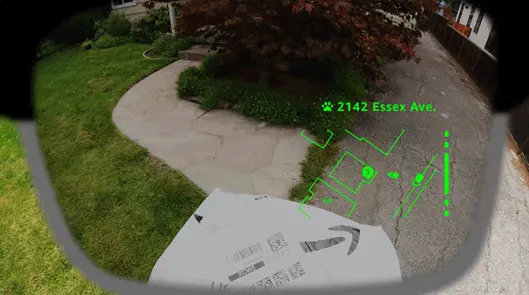
The Amelia glasses have been specifically designed for Amazon’s delivery associates (DAs) and use advanced computer vision processing and AI integration to speed up the last-mile delivery process. The glasses provide a hands-free experience and enable DAs to scan packages, follow turn-by-turn walking directions, and capture proof of delivery without looking at their phones. AI and computer vision are used to detect potential hazards, like pets or uneven walkways, and share that information for future deliveries. Amazon says this will help drivers keep focus on their safety and surroundings, while saving up to 30 minutes per 8-10-hour shift.

Source: Amazon
While Amazon has not provided technical specifications, the company has shared some videos to illustrate what the driver will see when wearing the Amelia glasses. A monochrome green display appears on the lower right corner and shows information such as package number, delivery address and a street map. To prevent distractions, the display automatically turns off when driving. A wearable controller inside the delivery vest contains a hardware switch, a swappable battery, and a button to reach emergency services. Prescription lenses or transition lenses can also be fitted.
Analyst take
There are already several consumer AR glasses with a monochrome green display, such as the Even Realities G1, Rokid Glasses and, most recently, Alibaba’s Quark AR glasses. Vuzix also offers similar glasses for enterprise applications. These devices are all based on a small high-brightness MicroLED projector paired with waveguide optics. The low resolution of the display and the narrow field of view limit the type of content that can be shown to the user, which explains why shipments of MicroLED glasses have been relatively low.
With the Amelia glasses, Amazon has focused on a specific use case, leveraging its own infrastructure to combine AR and AI. Amazon has thousands of delivery drivers through its Delivery Service Partner (DSP) program. In 2024, the program included 390,000 drivers, up from 279,000 the year before. The company reportedly plans to produce around 100,000 units of the Amelia glasses in 2026. This could be the largest ever volume order for MicroLED displays.
Although Amazon has not confirmed whether there will be a version for the consumer market, the technology developed for the Amelia glasses could be integrated into future models of Echo Frames, Amazon’s own line of smart glasses. Alibaba is another e-commerce giant that has recognized the importance of AI + AR glasses. Its Quark AI glasses are set to ship in December and feature a new AI Chat Assistant powered by Alibaba’s own large language model.
Counterpoint Research will host the AI + XR 360 Summit on November 17 at the Santa Clara Convention Center in Silicon Valley, California. This in-person event will bring together leading analysts and companies in the fields of AI, Smart Glasses and XR displays to discuss how these disruptive technologies will create new opportunities in the consumer and enterprise markets.

