

- Global drone revenue is projected to reach $77 billion by 2035, driven by commercial adoption and supportive government policies.
- Service revenue will likely reach $51 billion in 2035 as the industry is set to expand beyond hardware to AI services.
- Commercial drones will unlock the true potential of Physical AI opportunities in agriculture, industrial, logistics, inspection, public safety and disaster management.
- China leads the global drone market, while the US, Europe, India and other regions are accelerating adoption through regulations and domestic ecosystem developments.
- Geopolitical tensions, battery limitations and cybersecurity concerns will drive competition and shape industry dynamics.
Seoul, Beijing, Berlin, Buenos Aires, Fort Collins, Hong Kong, London, New Delhi, Taipei, Tokyo – June 23, 2026
Global drone revenue, including consumer and commercial segments, is expected to grow at a 14% CAGR to reach $77 billion by 2035 from 2025, according to the latest Counterpoint Global Physical AI Devices Market tracker. Initially, the drone market was driven by hobbyists and photographers for photography, videography, content creation and recreational flying, which was further boosted by improving camera quality and falling prices to make it a lifestyle device. Now, commercial drones are witnessing stronger growth momentum with a wide range of use cases, such as surveying, monitoring, infrastructure inspection, agriculture spraying, mapping, data collection, traffic management, search and rescue, firefighting and last-mile delivery. This growing adoption of drones is expected to transform the ‘low-altitude economy’, prompting governments to adopt supportive policies, airspace reforms and regulatory frameworks for faster innovation and commercial deployments.
Commenting on the drone market dynamics, Principal Analyst Soumen Mandal said, “Consumer drones have already transformed aerial photography, but the real growth opportunity lies in commercial drones. The expanding range of applications across agriculture, logistics, industrial operations, public safety and disaster management is unlocking the true potential of Physical AI, powered by edge computing, advanced sensors, seamless connectivity, computer vision and increasingly autonomous operations.”
Global Drone Device and Service Revenue Market Trend, 2025 vs 2035
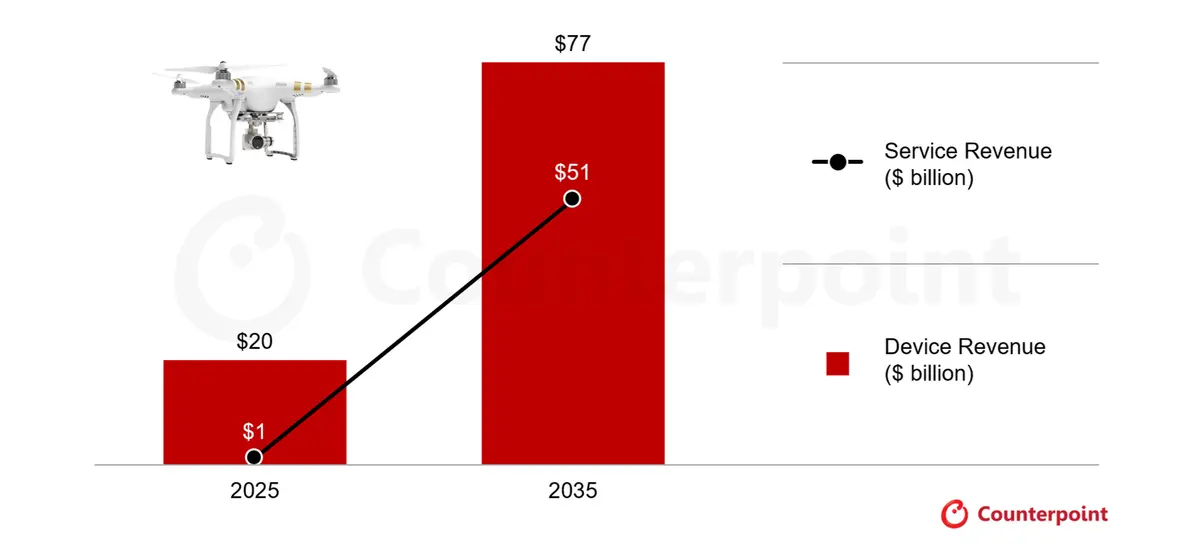
Annual drone or UAV shipments will likely exceed 19 million units in 2035, growing from 8 million units at the end of 2025. The drone market is evolving from a hardware business to a multi-layered ecosystem across the entire value chain – from chipset and sensors to connectivity, AI software, cloud platform, and drone-as-a-service (DaaS).
Commenting on market potential, Research Director Marc Einstein said, “Service revenue will create another $51-billion opportunity by 2035. In the long term, the value proposition will shift from hardware to AI, software, autonomous services and data-driven business models. This will create significant economic potential at scale and intensify competition, ultimately leading to market consolidation as the industry matures.”
Shenzhen, China, is widely regarded as the drone capital of the world, supported by favourable government policies and a tightly integrated supply chain ecosystem. Similarly, the FAA in the US is playing a key role in accelerating commercial drone applications through regulations around Beyond Visual Line of Sight (BVLOS) operations. Europe is expanding drone deployments across industrial applications, smart mobility and autonomous aerial services. India is pushing for agriculture drone applications to address rising labour costs and a shortage of labour. Countries in the Middle East, such as UAE and Saudi Arabia, are investing in drones as part of their smart city infrastructure developments. On the other hand, Japan and South Korea are trying to increase productivity and deal with labour shortages.
The restrictions on new DJI drones in the US have further encouraged countries to develop their own drone supply chain ecosystems, particularly for defence applications, while also strengthening domestic capabilities in consumer and commercial drones.
Edge AI processing and autonomous operations will increase drone capabilities. However, battery performance remains a hurdle in achieving longer flight hours and fully autonomous operations. There are also concerns over privacy and cybersecurity risks that need to be addressed to unlock the full potential of AI-driven drone applications.
About Counterpoint Research
Counterpoint Research is a global market research firm specializing in products across the technology ecosystem. We advise a diverse range of clients – from smartphone OEMs to chipmakers and channel players to Big Tech – through our offices located in the world's major innovation hubs, manufacturing clusters and commercial centers. Our analyst team, led by seasoned experts, engages with stakeholders across the enterprise – from the C-suite to professionals in strategy, analyst relations (AR), market intelligence (MI), business intelligence (BI), product and marketing – to deliver services spanning market data, industry thought leadership and consulting. Our core areas of coverage include AI, Automotive, Consumer Electronics, Displays, eSIM, IoT, Location Platforms, Macroeconomics, Manufacturing, Networks and Infrastructure, Semiconductors, Smartphones and Wearables. Visit our Insights page to explore our publicly available market data, insights and thought leadership, and to understand our focus, meet our analysts and start a conversation.

