- China Mobile will push forward the “5G Device Forerunner Initiative” program and launched its own-branded 5G devices in 2019. Besides, it will heavily invest in 5G innovation and application landing.
- China Telecom will continue to promote all-modes, with extra incentives to AI and advanced network capabilities.
- China Unicom will carry on subsidy reduction for terminals, and focus on quality and service improvement.
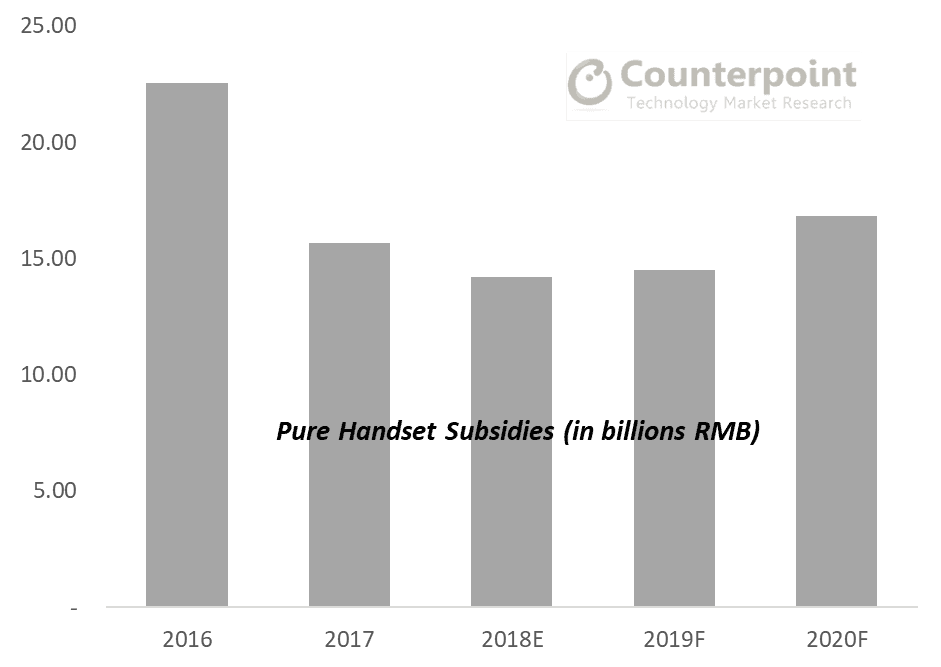
Over the last few years, Chinese operators have been optimizing the allocation of subsidies, resulting in decreasing incentives to terminal devices. Data from Counterpoint’s Market Pulse service shows that China’s overall smartphone sales volume declined 11% year-on-year in 2018. As fewer smartphones were sold, the total handset subsidies in the period continued to decline.
However, given the complexity of the first generation 5G devices, operators are expected to provide more subsidies to offset the significant increase in Bill of Materials (BOM) cost of devices or up to US$50 net addition according to the latest analysis from Counterpoint Research.
In view of this, we expect the downward trend of subsidies will be reined in this year and slightly reversed due to more subsidies for 5G devices. Based on Counterpoint’s latest forecast on 5G smartphones, there will be around 5.7 million units shipped through 2019, and the sales volume will grow to 36.5 million in 2020, up 540% year-on-year. In the long run, the ramp-up curve of 5G will be more like that of 3G. likely leading to a steady growth of 5G terminal subsidies, but since Chinese operators are inclined to incentivize sales channels, improve service quality and consumption experience, and directly subsidize consumers, total handset subsidies are unlikely to recover to the pre-2014 levels, despite the advent of 5G.
Exhibit 1: Pure Handset Subsidies Turn Upside
While we expect subsidies to increase across all Chinese operators, the manner in which they deploy their resources will differ.
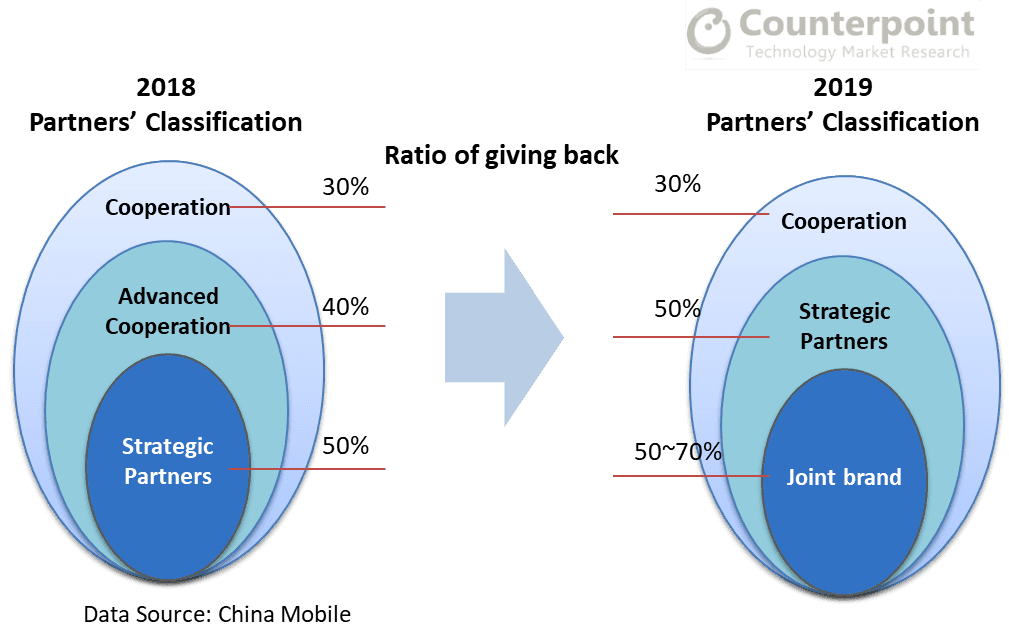
China Mobile will provide RMB 100 to 200 million subsidies to the first batch of 5G device providers. It also plans a 5G fund of over RMB 20 billion to promote 5G innovation and industry development. Meanwhile, China Mobile will carry on subsidizing 4G+ terminals in the early stage of 5G, since the ratio of 4G+ customers to total 4G customers is relatively low at only 34% at the end of 2018.
Exhibit 2: China Mobile Gives Back More Subsidies to Strategic Partners
China Unicom has been reducing handset subsidies. Its subsidy strategy carries distinct internet elements, with a total amount of RMB 21 billion being subsidized to facilitate the switching to 5G. While China Telecom will still focus on subsidizing all-modes handsets.
Beyond smartphones, Internet of Things (IoT) cellular modules have been another beneficiary of operator subsidy policy. For instance, China Telecom totally subsidized RMB 300 million or US$ 45 million through 2018, to bring down the overall cost of modules such as 4G and NB-IoT (Narrow Band-IoT). However, as the NB-IoT module prices fall between US$3~US$4, subsidies towards cellular modules are likely to decrease.
Exhibit 3: China Telecom Provided CNY 5.3 billion Subsidies in 2018
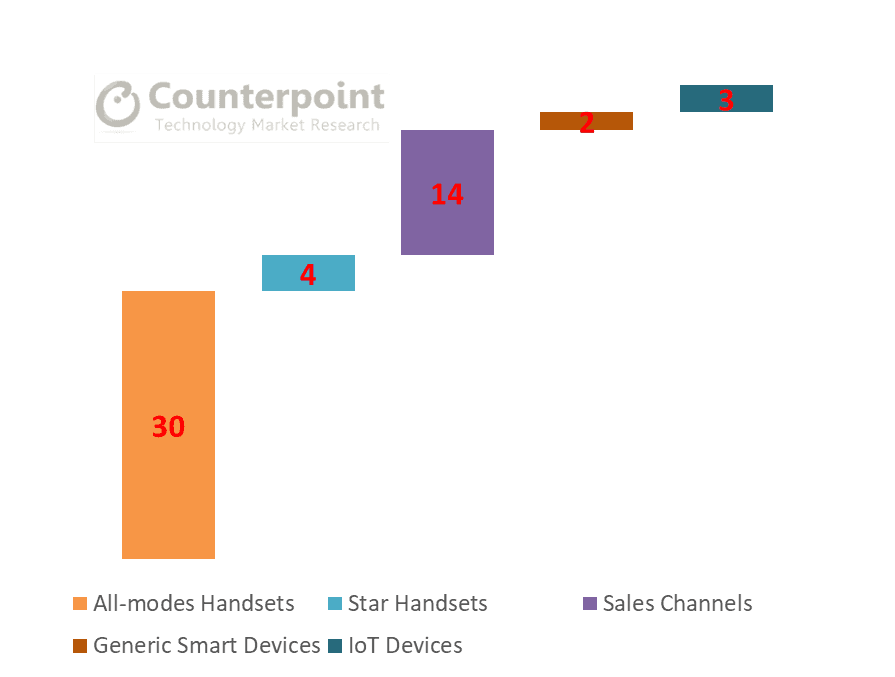
In addition, the switch to 5G also enables increased use of connected smart devices. Operators will provide dedicated subsidies to so-called generic intelligent devices including VR/AR, wearable gadgets, connected notebook, HD STB, MIFI, etc., which will further diversify in the 5G era. This is also in accordance with the new implementing plan, jointly released by the National Development and Reform Commission, which aims to drive consumer upgrades.


