

- Qualcomm’s Arduino has introduced Ventuno Q, a developer platform powered by the Dragonwing IQ8 edge AI compute platform delivering up to 40 TOPS.
- Dual processor architecture combines AI inference with STM32H5 microcontroller-based real time control for robotics and industrial systems.
- The platform is priced below $300 to lower barriers for developers building AI-powered edge and robotics applications.
- The launch reflects a broader industry shift toward integrated edge AI systems where sensing, AI processing and actuation operate directly on device.
At Embedded World 2026, Qualcomm’s Arduino introduced the Arduino Ventuno Q, a high-performance edge AI developer platform powered by Qualcomm’s Dragonwing IQ8 series, boosting the development of edge AI.
Edge AI is rapidly gaining momentum as enterprises increasingly move AI workloads closer to the device. The shift is driven by the need for lower latency, improved data privacy, reduced cloud inference costs and higher power efficiency. As AI models become more capable and applications expand across industrial and robotics domains, the edge is emerging as a critical layer for intelligent computing.
Qualcomm acquired Arduino in late 2025 to enhance its edge computing platform and provide developers with greater access to its portfolio of technologies.
A New Platform for Edge AI Development
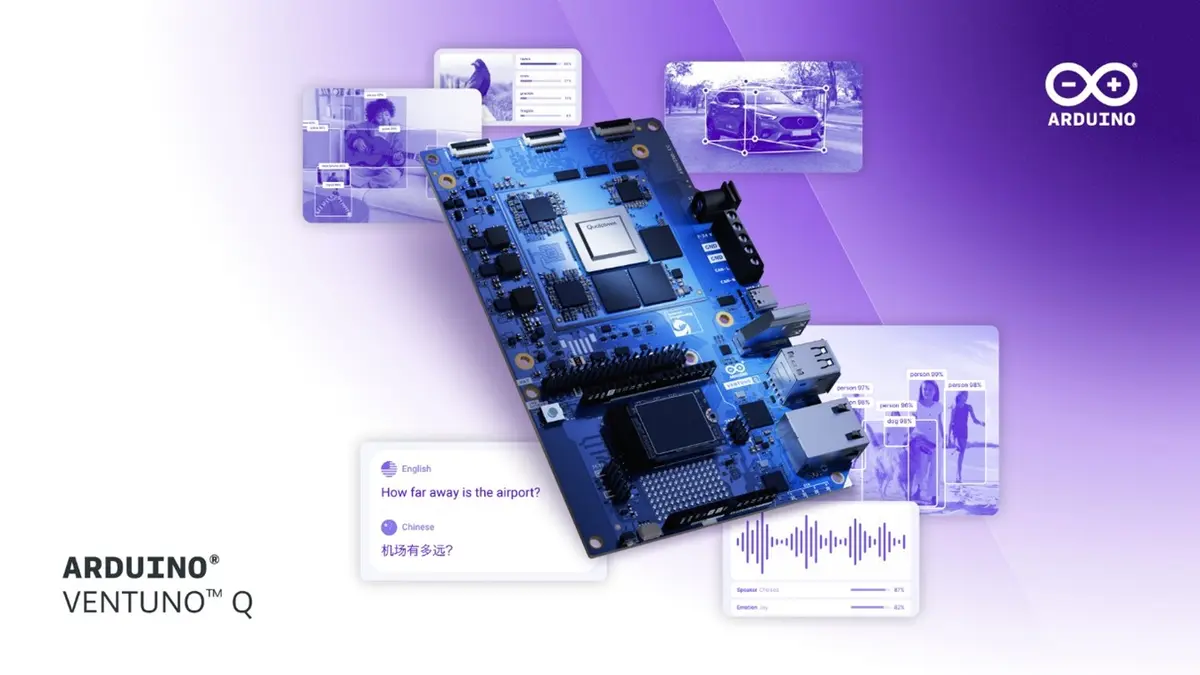
The Ventuno Q platform is designed to enable developers to build intelligent edge applications across robotics, industrial automation and embedded AI systems. The board delivers up to 40 TOPS of AI compute, enabling on-device workloads such as vision inference, contextual sensing and voice processing.
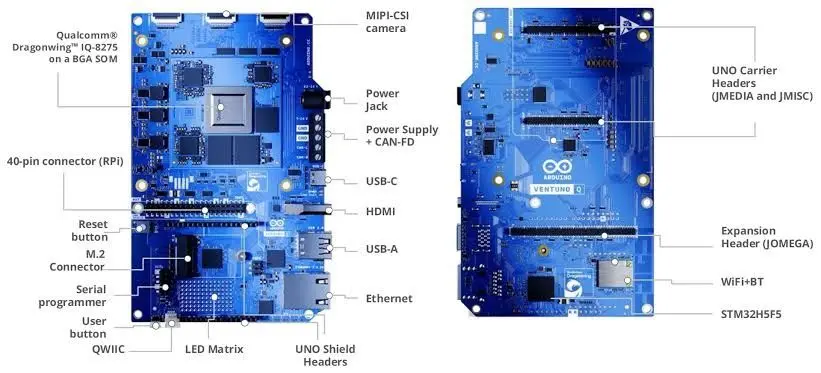
The platform also adopts a dual brain architecture that combines the Dragonwing IQ8 compute platform with the STM32H5 microcontroller from STMicroelectronics for deterministic real time control. This separation allows heavy AI inference workloads to run on the AI processor while real time tasks such as motor control and actuation are handled by the microcontroller.
For robotics and industrial environments, this architecture is particularly relevant. AI models can analyze visual or sensor data, while deterministic control systems ensure reliable interaction with physical machines and processes.
Source: Qualcomm
Lowering the Barrier for Edge AI Innovation
Ventuno Q also aims to make high-performance edge AI development more accessible. With pricing expected to be below $300, the platform could reduce the entry barrier for developers, startups and research institutions by nearly half compared with many existing edge AI development platforms. The board operates within a 10 W to 28 W power envelope, allowing deployment across a range of embedded and robotics applications where power efficiency and thermal constraints remain key considerations.
Source: Qualcomm
Expanding Edge AI Use Cases
Initial use cases for the platform are likely to emerge across robotics, industrial automation, machine vision and intelligent edge systems. However, as developers begin experimenting with the platform, new AI driven applications will likely continue to emerge.
By combining the Arduino developer ecosystem with Qualcomm’s Dragonwing edge AI compute capabilities and the STM32 microcontroller stack from STMicroelectronics the platform provides a foundation for faster experimentation and development of intelligent edge solutions.
Source: Counterpoint Research
Industry Perspective
The Ventuno Q announcement highlights how the AI computing model is changing. Earlier, most AI workloads were concentrated in a centralized cloud infrastructure. Today, intelligence is increasingly being distributed across endpoints, gateways and edge devices enabling real-time, low-latency, privacy-preserving decision-making. This is particularly important for robotics and industrial environments where machines need to interpret data and respond to physical conditions in real time. In many cases, relying only on cloud connectivity cannot meet the latency, reliability and operational needs of these systems.
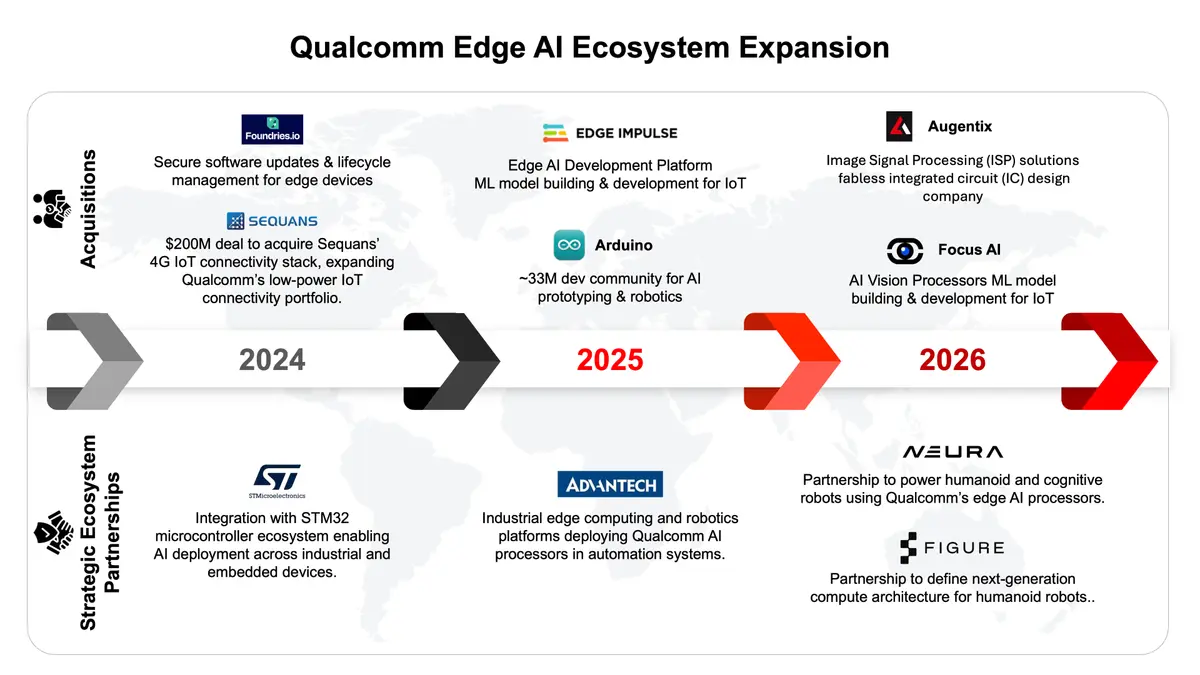
As edge AI continues to evolve, developer platforms that combine accessible ecosystems with high performance AI compute will play an important role in accelerating innovation at the edge. Qualcomm has evolved from providing mere connectivity to connectivity, compute and software platform to becoming a full stack AI solution company for device edge inferencing from the Dragonwing to Snapdragon portfolio. Qualcomm has strengthened its position in this space with key acquisitions such as Augentix, Arduino, Edge Impulse, Focus.AI, Sequans and Foundries.io as well as strategic partnerships with ST Micro, Figure and more. This is very analogous to NVIDIA's full stack leadership in advanced AI training to inferencing in cloud and advanced edge infrastructure.


