

- The global transition to electric vehicles is fragmenting, as China, US and the EU follow diverging policy and market paths.
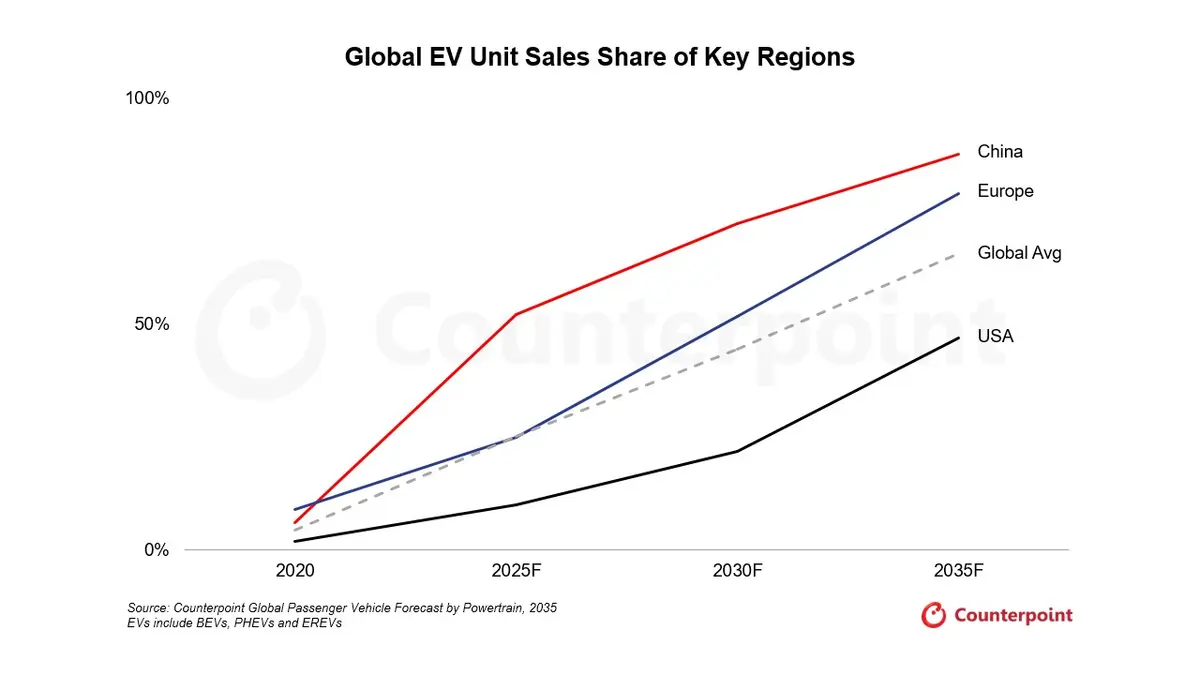
- China’s EV market is significantly ahead with over 50% share in the country’s overall passenger vehicle sales, while the US faces slowing momentum due to policy rollbacks and rising OEM uncertainty.
- The EU is recalibrating its EV strategy, softening the 2035 ICE ban while promoting affordable EVs through the M1E (small car) segment and super credits.
- M1E small EVs could unlock mass adoption in the EU countries, provided the vehicles are priced for real consumer affordability.
The global EV market is entering a phase of divergence, fragmenting the global electrification transition. While China is aggressively pushing toward EV dominance, the European Union (EU) and US are dithering and stepping backwards, rolling back emission regulations and recalibrating policies that favor electrification.
Diverging EV trajectories: China surges, US slows
China has already crossed the 50% mark for EV share in the country’s overall passenger vehicle sales, signalling that electric mobility there has moved from policy-driven adoption to market-led sustainability. Intense domestic competition, including price wars, and oversupply have pushed Chinese OEMs to look outward and expand aggressively into global markets with affordable, feature-rich EVs that challenge Western automakers on technology and cost.
In contrast, the US EV trajectory is losing momentum. The rollback of federal EV purchase incentives and potential dilution of emission regulations have weakened the policy framework that previously underpinned OEM investment. As a result, several automakers are scaling back EV programmes, pausing battery joint ventures and shifting focus toward hybrids and internal combustion engine (ICE) vehicles. The US and Canada have also imposed 100% tariffs on Chinese EVs, making their markets inaccessible to Chinese OEMs. All these risks delaying the US’ EV transition by several years and widening the gap with China and EU, markets that are more electrification-focused. Looking beyond 2028, a change in administration is expected to revive US EV policy momentum and support a recovery in EV sales.
EU’s two-step EV strategy: Rethinking ICE ban and introducing small car segment
The EU is taking a more Janus-faced approach, balancing its commitment to decarbonisation with strong pressure from the automotive industry, which contributes around €1 trillion in value and accounts for nearly 7% of the EU’s GDP. Caught between climate ambition and industrial realities, the EU now sits squarely between the aggressive EV push seen in China and the policy pullback unfolding in the US. While maintaining its long-term decarbonisation goals, the EU is recalibrating its “road-to-zero” strategy through a two-step policy shift that reshapes both the future of combustion engines and the role of small electric cars. Together, these moves reflect a more pragmatic approach to decarbonisation – one that balances climate goals with industrial competitiveness and consumer affordability.
The EU’s first major policy shift is the softening of its planned ban on new ICE vehicles from 2035. Instead of mandating a 100% reduction in tailpipe CO₂ emissions, effectively banning all non-EVs, the European Commission now proposes a 90% reduction compared with 2021 levels. This change allows hybrids, range-extended EVs and even pure-ICE vehicles to remain on sale beyond 2035, provided the remaining emissions are offset through biofuels, e-fuels or low-carbon inputs such as European-made “green” steel.
The move follows sustained lobbying from major automakers, including Volkswagen, Renault, Mercedes-Benz, BMW and Stellantis, as well as several EU member states such as Germany, Italy, Hungary and Poland, which have raised concerns around costs, supply-chain constraints and intensifying global competition. The added flexibility may help automakers stay competitive without disrupting production and investment, but it also risks weakening the EU’s long-term competitiveness against fast-scaling, cost-efficient Chinese EV makers.
Adding to the uncertainty, the target for 90% emissions could itself be revisited before 2030, with both automakers and member states likely to push down again toward the end of the decade, raising questions about the durability of the EU’s long-term decarbonisation roadmap.
The second pillar of the EU’s strategy is the introduction of a new small car category called M1E, meant exclusively for small electric cars. The M1E vehicles, a sub-category of the M1 category, will be limited to a maximum length of 4.2 metres. Several upcoming and existing models could qualify, including the Renault 4, Renault 5, and Volkswagen Group’s future small EVs, such as the ID Polo.
In China, small EVs such as the Galaxy Xingyuan, Wuling Hongguang Mini EV, BYD Seagull, Leapmotor C10, Geely Panda Mini and Changan Lumin have played a critical role in accelerating the country’s EV adoption, with several of these models ranking among China’s best-selling EVs. A similar focus on compact, affordable EVs through the introduction of the M1E segment could prove equally beneficial for boosting EV adoption in EU.
The EU has said in its policy announcement that M1E cars built within the EU region will earn “super credits” toward manufacturers’ CO₂ targets. Each vehicle sold will count as 1.3 credits instead of one, strongly incentivising local production and sales. The European Commission expects this to improve affordability and encourage member states to introduce aligned fiscal and non-fiscal incentives, such as subsidies, tax breaks and preferential parking. This may also benefit Chinese players like BYD, which are setting up manufacturing in EU, and encourage others to invest to widen their sales of PHEVs and even ICE vehicles in the region.
Outlook
Global automakers operating in key markets are increasingly struggling to follow a single EV strategy as regional policies and market conditions diverge. China demands ultra-competitive, cost-driven EVs with advanced software features, the EU is recalibrating toward regulatory flexibility and affordable small EVs, and the US is shifting focus back to hybrids and ICE vehicles.
This divergence is forcing global automotive OEMs to regionalise product portfolios, powertrain strategies and supply chains, reducing economies of scale and increasing costs. Platform standardisation, battery sourcing and software roadmaps become harder to align, while capital allocation is split across conflicting priorities. For example, Ford has absorbed roughly $19.5 billion in EV losses, cancelled models and pivoted to hybrids. GM has delayed EV profitability and cut near-term volumes, while Honda has slowed EV rollouts and extended hybrids. Fragmented strategies are eroding scale benefits and raising costs. As a result, regional adaptability and implications are becoming as important as global scale in shaping future EV success.

